
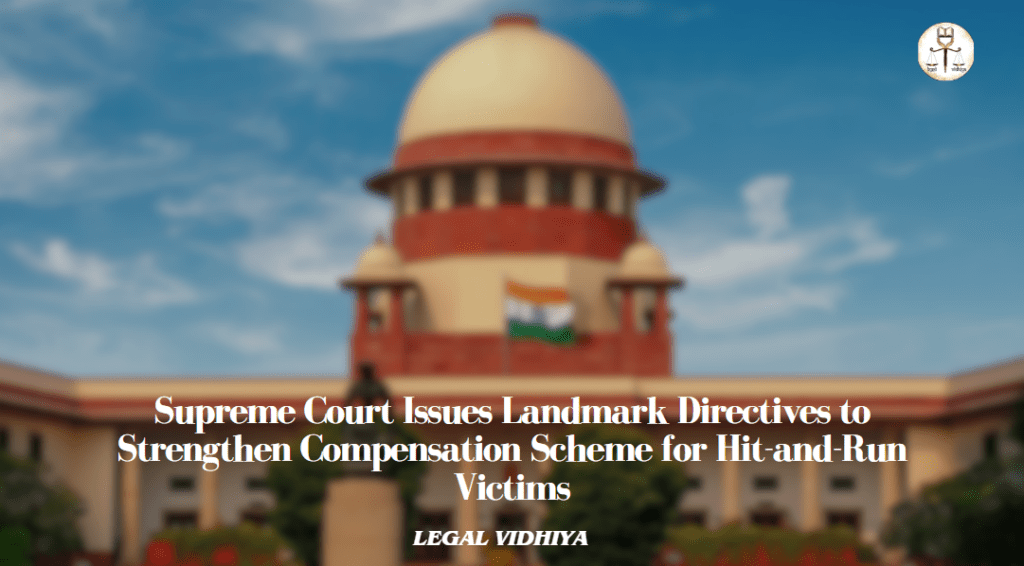
In a significant development, the Supreme Court of India has issued a series of directives aimed at enhancing the implementation of the Motor Vehicles Act, 1988, specifically pertaining to the compensation awarded in cases of hit-and-run motor accidents. The directives were issued in response to a writ petition (C) No. 295 of 2012 filed by S. Rajaseekaran against the Union of India and others. The court addressed concerns about the effective execution of the Compensation of Victims of Hit and Run Motor Accidents Scheme, 2022.
The key focus of the directives is to improve awareness about the compensation scheme and ensure that victims or their legal representatives are informed promptly. The court expressed concern over the low utilization of the scheme and the need for public awareness initiatives.
Background:
The Motor Vehicles Act, 1988, underwent amendments, and as of April 1, 2022, Section 161 introduced special provisions related to compensation in hit-and-run motor accidents. The Compensation of Victims of Hit and Run Motor Accidents Scheme, 2022, was implemented to streamline the process of providing compensation to victims and their families.
However, the court observed that despite the existence of the scheme, there were minimal claimants coming forward to avail of the benefits. The lack of awareness and procedural lapses seemed to contribute to this issue.
Key Directives:
1. Standing Committee Review:
The court directed the Standing Committee to thoroughly review the annual report submitted by the General Insurance Council. This report is crucial for evaluating the working of the scheme and identifying areas that require amendments or improvements. The committee was also tasked with making recommendations to the Central Government for any necessary amendments.
2. Public Awareness Initiatives:
Recognizing the need for widespread public awareness, the Standing Committee was directed to issue comprehensive directions for initiatives that sensitize the public about the Compensation of Victims of Hit and Run Motor Accidents Scheme, 2022. The aim is to encourage eligible claimants to come forward and benefit from the scheme.
3. Monitoring Committees at District Level:
The court mandated the formation of Monitoring Committees at the district level to oversee the implementation of the scheme. These committees will consist of representatives from the District Legal Service Authority, Claims Enquiry Officer, and a police officer. Regular meetings are expected to ensure compliance and address any challenges faced at the ground level.
4. Timely Notification to Victims:
In an effort to enhance victim awareness, the court directed police stations to promptly inform victims or their legal representatives about the availability of the compensation scheme in cases where the vehicle involved cannot be identified within one month of the accident. The contact details of the jurisdictional Claims Enquiry Officer should also be provided.
5. Extension of Time Limit:
The court urged the Central Government to consider modifying the time limit for filing claims under the scheme. This modification would allow those entitled to compensation under the previous Solatium Scheme to apply within an extended timeframe as a one-time measure.
6. Incremental Enhancement of Compensation:
Recognizing the impact of inflation, the court directed the Central Government to consider gradual annual increases in compensation amounts specified in the scheme. This measure aims to ensure that the compensation remains relevant and adequate over time.
Conclusion:
The directives issued by the Supreme Court mark a significant step toward fortifying the compensation framework for victims of hit-and-run motor accidents. By addressing issues related to awareness, timely notification, and procedural enhancements, the court aims to ensure that the benefits of the Compensation of Victims of Hit and Run Motor Accidents Scheme, 2022, reach those who need them the most. The decision also emphasizes the dynamic nature of legal frameworks, urging authorities to adapt to changing circumstances for the benefit of the citizens.
CASE NAME- S. Rajaseekaran v. Union of India & Ors.
Arushi Mengi, a 2nd year student at The Law School, University of Jammu, an intern under Legal Vidhiya.
Disclaimer: The materials provided herein are intended solely for informational purposes. Accessing or using the site or the materials does not establish an attorney-client relationship. The information presented on this site is not to be construed as legal or professional advice, and it should not be relied upon for such purposes or used as a substitute for advice from a licensed attorney in your state. Additionally, the viewpoint presented by the author is of a personal nature.



0 Comments