
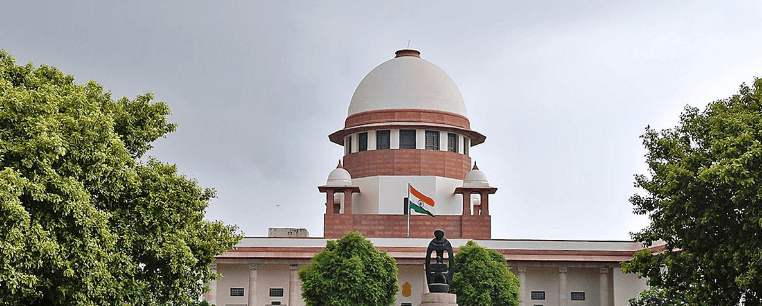
The Supreme Court recently ruled that the amount of punishment in any case must depend on the
atrocity of the crime, and therefore takes into account the nature of the crime and the manner in which
it is committed to determine the appropriate punishment. It is the duty of each court to [Punjab vs. Dil
Bahadur].
According to the principle of proportionality, justice and fairness require that the guilty person should
be entitled to receive punishment for the crime committed based on the seriousness of the crime etc
must be considered in order to guarantee fairness, crime and penalty must be coordinated and
balanced. To put it another way, in order to guarantee justice, crime and punishment need to be
coordinated and balanced.
India’s Penal Code is punitive and dissuasive, with its main aim and aim being to punish offenders for
committing offenses within the law, the Supreme Court said on March 28, while reversing a decision
made by the Punjab and Haryana High Court to reduce a man’s sentence for intentional driving and
involuntary manslaughter in a car accident. The Supreme Court has firmly stated that the excessive
sympathy shown by Court is unjustifiable and therefore deserves to be interfered with in its order.
The appeal arose from a car accident caused by defendant’s “reckless and negligent” driving. His reckless driving killed one person, turned the ambulance into a turtle, and injured two people in the ambulance so was convicted under Sections 279 and 304A of the Indian Penal Code. The Supreme Court upheld the defendant’s conviction, but thought it prudent to intervene in the lower court’s ruling given the financial situation of the defendant, who is a professional driver.
Supreme court had a different perspective than the high court, One defenceless individual died as a result of the accused’s reckless and careless driving, and two other passengers in the ambulance were injured .
The ambulance turned upturn after the accident, which only highlights the effect on the ambulance
and the reckless and irresponsible driving on the part of the accused, it was not properly taken into
account by the high court.
Therefore, the bench held that there was no good reason to interfere with the reasonable judgment
that the trial court applied to the defendant. Additionally, the court noted: The respondent’s conditions,
coming from an unfortunate family, ought to be considered as uncontrollable issues at hand. However,
the high court did not correctly consider that as a result of the defendant’s reckless and negligent
behavior, one innocent person died and two people were injured.
The Apex court set aside the high court verdict reducing the sentence and restored the sentence
imposed by the trial court, allowing the appeal, it granted four weeks to the accused to surrender to
undergo the remaining sentence.
Written by Sonali Pradhan Netaji Subhash University




0 Comments