
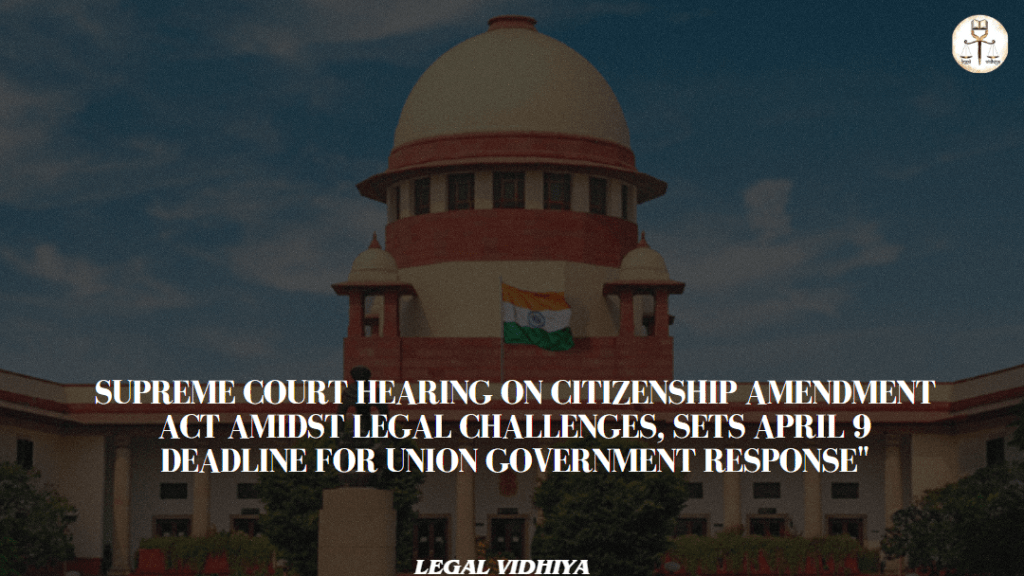
On Tuesday, the Supreme Court issued a notice to the union government regarding numerous applications seeking to halt the implementation of the Citizenship Amendment Act (CAA) and the Citizenship Amendment Rules 2024. The court has scheduled the matter for April 9, awaiting the Union’s response.
The bench, comprising Chief Justice DY Chandrachud and Justices JB Pardiwala and Manoj Misra, postponed today’s hearing following a request from Solicitor General Tushar Mehta. Mehta sought time to respond to the petitions and applications, citing the large number of petitions and the need to prepare a comprehensive reply. He argued that the CAA doesn’t revoke anyone’s citizenship and therefore doesn’t prejudice the petitioners.
However, Senior Advocate Kapil Sibal objected to the lengthy timeframe requested by Mehta, stating that it was excessive. He emphasized that if the citizenship process begins, it cannot be easily reversed, and therefore, waiting until the court decides the matter is reasonable.
Advocate Nizam Pasha, representing AIMIM chief Asaduddin Owaisi, highlighted that the Centre’s preliminary affidavit opposing a stay on the Act had already been filed, questioning the need for additional time.
In response, SG Mehta acknowledged the point but insisted on filing a detailed affidavit in response to the batch of applications.
Senior Advocate Ranjit Kumar, representing a Hindu immigrant from Balochistan, argued that granting citizenship to persecuted individuals like his client shouldn’t be a concern. However, other counsels contended that prejudice would arise, particularly for Muslims excluded from the National Register of Citizens (NRC).
Chief Justice Chandrachud eventually granted the Union government three weeks, instead of four, to file a response, instructing them to focus solely on the interim applications at this stage.
Today’s hearing reflects the flurry of legal actions following the recent notification of the rules by the union government, with various petitioners filing interlocutory stay applications in their ongoing writ petitions.
Indian Union of Muslim League & Ors. v. Union of India & Ors.
Written by- Pradyumn sharma
Disclaimer: The materials provided herein are intended solely for informational purposes. Accessing or using the site or the materials does not establish an attorney-client relationship. The information presented on this site is not to be construed as legal or professional advice, and it should not be relied upon for such purposes or used as a substitute for advice from a licensed attorney in your state. Additionally, the viewpoint presented by the author is of a personal nature.





0 Comments