
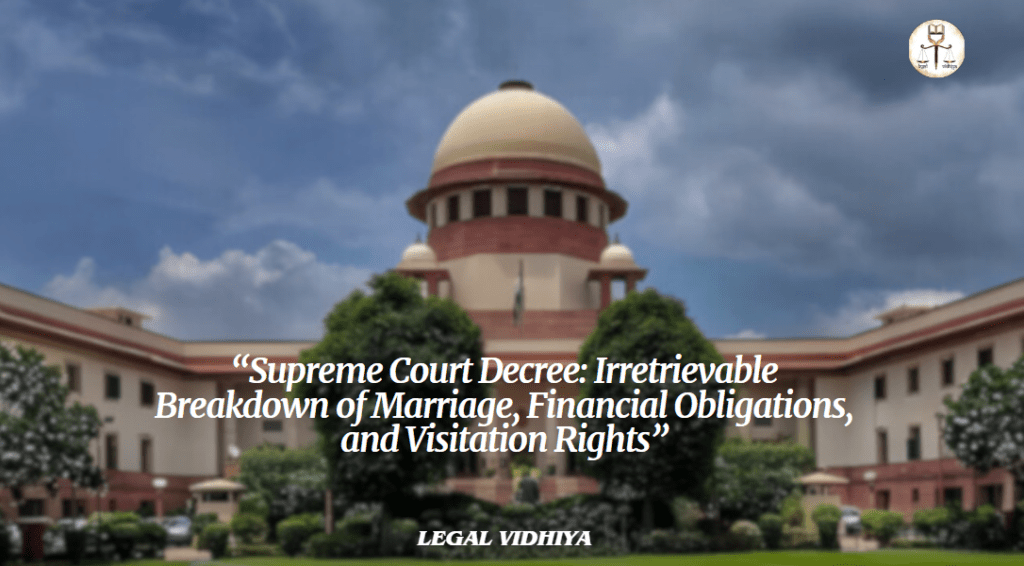
In this case, the appellant and respondent, a married couple, have been living separately for the past 12 years. The husband works as a DGM (Executive Engineer) in Tripura, while the wife is a teacher in Udaipur. The marital discord began within three years of marriage, with the husband alleging the wife’s disrespect towards his parents and her prioritization of work over household responsibilities. In response, the wife claimed torture, cruelty, and dowry demands.
Several legal proceedings took place, including a petition for restitution of conjugal rights, which was dismissed, and a subsequent petition for dissolution of marriage, which met the same fate. The High Court dismissed the appeal, emphasizing that the couple’s separation for over a decade didn’t necessarily constitute cruelty or irretrievable breakdown of marriage.
The Supreme Court, however, took a different stance. It acknowledged the couple’s prolonged separation, considering it a case of irretrievable breakdown of marriage. The court observed that the bitterness, dead emotions, and extended separation could be construed as a facet of cruelty, referencing a previous judgment (Rakesh Raman v. Kavita) that highlighted mutual cruelty leading to irretrievable breakdown.
Citing the Constitution Bench Judgment in Shilpa Sailesh v. Varun Sreenivasan, the court asserted its power under Article 142 of the Constitution of India to grant a decree of divorce in cases of irretrievable breakdown. It declared the marriage irretrievably broken down and dissolved it.
Recognizing the couple’s parental responsibilities, especially towards their 12-year-old daughter, the court ordered the husband to deposit Rs. 20,00,000 in the wife’s account within six months. This amount, kept as a Fixed Deposit, would accrue interest for the daughter’s future education expenses. Until this deposit, the husband was directed to pay Rs. 15,000 per month as maintenance.
Additionally, the court granted visitation rights to the husband, allowing him to spend time with his daughter until she reaches maturity. The terms of visitation rights were to be decided by the Mediation Centre attached to the high Court of Tripura. The judgment quashed the High Court’s decision and concluded the case with these directions.
In conclusion, the Supreme Court, in response to the husband and wife’s long-standing marital discord and separation, declared the marriage irretrievably broken down. Emphasizing the prolonged bitterness, dead emotions, and continued separation as a form of cruelty and irretrievable breakdown, the court exercised its authority under Article 142 of the Constitution of India to grant a decree of divorce.
To address the parental responsibilities, especially concerning their 12-year-old daughter, the court mandated the husband to deposit Rs. 20,00,000 in the wife’s account within six months. This amount was to be kept as a Fixed Deposit, accruing interest for the daughter’s future education expenses. Until this deposit, the husband was directed to pay Rs. 15,000 per month as maintenance.
Acknowledging the importance of the father’s presence in the daughter’s life, the court granted visitation rights to the husband, allowing him to spend time with the child until she reaches maturity. The specific terms and conditions of these visitation rights were to be determined by the Mediation Centre attached to the High Court of Tripura.
Ultimately, the Supreme Court set aside the High Court’s decision from February 28, 2022, and the judgment concluded by granting a decree of divorce based on the irretrievable breakdown of the marriage. The detailed instructions regarding financial responsibilities and visitation rights aimed to provide a balanced resolution to the complex family situation.
AREEBA, LLYOD LAW COLLEGE, First year Legal Journalism intern at Legal Vidhiya
Disclaimer: The materials provided herein are intended solely for informational purposes. Accessing or using the site or the materials does not establish an attorney-client relationship. The information presented on this site is not to be construed as legal or professional advice, and it should not be relied upon for such purposes or used as a substitute for advice from a licensed attorney in your state. Additionally, the viewpoint presented by the author is of a personal nature.



0 Comments