
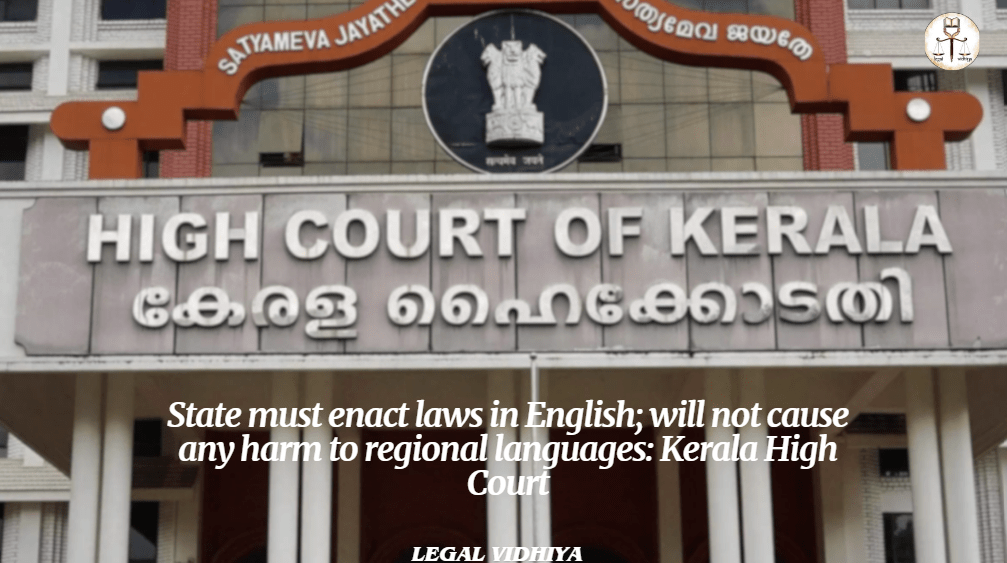
The Kerala High Court has ruled in PH Babu Ansari & Anr. V. The Municipal Corporation that laws and rules of the State must be published in English and that if a law is established in a regional language, English translations of the legislation must be made available.
Justice Bechu Kurian Thomas stated that this was also mandated by the Indian Constitution and expressed the opinion that the development of regional languages would not be harmed by laws being passed in English. The development of the regional language will not be impacted by the Constitution’s requirement that laws be passed in English in a multicultural nation like India. However, with greater knowledge of its rules, it can improve the State’s economic potential as an investment destination, according to the court.
According to the Court, enacting legislation in English could draw in more investment since it would be easier for a larger audience to understand, particularly when the State is seeking foreign investment. It is unnecessary to stress again how important it is to publish laws and regulations in English. It would be inconsistent for a State such as Kerala to extend an invitation to investors from across the globe if its rules were unintelligible to them. It is impossible to overlook the significance of English as a global language for understanding and communication both inside and outside of the nation. The Court held that while thinking about the expansion and development of the State, local concerns must be set aside. Justice Thomas continued by urging the State government to fulfill its constitutional obligation of making available law writings in the English language. The court cautioned that if this didn’t happen, the Court would have to give instructions on the matter. In order to avoid having to give suitable instructions in this respect, this Court reminds the State Government to comply with the Constitutional requirement to produce the texts of all statutes, rules, and other enactments in English, according to the ruling from November 24.
These observations were made by the High Court during its consideration of a request to have a specific piece of land taken out of the Kottayam Structural Plan/Master Plan’s “park and open space” classification. The property owners, or petitioners, who submitted the plea also requested approval for their applications for construction permits and authorization to develop structures outside of the Master Plan’s boundaries. Despite sending out purchase letters announcing their intention to purchase the aforementioned plot, the petitioners said that the municipal authorities had failed to formally get the plot within the two-year legal period.
In response, the municipal authorities stated that the petitioners lacked authorization to build structures on the designated plot of land because the property was zoned for “park and open space.” Additionally, the authorities claimed that the petitioners’ purchase notice was not sent in the format required by the applicable State regulations. However, the Kerala Town and Country Planning Act, 2016 and its regulations regarding purchase notices did not specify a format, so the High Court granted the property owners relief. The Court noted pertinently that the 2016 Act’s regulations were only available in Malayalam. The Court was prompted by this to address the more general problem of State rules not being available in English It is mandatory for the legislature and the regulatory body to release an English translation concurrently with the introduction and approval of the legislation and regulations. The Court emphasized that the need for an English text is a constitutional requirement that cannot be waived.
The Court then granted the property owners’ plea and gave the authorities instructions on how to handle their applications for building permits. The Court reasoned that If the authorities wanted to take control of the plot, they should have purchased it within two years of designating it as a “park and open space”.
The Court further observed that the property owners had sent out a purchase notice outlining their intentions, even in the lack of a prescribed form. A property owner’s rights cannot be impeded by the State’s failure to specify the format of such a notice, the Court ruled. Senior Advocates VV Asokan, along with advocates KI Mayankutty Mather, T Sreekala, and S Parvathi, represented the petitioners. Senior Government Pleader K Amminikutty and Standing Counsel CS Manilal represented the municipal authorities.
References :
Anushka Shukla, Faculty of Law, University of Lucknow, Intern At Legal Vidhiya
Disclaimer: The materials provided herein are intended solely for informational purposes. Accessing or using the site or the materials does not establish an attorney-client relationship. The information presented on this site is not to be construed as legal or professional advice, and it should not be relied upon for such purposes or used as a substitute for advice from a licensed attorney in your state. Additionally, the viewpoint presented by the author is of a personal nature.





0 Comments