
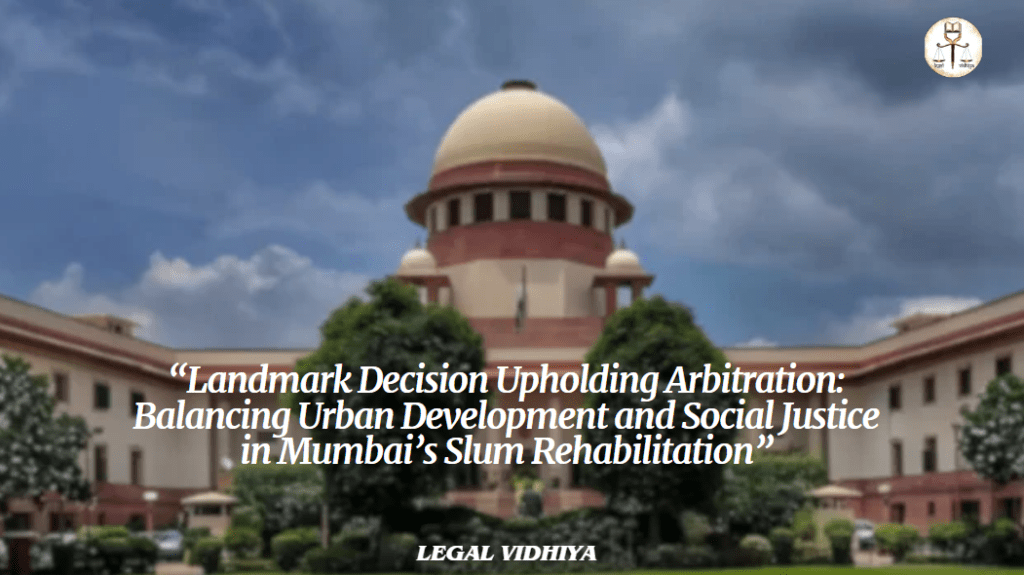
The court addressed a dispute over a Slum Rehabilitation Scheme proposed by the Slum Rehabilitation Authority (SRA) in Maharashtra. The project aimed to construct towers, commercial and recreational tenements, amenities, balwadis, welfare centers, and society offices in Lower Parel Division at J.R. Boricha Marg. While some towers were completed, disputes and litigation halted further allotments.
The judgment contextualizes Mumbai’s slums, emphasizing their origin in rural-urban migration and industrial growth, leading to crowded settlements with poor living conditions. Mumbai hosts a significant percentage of the country’s slum population, a historical issue dating back to colonial times.
The legal narrative delves into the historical neglect of slum dwellers, initially by bodies like the Bombay Improvement Trust and later the Slum Areas (Improvement and Clearance) Act of 1956. The Act focused on clearing slums rather than improving living conditions, lacking socially sensitive provisions.
Sections 4 and 4A of the 1971 Act outlined the declaration of slum areas, considering factors like inadequate amenities and unsanitary conditions. The Tribunal process for appeals and resident objections was detailed, aiming for fair hearings and final decisions.
The Maharashtra Regional and Town Planning Act, 1966, granted the SRA the status of a Planning Authority for slums, allowing the formulation of Development Control Regulations (DCR). The Rehabilitation project fell under Regulation 33(10) of DCR, 1991.
In summary, the court’s decision upheld the arbitration process in a dispute related to a Slum Rehabilitation Scheme, emphasizing the historical context of slums in Mumbai and the legal framework governing slum declarations and redevelopment. The judgment aimed to balance the need for urban development with social considerations for the marginalized slum population.
In conclusion, the court’s decision validated the arbitration process concerning the Slum Rehabilitation Scheme in Mumbai. The judgment shed light on the historical context of slums in the city, emphasizing the challenges faced by the marginalized population due to rapid urbanization and industrial growth.
The legal narrative outlined the evolution of legislative measures, from the neglectful approach during colonial rule to the Slum Areas (Improvement and Clearance) Act of 1956. It highlighted the struggles of slum dwellers and the lack of socially sensitive provisions in early legislation.
The court’s decision recognized the complexities of slum redevelopment and the importance of balancing urban development with the welfare of the marginalized population. By upholding the arbitration process, the judgment aimed to bring resolution to the ongoing dispute over the Slum Rehabilitation Scheme, contributing to the larger conversation about addressing inequalities in Mumbai’s urban landscape.
AREEBA, LLYOD LAW COLLEGE, First year Legal Journalism Intern at Legal Vidhiya
Disclaimer: The materials provided herein are intended solely for informational purposes. Accessing or using the site or the materials does not establish an attorney-client relationship. The information presented on this site is not to be construed as legal or professional advice, and it should not be relied upon for such purposes or used as a substitute for advice from a licensed attorney in your state. Additionally, the viewpoint presented by the author is of a personal nature.


0 Comments