
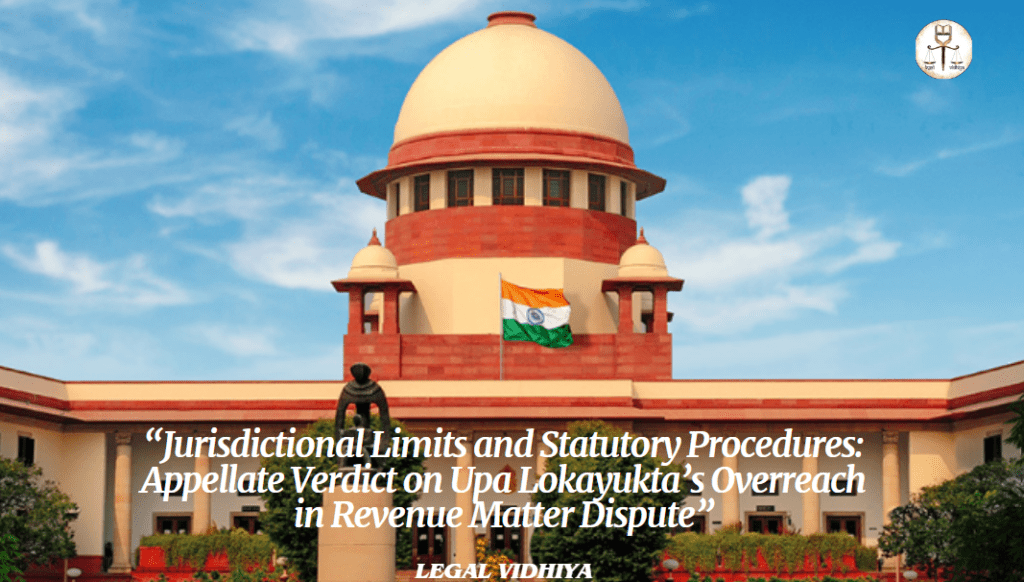
In this judicial matter, the appellants contested a decision made by the Upa Lokayukta, which was subsequently upheld by the High Court. The case revolves around a complaint filed by respondent No. 1 regarding discrepancies in the revenue records related to a piece of land owned by late K. Gopalakrishnan Nair. The complainant sought correction of these records and mutation of the land in the names of legal heirs.
The Upa Lokayukta, In an order dated 18.10.2016, directed the Tehsildar to rectify the mistakes in the revenue records and collect tax from the complainant. The appellants challenged this decision, asserting that the Lokayukta exceeded its jurisdiction by issuing positive directions related to revenue matters, which fall under the purview of statutory authorities outlined in the 1961 Act and 1964 Rules. The appellants argued that Lokayukta’s role is to address maladministration, not to intervene in revenue matters.
Despite being served notice, the respondents did not appear during the proceedings, and the order was reserved. Section 12 of the 1999 Act, dealing with Lokayukta reports, states that if Lokayukta finds actions causing injustice, it can recommend remedies to the competent authority. The complainant’s plea was rooted in alleged maladministration due to the refusal to correct the revenue records.
However, legal precedent, as cited in Sudha Devi K. v. District Collector, emphasized that Lokayukta lacks the authority to issue positive directions and can only submit reports with recommendations. The judiciary reiterated this stance in District Collector v. Registrar, Kerala Lokayukta, asserting that complainants should exhaust statutory remedies before approaching Lokayukta.
In the current case, the Upa Lokayukta’s direction for the correction of revenue records was upheld, contradicting the legal interpretation of the 1999 Act. The court, in its decision, highlighted that the Lokayukta had overstepped its jurisdiction by issuing positive directions.
The judgment emphasized that the complainant had not pursued statutory remedies available for rectifying mistakes in revenue records. Therefore, the orders of the High Court and Upa Lokayukta were set aside, granting the respondent the option to avail appropriate remedies under the relevant statute for correcting revenue records.
In conclusion, the court found that the Upa Lokayukta’s decision went beyond its jurisdiction, emphasizing the importance of adhering to statutory procedures in such matters. The appeal was allowed, and no costs were imposed. This case underscores the significance of maintaining a clear distinction between the roles of Lokayukta and statutory authorities, ensuring that each entity operates within its defined legal boundaries.
In conclusion, the judicial verdict on the promotion dispute centered around the Upa Lokayukta’s decision, which was challenged by the appellants. The dispute arose from a complaint filed by respondent No. 1 concerning errors in revenue records related to a piece of land owned by late K. Gopalakrishnan Nair. The complainant sought correction of these records and mutation of the land in favor of legal heirs.
The court found that the Upa Lokayukta had exceeded its jurisdiction by issuing positive directions related to revenue matters, which fall under the purview of statutory authorities outlined in the 1961 Act and 1964 Rules. Emphasizing that Lokayukta’s role is to address maladministration, not to intervene in revenue matters, the court set aside the orders of both the High Court and the Upa Lokayukta.
Despite the complainant’s plea rooted in alleged maladministration due to the refusal to correct revenue records, the court referred to legal precedent, particularly Sudha Devi K. v. District Collector, which highlighted that Lokayukta lacks the authority to issue positive directions. The subsequent case of District Collector v. Registrar, Kerala Lokayukta, reinforced the notion that complainants should exhaust statutory remedies before approaching Lokayukta.
The judgment underscored that the complainant had not pursued available statutory remedies for rectifying mistakes in revenue records. Consequently, the court allowed the appeal, setting aside the orders of the High Court and Upa Lokayukta. The respondent was advised to explore appropriate remedies under the relevant statute for correcting revenue records.
This case establishes a precedent emphasizing the importance of adhering to statutory procedures and maintaining clear distinctions between the roles of Lokayukta and statutory authorities. It serves as a reminder that entities must operate within their defined legal boundaries to ensure a fair and lawful resolution of disputes.
Areeba , LLYOD LAW COLLEGE, First year Legal journalism intern at Legal Vidhiya.
Disclaimer: The materials provided herein are intended solely for informational purposes. Accessing or using the site or the materials does not establish an attorney-client relationship. The information presented on this site is not to be construed as legal or professional advice, and it should not be relied upon for such purposes or used as a substitute for advice from a licensed attorney in your state. Additionally, the viewpoint presented by the author is of a personal nature.



0 Comments