
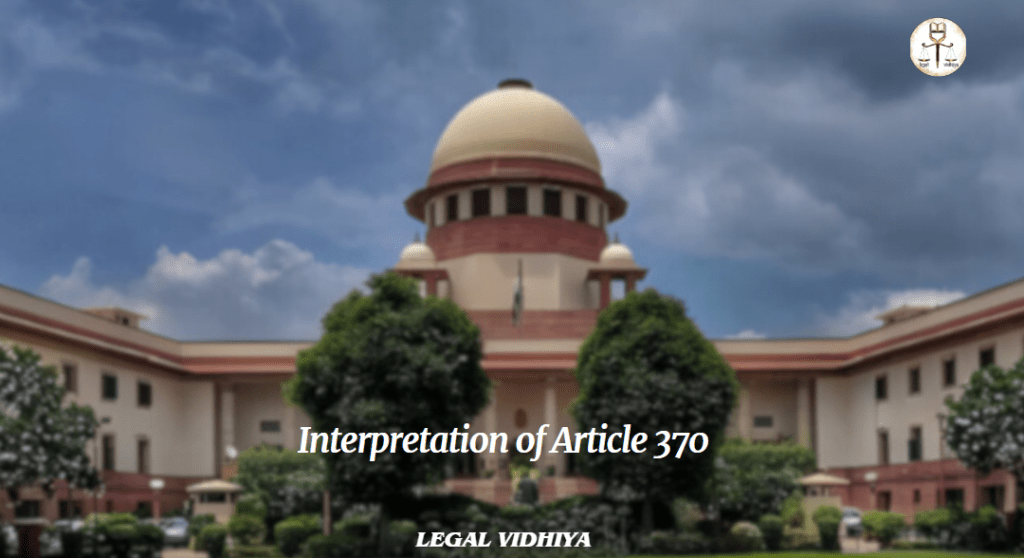
Article 370 of the Indian Constitution granted special autonomous status to the region of Jammu and Kashmir. It provided a degree of autonomy to Jammu and Kashmir, allowing the state to have its own constitution, a separate flag, and independence over matters except for defense, foreign affairs, finance, and communications. Additionally, it limited the Indian Parliament’s legislative powers concerning Jammu and Kashmir. However, this article was abrogated on August 5, 2019, revoking the special status previously granted to the region.
Article 370 was placed among temporary and transitional provisions, marked with a marginal note signifying its temporary nature. It was introduced when the Maharaja of Jammu and Kashmir acceded to India by signing an Instrument of Accession. Specifically, Article 370(1) explicitly stated that Article 1 would entirely apply to the State, unlike other Constitution provisions, which necessitated consultation or concurrence for their application.
Article 370 contains two significant non-obstante clauses. The first clause (in (1)) overrides the entire Constitution, allowing clauses (a), (b), (c), and (d) to govern Jammu and Kashmir without constitutional constraints. The second clause (in (3)) empowers the President to revoke Article 370, disregarding previous provisions, including the non obstante clause in Clause 1. Once the President exercises this power, the limitations in clauses (1) and (2) will no longer apply to the State.
Upon the adoption of the Constitution on January 26, 1950, Jammu and Kashmir became an integral part of India’s territory. India, defined as a Union of States under Article 1, delineated territories outlined in Parts A, B, and C of the First Schedule. Originally categorized as a Part B State, Jammu and Kashmir’s status changed following the Seventh Amendment, which abolished the distinctions between Part A, B, and C,
thereby integrating it as a State within the Union. Article 370, in combination with Article 1, affirms the complete and enduring integration of Jammu and Kashmir into India. Any interpretation of Article 370 suggesting a temporary nature regarding Jammu and Kashmir’s integration with India is unwarranted.
Written by Samruddhi Kulkarni from ILS Law College pune (BA.LL.B) semester 1 intern under legal vidhiya
Disclaimer: The materials provided herein are intended solely for informational purposes. Accessing or using the site or the materials does not establish an attorney-client relationship. The information presented on this site is not to be construed as legal or professional advice, and it should not be relied upon for such purposes or used as a substitute for advice from a licensed attorney in your state. Additionally, the viewpoint presented by the author is of a personal nature.





0 Comments