
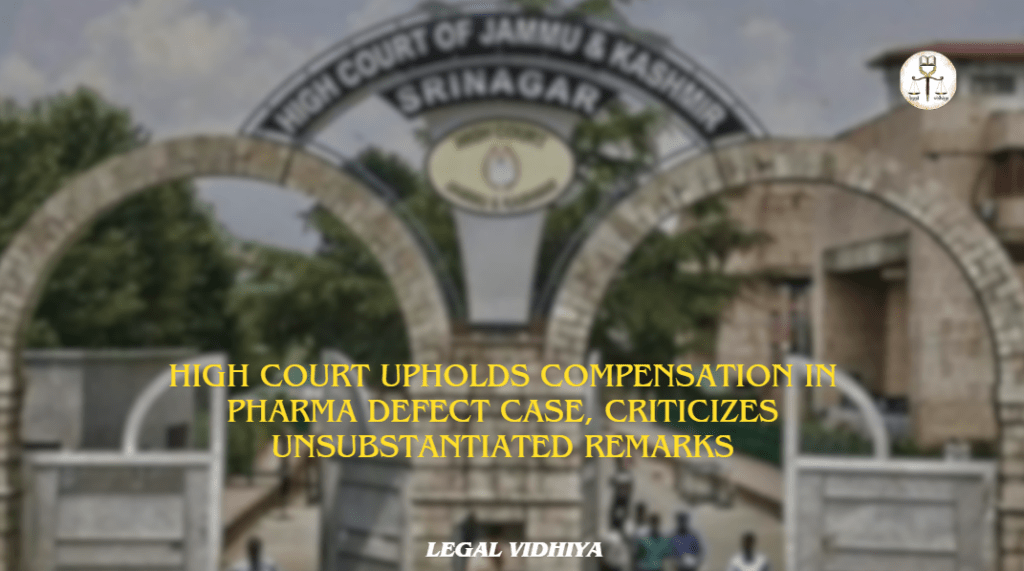
In a recent development, the High Court of Jammu & Kashmir and Ladakh issued an order in OWP No.983/2008, involving a petition filed by M/s Safnofia India Limited against Anju Anand and another. The case revolves around a consumer complaint wherein the petitioner, a pharmaceutical company, challenged an order from the State Consumer Protection Commission regarding compensation for an alleged defect in one of its drugs.
Background of the Case:
Anju Anand (respondent No.1) had filed a complaint against M/s Safnofia India Limited, asserting that a strip of Allegra, an anti-allergic drug purchased from the company, contained only three doses instead of the promised six. The initial ruling by the Divisional Consumer Forum, Jammu, awarded compensation of Rs.1,500. However, dissatisfied with the amount, Anju Anand appealed to the State Consumer Protection Commission, which not only upheld the complaint but enhanced the compensation to Rs.50,000.
M/s Safnofia India Limited contested the State Commission’s order, primarily objecting to certain observations made by the Commission. The petitioner argued that the State Commission’s remarks suggesting the medicines were spurious and making disparaging comments about the quality and quantity of the drug were not substantiated by the evidence presented during the proceedings. The petitioner sought the expunging of these observations while maintaining the enhanced compensation.
After a thorough examination of the case, the High Court, comprising Hon’ble Mr. Justice Atul Shreedharan and Hon’ble Mr. Justice Javed Iqbal Wani, rendered its verdict on June 15, 2023. The Court upheld the enhanced compensation of Rs.50,000 but imposed an additional Rs.20,000 as litigation expenses on the petitioner. Crucially, the Court acceded to the petitioner’s request to expunge the contentious remarks made by the State Commission in its order.
Court’s Observations:
The High Court expressed concern over the State Commission’s unfounded remarks about the pharmaceutical product and the alleged collusion between the petitioner and the Drug Controller. The Court emphasized the importance of ensuring that observations made in judgments are well-founded and supported by evidence on record. It underscored the need for a fair and evidence-backed approach, particularly when commenting on the quality and integrity of products and potential collusion between entities.
The High Court’s decision sets a precedent in consumer protection cases, highlighting the significance of evidence-backed observations. While the Court affirmed the consumer’s right to fair compensation for defective products, it also emphasized the responsibility of adjudicatory bodies to avoid making comments that may harm a company’s reputation without proper substantiation.
The judgment aligns with broader legal principles emphasizing the importance of fairness, procedural integrity, and evidence-backed decisions in consumer protection cases. It underscores the balance that must be maintained between protecting consumer rights and ensuring that companies are treated fairly, without unwarranted damage to their reputation.
Conclusion:
The verdict in OWP No.983/2008 reflects the High Court’s commitment to upholding justice while cautioning against baseless remarks that could have far-reaching consequences for businesses. As the legal landscape evolves, this decision serves as a reminder of the judiciary’s role in safeguarding both consumer rights and the principles of fairness and justice. Companies, in turn, are urged to adhere to high standards to avoid legal repercussions and maintain consumer trust.
CASE NAME- OWP No.983/2008: M/s Safnofia India Limited vs. Anju Anand and another.
Arushi Mengi, a student of 2nd year at The Law School, University of Jammu, an intern under Legal Vidhiya.
Disclaimer: The materials provided herein are intended solely for informational purposes. Accessing or using the site or the materials does not establish an attorney-client relationship. The information presented on this site is not to be construed as legal or professional advice, and it should not be relied upon for such purposes or used as a substitute for advice from a licensed attorney in your state. Additionally, the viewpoint presented by the author is of a personal nature.




0 Comments