
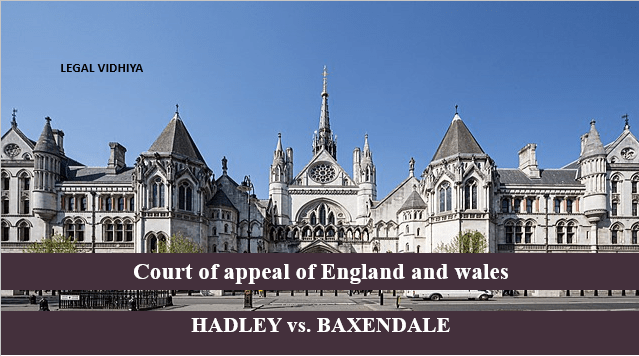
HADLEY vs. BAXENDALE has been widely celebrated as a landmark in the law of contracts, and more widely as a triumph of the common law system.
| Citation | (1854) EWHC J70 |
| Date of Judgement | 23 FEB 1854 |
| Court | England and Wales High Court (Exchequer Court) |
| Case Type | English Contract Law |
| Plaintiff | Hadley and Anor |
| Respondent | Baxendale and Ors |
| Bench | J. Edward Hall Alderson |
| Principle of case | “Definite rule should be laid down to the jury by the learned Judge at Nisi Prius” |
FACTS OF THE CASE:
- The plaintiff carried on the business of millers and meal man in co-partnership and were proprietors and occupiers of the city of Gloucestor, England
- They had a steam engine, by means of which they worked and cleaned corn and ground the same into mean and dressed the same into flour,sharp and bran.The steam-engine was manufactured by Messrs. Joyce and Co. ,the engineers, at Greenwich.
- On May 11, 1853, the crankshaft of the steam engine broken and out of repair.
- The fracture was discovered on 12th MAY, 1853.
- On the 13th May 1853 the plaintiffs sent one of their servants to the office of defendant, who are the well-known carriers trading under the name of ‘Pickford and co.’ for the purpose of having the shaft carried to Greenwich. Servant told the clerk that the mill was stopped, and the shaft must be sent immediately.
- Hadley wanted to have a new crankshaft made for the said mill and ordered the same to W.Joyce and Co. who is the original manufacturer at Greenwich in the country Kent.
- It was necessary to the plaintiff to send the broken shaft to the said W.Joyce and Co. before they could complete the new shaft.
- Defendants were the local logistics of business under the name ‘Pickford and Co’ which was owned by Baxendale. Plaintiff delivered the broken shaft to defendants at their request as they were the common carriers between Hadley and W.Joyce and Co.
- They said that if it was sent up to twelve o’clock by the plaintiff then it will be delivered at the Greenwich the following day and also the sum of money was paid for its carriage for the whole distance.
- Defendants promised that the said shaft shall be delivered for the plaintiff to Greenwich from Gloucester with due diligence and proper care in a reasonable time after receiving the delivery from plaintiff.
- But the second day elapsed and was wholly neglected and refused so to do for the space of seven days after the said shaft was so delivered to them.
- By the reason of the carelessness, negligence and improper conduct of defendants, the said broken shaft was not delivered for the plaintiffs to the said W.Joyce and Co. until the expiration if a long and reasonable time.
- Due to which the completing of a new shaft was delayed for five days and due to which plaintiff were prevented from working in steam-mills and from cleaning corn and grinding some meal into flour, sharps or bran and from carrying on their business as millers and meal men for the space of five days.
- On the basis of this claims, the plaintiff filed a case on ‘Pickford and Co.’ for the damages of $300 in the trial court.
ISSUES:
- Whether the plaintiff is entitled to the damage of $300?
- Whether the delay in delivery of defendants prevented the plaintiff from working and carrying on their business as millers and meal man?
- Whether loss of profit can be claimed by the Plaintiff’s?
ARGUMENTS:
Plaintiff’s Argument:
- They asked for $300 damages on the basis of the below claims:
- Due to delay they were unable to supply many of their customers with flour, sharps and bran during the period and were obliged to buy flour to supply some of their other customers
- Lost the means and opportunity of selling flour, sharps, and bran
- Deprived of gains and profits
- Unable to employ their workmen
- They responded that these damages were not too remote and they are natural and necessary consequence of the defendant.
- Several of the cases which were principally relies upon by the plaintiffs are:
- Waters v. Towers (1 Exch. 401)- there was a special contract tp do the work in the particular time, and the damage occasioned by the non-completion of the contract was that to which the plaintiffs were held to be entitled.
- In Borradale v. Brunton (8 Taunt 535) there was a direct engagement that the cable should hold the anchor.
- Bodley v. Reynolds (8 Q.B. 779)- In this case it says that in case of taking away a workman’s tools, the natural and necessary consequence is the loss of employment.
Defendant’s argument:
- They objected in the trial court that these damages were too remote, and that defendants were not liable.
- At the trial court it was awarded by the jury $25 for which Baxendale was willing to pay but later after considering J. Crompton instructions at the original trial the jury returned a verdict of $50, Baxendale appealed to the Exchequer Court.
- They referred the following cases in which their present case comes under:
- Jones v. Gooday (8M and W. 146), Walton v. Fothergill (7 Car. And P. 392), Boyce v. Bayliffe (1 Camp. 58) and Archer v. Williams (2. C. and K. 26)
- The immediate cause should be taken into consideration while calculating the loss.
- There was no special contract between the parties
- They had certain duty but that duty was not to be enlarged to an indefinite extent in the absence of a special contract or fraud or malice.
- The maxim “dolus circuitu non purgatur” [Fraud is not purged by circuity] does not apply.
- There is no pretence for saying that they entered into a special contract to bear all the consequences of the non- delivery of the article
- They were merely bound to carry it safely and deliver within a reasonable time.
- The duty of the clerk in the defendant’s office was to enter the article and take the amount of carriage but a mere notice to him will not make defendants as carriers liable as a special contract.
JUDGEMENT:
- Judgment was delivered by Justice Alderson, B.
- There ought to be a new trial in the case as t will be great injustice if the jury is left without any definite rule to guide them.
- Relied upon the case of Blake v. Midland Railway Company (18 Q. B. 93) i.e thaw Court granted a new trial on this very ground that the rule had not been definitely laid down to the jury by the learned Judge at Nisi Prius
- Where two parties have made contract which one of them broken, the damages which the party ought to receive must be fair and reasonable either naturally or at the time they made a contract, as the probable result is the breach of it.
- In the special circumstances wholly unknown to the party breaking the contract shall only be supposed to pay the amount of injury which would arise generally. For such loss would neither have flowed naturally from the breach of contract.
- The Judge of the trial court ought to have told the jury that upon the facts laid before them they shall not take the loss of profits into consideration at all in estimating the damages.
- There must therefore be a new trial in the case.
REFERENCES:
- Melvin Aron Eisenberg, The Principle of Hadley v. Baxendale, Vol 80:563 ,California Law Review , 563 (1992) ,https://lawcat.berkeley.edu/record/1114269/files/fulltext.pdf
- Wayne Barnes, Hadley v. Baxendale and other common law borrowings from the Civil Law, Vol 11 , Texas Wesleyan Law Review, Page no. 629,630 (2005),https://core.ac.uk/download/pdf/217218118.pdf
- BAILII , https://www.bailii.org/ew/cases/EWHC/Exch/1854/J70.html ,(last visited Nov 3, 2023)
This Article is written by Vijeta.Suresh.Kondebettu of Raja Lakhamgouda Law College, Intern at Legal Vidhiya.





0 Comments