
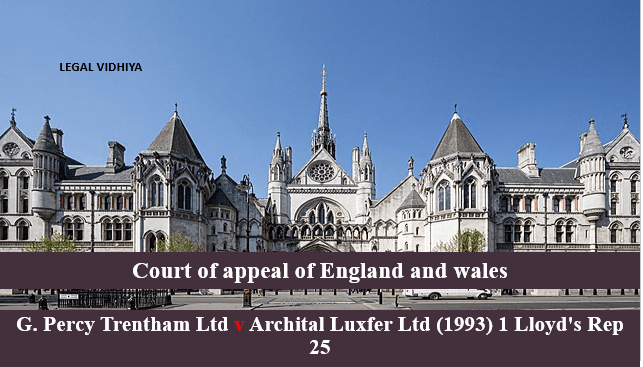
| CITATION | [1992] EWCA Civ J0720-2 |
| DATE OF JUDGMENT | 20th July, 1992 |
| COURT | COURT OF APPEAL, UK |
| APPELLANT | G PERCY TRENTHAM LTD. |
| RESPONDENT | ARCHITAL LUXFER LTD. |
| BENCH | LORD JUSTICE NEIL, LORD JUSTICE STEYN, LORD JUSTICE RALPH GIBSON |
INTRODUCTION
The case of ” G. Percy Trentham Ltd v Archital Luxfer Ltd (1993) 1 Lloyd’s Rep 25″ discusses the question of conclusion of valid contracts were concluded between the two parties – Trentham, a building and civil engineering contractor, and Archital, who conducted window works. The case discusses the various negotiations between the two parties and the grounds for formation of a valid contract.
FACTS OF THE CASE
- Municipal Mutual Insurance Limited had engaged Trentham as main contractors for a project to design and build industrial units in two phases. Phase 1 was governed by an agreement dated 2nd February, 1984 and Phase was governed by an agreement dated 18th December, 1984.
- The project, in both phases, included the work of design, supply and installation of aluminium window walling, doors, screens and windows or alternatively, window works. Archital was engaged in business as manufacturers, suppliers and installers of aluminium window walling, doors, screens and windows.
- Archital undertook the window works in phase 1 and phase 2 for Trentham and Trentham paid Archital for the same.
- Trentham claims that two separate sub contracts, one covering phase 1 and another covering phase 2, came into existence. Archital denies this claim that the dealings between the parties resulted in the conclusion of binding sub-contracts.
- Although both parties had carried out their obligations, Archital had completed the works and Trentham had made the payments, the dispute arose when Municipal Mutual made claims against Trentham for alleged delays and defects.
- In arbitration for these claims, two interim awards were made against Trentham in the sums of £558,335 and £343,820. Subsequently, Trentham started proceedings against seven sub-contractors for an indemnity in respect of the sums as it is liable to pay to Mutual Insurance. Archital is one of these sub-contractors.
- Trentham alleges that there were defects in the window works. Archital does not deny or admit the alleged defects but disputes that any sub-contracts ever came into existence. The case was brought before Judge Rich, Q.C. who decided the case in favour of Trentham. The present case is an appeal to challenge these findings.
ISSUES RAISED
- Whether valid sub-contracts governing phase 1 and phase 2 were made between Trentham and Archital?
CONTENTIONS OF APPELLANT
- Archital had submitted four alternative quotations for phase 1 window words to Trentham. On 24th January 2984, Archital revised the order to an extent. This offer was conditional to the incorporation of Archital’s standard conditions or the blue form.
- Trentham made a counter offer on 30th January 1984 which put the condition for acceptance of Trentham’s standard terms of sub-contract. It put forward a condition that a signed acknowledgement slip must be immediately forwarded. The conditions were never completed.
- Archital had completed all the terms of the contract as directed by Trentham and fulfilled all contractual obligations resulting in a binding sub-contract between the parties,
CONTENTIONS OF REPONDENT
- Archital contends that there was no binding sub-contract as they had not agreed to certain conditions put forward by Trentham and had never signed a valid sub-contract.
- The parties had not agreed to a dispute resolution mechanism as is generally observed in contracts of commercial nature.
JUDGEMENT
The Judge highlights four matters of importance with respect to English Contract Law. Firstly, English Contract Law lays emphasis on the reasonable expectations of sensible men. Secondly, the coincidence of offer and acceptance in the vast majority of cases represent the mechanism of contract formation. But is is not necessarily so in the case of a contract alleged to have come into existence during and as a result of performance. Thirdly, the contract was already executed rather than executory in nature. Fourthly, if a contract only comes into existence during and as a result of performance of the transaction it will frequently be possible to hold that the contract impliedly and retrospectively covers pre-contractual performance.
The Judge pointed out that there were now three matters to be considered: (i) payment procedure; (ii) insurance of unfixed goods; and (iii) disputes procedure. The payment procedure had been agreed to by both parties by letter dated 24th February 1984. The second matter relates to Architalʹs request that Trentham should pay the cost of insuring unfixed goods which remained the property of Archital. Trentham did not agree to bear these costs yet Archital carried on the business on its own risk. On the third matter, agreement on dispute resolution was not essential to the conclusion of the contract: the parties were content to treat it as a matter for further agreement after the conclusion of the contract.
The Judge highlighted the commercial nature of the contract. He noted that work had been carried out by one side in return for payment by the other side. Thus, both parties had fulfilled their contractual obligations. During negotiations of phase 1 of the contract all obstacles had been removed This is not a scenario where there was an ongoing requirement for a written agreement to establish a contract. A fully completed transaction resulted in a contract during performance, even if the specifics of offer and acceptance are not precisely analyzed. The timing of the contract’s formation, occurring after some work was done and payment made, does not diminish its validity. The inference is that the contract inherently governed pre-contractual performance, leading me to affirm the existence of a binding contract for Phase 1. The Judge asserts that the challenge regarding the contract for phase 2 is rooted in the belief that no contract was concluded for phase 1. Since it has been determined that there was a valid contract for phase 1, the arguments for phase 2 collapses.
ANALYSIS
- Counter Offer – A counter offer is a response to an initial offer made during negotiations. Instead of accepting the terms presented in the original offer, the party receiving the offer proposes different terms. In essence, the counteroffer serves as both a rejection of the initial offer and a new offer with revised or additional conditions.
- Performance and Fulfilment – A contract assigns certain duties to the parties involved. The contractual duties or obligations in this case were the window works by Archital and the payment for the same by Trentham. Both parties had fulfilled their contractual duties.
- Contract Formation – This case pointed out that it is not necessary for a contract to be formulated into a written agreement. In certain cases, the reasonable expectations of sensible men and conduct of the parties implies contract formation.
CONCLUSION
In conclusion, the case underscores the importance of understanding contract formation beyond written agreements, recognizing the significance of parties’ conduct and reasonable expectations. Additionally, the judgment emphasizes the fulfilment of contractual obligations by both parties and the implications of counteroffers in negotiations. The overall analysis highlights the nuanced nature of contract law and the relevance of context-specific considerations in determining the existence and scope of contractual agreements.
REFERENCES
This Article is written by Astha Samal student of National Law University Odisha; Intern at Legal Vidhiya.




0 Comments