
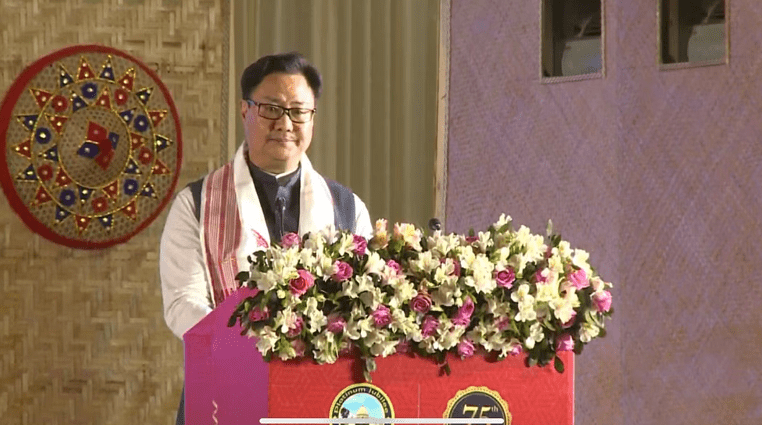
According to Rijiju, “some elements” do not want to see India advance, so they are attempting to portray a conflict between the judiciary and the executive.
Law minister Rijiju
Differences between the executive and judicial branches are inherent to democracy and shouldn’t be characterized as “confrontation,” according to Union Law Minister Kiren Rijiju on Friday.
According to Rijiju, “some elements” do not want to see India advance, so they are attempting to portray a conflict between the judiciary and the executive.
“It is my duty as a minister of law to uphold the law. We occasionally fall victim to uniformed discussions and debates, making judicial independence a priority. CJI has made it clear that he believes there should be good relations between the executive, legislative branch, and judicial branch. In the age of the internet, some elements do not want to see India advance. There have been attempts to depict the conflict between the executive and judicial branches. Though they cannot be called a confrontation, differences of opinion are an essential component of democracy, he said.
Speaking at the Gauhati High Court’s platinum jubilee celebrations, the Law Minister.
In his speech, Rijiju emphasized the need for cooperation between the executive, judicial branch, and legislature.
“Bar and judicial members will need to collaborate. Justice cannot be served without both judges and bar members, according to the Union Law Minister.
At the same event, Chief Justice of India (CJI) DY Chandrachud stated that strong constitutional statesmanship should characterize the administrative side of the relationship between the executive and the judiciary.
However, the CJI emphasized that on the judicial side, citizens place their faith and confidence in the judicial system’s fierce sense of independence.
The Minister has recently expressed his disapproval of the Collegium system and judicial appointments, among other things, in his views on the judiciary.
He and the judiciary engaged in a verbal battle that erupted late last year.
Rijiju claimed that the collegium system is too opaque and that judges are not appointed to positions anywhere else in the world in October of last year.
On November 5, he had stated that the collegium system’s “lack of transparency” was the result of “intense politics at play,” even within the judicial community, which is currently in charge of selecting judges. He also stated that the Central government would not remain “silent” indefinitely regarding this issue.
Several former judges took offense to this and retaliated by claiming that the government was to blame for the lack of transparency.
Later, he referred to the collegium as an alien system and said that if the judiciary believed the government was holding onto files, the judges should make their own appointments of judges.
The Supreme Court quickly voiced its qualms about these statements, and in open court no less.
On November 28, a bench of Justices Sanjay Kishan Kaul and AS Oka stated that the Centre was frustrating the entire system and degrading judge seniority by delaying the nomination of recommended names. The Attorney General and Solicitor General were tasked by the bench with advising the Center on the matter.
The Law Minister stirred up controversy last month when he claimed that some (retired) judges are activists and are a part of an anti-India gang that is attempting to turn the judiciary against the government, and that those who do so will be held accountable.
More than 300 attorneys, including 62 Senior Advocates who practice before the Supreme Court and numerous High Courts across the nation, issued a statement condemning the Law Minister’s remarks. He received a lot of backlash for the statement.
Written By- Tushar Vashisth students of 3rd year BBA LLB at Chandigarh University




0 Comments