
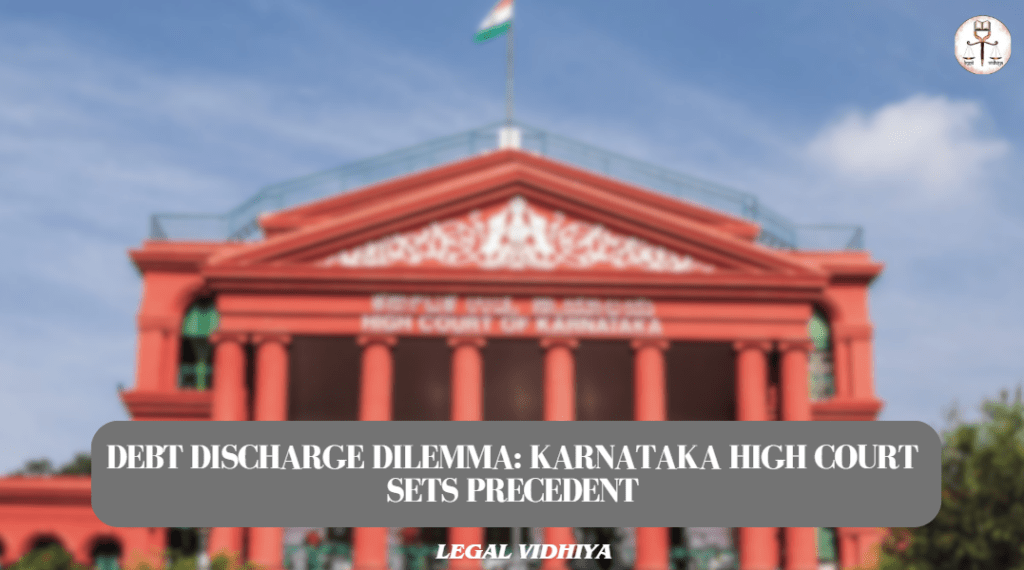
In a recent legal dispute between the Union Bank of India and DR. NIRANJAN GOWDA, significant insights into debt acknowledgment, loan discharge, and the consequences for legal recourse were unearthed. The crux of the matter revolved around a loan agreement of Rs. 3,55,000/- extended to Defendant No.1, who had pledged as a surety. This agreement was formalized through a Promissory Note, where Defendant No.1 committed to repay the loan in 36 equal monthly instalments of Rs. 12,005/-. Additionally, an Hypothecation Deed was executed in favour of the Bank to secure the loan. However, Defendant No.1 failed to honour these commitments, prompting the Bank to resort to legal action.
In the ensuing legal battle, two pivotal issues emerged. Firstly, Defendant No.1 contended that the suit brought by the Bank was barred by limitation, emphasizing the passage of time since the loan’s origination. Secondly, Defendant No.1 argued that the debt had been discharged owing to a substantial transfer from their Savings Bank Account, coupled with purported assurances from the Bank regarding suit withdrawal upon closure of the loan account. Conversely, the Bank countered these assertions by maintaining that the suit was necessitated by Defendant No.1’s default and highlighted the non-closure of the loan account as evidence against discharge.
Both parties presented compelling arguments to support their respective positions. The Bank emphasized the exigency of legal action due to Defendant No.1’s default, citing the ongoing status of the loan account as indicative of the debt’s persistence. In contrast, Defendant No.1 relied on the statute of limitations and the purported discharge of the loan, supported by assurances purportedly made by the Bank.
After careful consideration of the evidence and legal arguments presented, the Trial Court rendered its verdict. It found that the acknowledgment of debt made by Defendant No.1 occurred beyond the statutory limitation period, rendering it invalid. Moreover, the court placed significant weight on the transfer of funds from Defendant No.1’s Savings Bank Account to the loan account, coupled with indications of account closure. Consequently, the court ruled in favour of Defendant No.1, dismissing the suit on grounds of invalid debt acknowledgment and loan discharge.
The implications of this ruling are profound for both financial institutions and borrowers. Firstly, it establishes a precedent regarding the temporal validity of debt acknowledgments, clarifying that such acknowledgments hold no legal weight beyond the statutory limitation period. Furthermore, it underscores the significance of account activity in determining the status of a loan, with closures or fund transfers potentially indicating discharge. As a result, financial institutions are urged to maintain meticulous records, while borrowers are provided with safeguards against stale claims. In essence, the Union Bank of India versus Defendant No.1 case serves as a cautionary tale, highlighting the complexities inherent in debt acknowledgment and loan discharge, and emphasizing the importance of timely legal action and comprehensive documentation in financial disputes.
Written by- Kaavya Gopal, PES University, 6th semester, intern under legal vidhiya
Disclaimer: The materials provided herein are intended solely for informational purposes. Accessing or using the site or the materials does not establish an attorney-client relationship. The information presented on this site is not to be construed as legal or professional advice, and it should not be relied upon for such purposes or used as a substitute for advice from a licensed attorney in your state. Additionally, the viewpoint presented by the author is of a personal nature.





0 Comments