
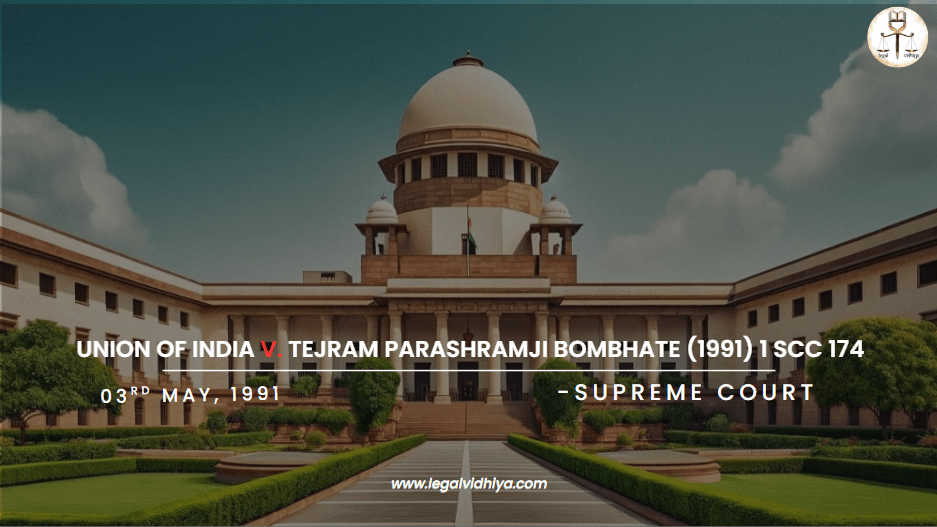
| CITATION | (1991) 3 SCC 11 : AIR 1991 SC 2170 |
| DATE | 03 May, 1991 |
| COURT NAME | SUPREME COURT OF INDIA |
| PLAINTIFF/APPELLANT/PETITIONER | Union of India and Others |
| DEFENDANT/RESPONDENT. | Tejram Parashramji Bombhate and Others |
| JUDGES | Justice K. Jagannatha Shetty |
INTRODUCTION
This case, decided by the Supreme Court of India on May 3, 1991, highlights a basic principle of governance: the judiciary’s role in respecting the policy decisions and financial independence of the executive. It focuses on a disagreement between teachers of an unsanctioned secondary school and the Central Government. This case questions how far a tribunal can force the government to act on policy issues.
FACTS OF THE CASE
School Background
- The Ordnance Factory at Ambazari in Maharashtra is a government-run defense facility, managed directly by the Central Government.
- In order to address the educational requirements of the factory employees’ children, the Central Government approved and ran a Primary School that provided education from Standard I to V.
- This Primary School was entirely financed and overseen by the Government. It had officially sanctioned teaching positions, and the teachers were consistently hired through government-sanctioned processes. The Teachers appointed here received a regular salaries,pension,job-secrutiy.
Unauthenticated Secondary School
Within the same premises as the Government Primary School, there was also a Secondary School operating for Classes VI to X.
However, this Secondary School lacked official approval from the Central Government. Rather, it was initiated and managed informally by the factory worker who generally the teachers appointed through employees arrangement from school to provide educational continuity after Class V.
Consequently, the Secondary School was not included in any formal government education initiative. The Government had not established or authorized any positions for this level.
Hiring of Educators
The educators employed at the Secondary School (the subjects of the case) were recruit through a private arrangement by the employees’ association or school committee, rather than through the Central Government.
These positions were filled without any formal recruitment procedures that would typically involve government regulations, notifications, or selection through the Employment Exchange or Service Commission.
Their compensation was provided as an honorarium rather than a salary, (as they are not employed through government payroll schemes,) funds originating from student fees, parental contributions, and occasional donations, rather than from government financial support.
Type Of Employement
The respondents who were teaching at the unofficial school were not categorized as government workers.
They did not qualify for standard pay scales, pension schemes ,employment benefits, or job stability.
Nevertheless, they persisted in teaching at the Secondary School, often for many years, convinced that their efforts had a public significance.
Dispute and Legal Measures
The Respondent believed that their work was comparable in value and nature to that of the regular teachers at the government-operated Primary School.
They felt that they should receive the same compensation for performing the same work, so they wanted their services to be regularized.They deserve the same amount of respect to their work as they are educating the children of factory workers they should be also entitled to same respect.
Consequently, they submitted O.A.(original Application) No. 58 of 1988 to the Central Administrative Tribunal (CAT), Bombay Bench.
Their requests included:
- Regularization of their services and recognition of their efforts.
- Establishment of sanctioned positions for the Secondary Schools similar to government aided schools.
- Compensation that is equal to that of the full-time teachers at the Primary School.
Directions by the CAT
On June 21, 1988, the CAT delivered a ruling that appeared to be a triumph for the educators. The Tribunal issued a set of definitive instructions to the Union of India and the officials of the Ordnance Factory:
Determine the Number of Teachers Required
The Government had to promptly assess the number of teachers necessary for the Secondary School to operate effectively.
Establish Official Teaching Positions
After this assessment, it was recommended that they create formal, permanent teaching positions for the school.
Set Recruitment Guidelines and Prioritize Current Staff
The Government was instructed to develop formal guidelines for recruiting individuals for these positions.The existing teachers at the school (who initiated the case) should receive priority in the hiring process. New candidates from the Employment Exchange could only be considered if the current teachers were deemed unsuitable.
Make Positions Permanent and Ensure Fair Compensation
Once appointed, the teachers should become full-fledged government employees. They should receive equivalent salaries and benefits as those given to teachers in the government-run Primary School.
Include Support Staff Such as Peons
The same procedures needed to be applied for non-teaching personnel as well. A particular peon, Shri Tadas, was to be given an equitable opportunity to apply for a permanent position.
Complete Everything Before the Start of the New School Year
The Tribunal directed the Government to finalize all these actions before the commencement of the 1989–90 academic year. In the meantime, the school may continue its operations as usual, and the teachers will maintain their current working conditions to the their allotting positions of work.
Appeals Filed Against the Tribunal’s Orders
The officials from the Ordnance Factory and the Union of India were taken aback by the Tribunal’s orders. They believed the Tribunal was compelling them to:
- Authorize and operate a Secondary School that had never been officially approved by the government, and
- Establish and finance new permanent positions, which lacked both budget and prior authorization.
They contended that these issues were related to policy and finances, thus beyond the Tribunal’s jurisdiction. Consequently, they contested the CAT’s ruling by submitting an appeal to the Supreme Court — Civil Appeal No. 233 of 1991.
Simultaneously, some teachers who had not been regularized despite the Tribunal’s directives felt neglected. They initiated a separate appeal — Civil Appeal No. 480 of 1989 — requesting the Supreme Court to ensure their inclusion in the regularization process.
Issues of the Case-
- Is it possible for the Tribunal to compel the government to formally acknowledge the Secondary School and establish permanent positions for its educators?
- Were the teachers, who received an honorarium from the employees, a moderate stipend justified in expecting the same job stability and compensation as government teachers at the Primary School? Is it not violating the Doctrine Principle as to “Equal Pay for Equal Work”.
- Did the Tribunal overstep its Limitations by instructing the government to alter its approach to school operations, particularly regarding public funding?
JUDGEMENT
The Supreme Court, in a ruling made by Justice K. Jagannatha Shetty, ruled in favor of Union of India and overturned the orders issued by the Central Administrative Tribunal. The Court clarified that the Tribunal did not have the legal power to compel the government to endorse the Secondary School, establish new teaching positions, or formalize the status of teachers who were not officially hired. It stressed that the Secondary School was never officially approved by the Central Government, and the teachers employed there were not appointed through any recognized government procedure. Since the school was initiated and run by factory workers in a private capacity, the government had no legal responsibility to take it over. The Court also noted that the government had previously decided to focus solely on managing Primary Schools. This decision was related to executive policy and financial planning, and the courts or tribunals lack the authority to intervene in these matters. As a result, the Supreme Court accepted the government’s appeal (Civil Appeal No. 233 of 1991) and rejected the teachers’ appeal (Civil Appeal No. 480 of 1989).
REASONING
Non-Involvement Of Government Authority
The Supreme Court made it clear that there was no evidence indicating that the teachers (respondents) were ever appointed by or on behalf of the Central Government. Their hiring did not follow any formal procedure, nor was it authorized by any government body. Rather, they were recruited by the employees of the Ordnance Factory to teach at the Secondary School, which was established privately and operated entirely without government approval. In contrast to the Primary School — which was fully sanctioned, financed, and staffed by the Central Government — the Secondary School operated as a community initiative. The teachers received a modest honorarium rather than a salary, funded by student fees and voluntary contributions, not by public money. The Court highlighted this difference to indicate that these teachers could not assert the same rights as regular government workers. It also noted that merely carrying out similar tasks is not sufficient — what is important is how the position was formed, who appointed the individual, and under which regulations. In this instance, since the appointments were made outside any official framework, the government simply was not liable for regularizing them or treating them equally with its own personnel.
Policy Decision
The Supreme Court clarified that the Central Government had purposefully decided to restrict its role in education to only Primary Schools. This choice was not accidental; it was an intentional policy initiative reflecting the government’s strategy to manage its resources, budgets, and administrative priorities. Supporting education beyond the primary level would have required an increased investment, more personnel, and an expanded infrastructure — commitments the government was unwilling to make at that moment. However, the Tribunal’s directives essentially compelled the government to extend its responsibilities to a Secondary School that it had never officially approved.
The Court viewed this as a significant overreach to there power. It emphasized that decisions on the allocation of public funds and the formation of policies are within the jurisdiction of the executive branch i.e Government authorities — a realm that courts or tribunals cannot direct unless explicitly authorized by law. A tribunal’s direction, regardless of how fair or advantageous it may appear, does not grant it the authority to contravene established policy. Without a strong legal foundation, such intervention is not merely inappropriate — it poses a risk to the principle of separation of powers itself.
No Legal Backing
The Supreme Court clarified that there was no legislation or regulation that obligated the government to establish or finance a Secondary School. This was not something the government was legally required to undertake. Therefore, when the Tribunal instructed the government to evaluate the school’s requirements, create positions, and develop hiring protocols, the Court believed those directives lacked legal foundation. It stated that the Tribunal had exceeded its authority by encroaching on governmental responsibilities—such as forming policies and determining the allocation of public funds.
Not Violating Equal Pay For Equal Work Principle
The Supreme Court rejected the teachers’ demand for equal pay, explaining that the “equal pay for equal work” rule didn’t apply here. The teachers in the Secondary School weren’t appointed by the government, weren’t working in sanctioned posts, and their school wasn’t even recognized by the government. Their terms of employment, who hired them, and the way the school operated were all completely different from those of regular Primary School teachers. Since the two situations weren’t truly comparable, the Court said the claim for equal pay had no legal ground.
CONCLUSION
The Union of India vs. Tejram Parashramji Bombhate case highlights the distinction between empathy and legal principles. Although the educators’ struggle for fair treatment and job security was genuine, the Court had to acknowledge that they were not government employees, nor was their institution officially recognized. The Supreme Court emphasized that courts cannot supersede policy choices or compel the government to allocate funds without a legal basis. Requests for regularization or equitable pay, no matter how reasonable they may appear, must adhere to appropriate legal procedures. This ruling also underscored that executive actions—particularly those related to budgets and policies—are outside the scope of judicial commands, unless supported by law. The decision establishes a significant precedent for honoring the limits of judicial authority and stresses that systemic reforms for such workers must originate from legislation or administrative changes, rather than from judicial interventions.
REFERENCES
- https://indiankanoon.org/doc/1545570/
- Supreme Court Cases And Judgements | Blogspot.com
- https://vlex.in/vid/appeal-civil-233-of-852321275
Written by Vikas Sharma an Intern under Legal Vidhiya.
Disclaimer: The materials provided herein are intended solely for informational purposes. Accessing or using the site or materials does not establish an attorney-client relationship. The information presented on this site is not to be construed as legal or professional advice, and it should not be relied upon for such purposes or used as a substitute for advice from a licensed attorney in your state. Additionally, the viewpoint presented by the author is personal.

‘Social Media Manager’ and ‘Case Analyst’ of Legal Vidhiya.




0 Comments