
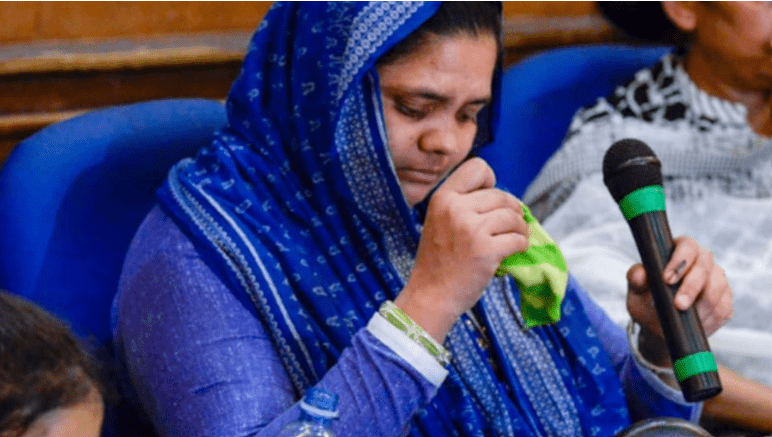
Orally, Justice Joseph stated that the government’s refusal to produce the files constituted contempt of court because it had not yet submitted a review of the Court’s prior order.
On Tuesday, the Central and Gujarat governments notified the Supreme Court that they might appeal the top court’s directive to them to submit documents pertaining to the release of 11 prisoners who were convicted of gangraping Bilkis Bano during the Gujarat riots in 2002.
ASG SV Raju, who is representing both governments, informed a panel of Justices KM Joseph and BV Nagarathna of the situation.
The Court’s most recent order had read,
“The relevant files regarding the grant of remission to the party respondents will be ready with the first respondent, Union of India, as well as the second respondent, State of Gujarat, on the next date of hearing.”
The bench was not impressed when the ASG informed the Court today about the review.
Orally, Justice Joseph stated that the government’s refusal to produce the files constituted contempt of court because it had not yet submitted a review of the Court’s prior order.
“What is the issue with presenting the files to us today? You are in contempt for not producing it. Why are you avoiding me right now? You didn’t submit a review, and we never intervened, Justice Joseph said.
The State government could have made a decision independently and was not required to support the Central government’s stance on remission, according to the Court.
“Just because the Union agreed doesn’t mean you don’t still need to use your own judgment. No State can evade the legal requirements. If you promise not to provide us with any justifications or the files, then for us,… Justice Joseph added, “We will be free to draw our own conclusions.
You will be in a better place if you show, said Justice Nagarathna.
For one of the PIL petitioners, Senior Advocate Kapil Sibal proposed that it be produced under a sealed cover.
The ASG clarified that in order to provide a specific response, he would need more information since he had only been briefed on the possibility that the governments might contest this order.
Relevantly, the Court also voiced strong disapproval of the defendants’ delay strategies after one of the defendants’ attorneys requested an extension of time to submit his counter-affidavit.
“We are also aware of the accused’s potential plan to drag the case out until at least December. They will claim that they were not served and will ask for four weeks, according to Justice Nagarathna.
The attorney then emphasized that even though the matter involved their liberties, notice had only been issued on March 27 and less than a month had passed.
During the hearing, the Court also questioned the ASG, who was speaking on behalf of both the Central and Gujarat governments, about any potential conflicts of interest.
The Gujarat government’s decision to pardon 11 convicts who had gang-raped Bilkis Bano and killed her family members during the 2002 Godhra riots was being contested by a number of petitions before the court.
Jaswant Nai, Govind Nai, Shailesh Bhatt, Radhyesham Shah, Bipin Chandra Joshi, Kesarbhai Vohania, Pradeep Mordhiya, Bakabhai Vohania, Rajubhai Soni, Mitesh Bhatt, and Ramesh Chandana are the 11 prisoners who were released.
Last month, the Supreme Court gave notice of the case. The Court stated at the time that the crime committed against Bano and her family members was horrific but emphasized that the case would be decided in accordance with the law.
While the other cases are of the public interest litigation (PIL) variety, Bano is one of the petitioners.
The top court requested the Gujarat government’s response to some of the arguments on August 25 of last year.
Only Bano’s writ should be taken into consideration, according to senior attorney Sidharth Luthra, who is today representing one of the prisoners. He continued by saying that the crime’s nature could not, at this point, justify a longer sentence.
They avoided the healing procedure. Those are things to be determined at the outset … They are currently attempting to challenge some judgments made by the two judges, according to Luthra.
The Court made it clear that its decision was limited to the issue of whether the Gujarat government’s use of its authority was consistent with established law and policy.
“The occus standii matter is resolved. Writ petition is false. The issue is on what foundation you have used your authority. Whether you applied your mind, were guided by pertinent factors, and asked the right questions,” the Court continued.
For the petitioners, senior attorney Abhishek Manu Singhvi appeared alongside attorneys Vrinda Grover and Shobha Gupta.
On May 2, the Court finally scheduled the case for disposition.
.Written By- Tushar Vashisth students of 3rd year BBA LLB at Chandigarh Universit


0 Comments