
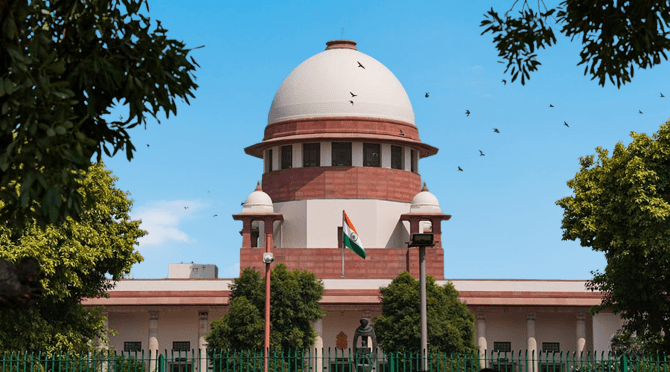
Supreme Court clarifies High Courts’ Jurisdiction at Discharge Stage or When Exercising S. 482 CrPC Powers in Central Bureau of Investigation v. Aryan Singh. In the matter of Central Bureau of Investigation v. Aryan Singh, the Supreme Court of India recently rendered a historic decision that clarified the High Courts’ jurisdiction during the discharge stage and when exercising Section 482 of the Criminal Procedure Code (CrPC) powers. The decision, which was made by a court that included the Chief Justice of India and two other judges, will have a big impact on India’s criminal justice system.
Whether High Courts have the authority to halt a criminal prosecution or an investigation at the discharge stage or when exercising Section 482 of CrPC powers was the question before the Supreme Court in this case. The Supreme Court came to the firm opinion that the High Courts’ power at such stages is constrained and should only be used sparingly and in exceptional circumstances after carefully reviewing the relevant provisions of the CrPC and several earlier judgements.
In its ruling, the Supreme Court noted that the trial court is the proper place to evaluate the case’s merits and determine if there is enough evidence to move forward with the trial at the level of discharge. According to Section 482 of the CrPC, the High Courts have inherent authority to stop misuse of the legal system and to uphold the interests of justice. This authority, however, is not a regular appellate jurisdiction and cannot be utilized to reevaluate the evidence or determine the truthfulness of the accusations presented in the complaint or the charge sheet.
The Supreme Court based its decision on a number of earlier rulings. The Supreme Court ruled in State of Maharashtra v. Priya Sharan Maharaj that high courts should not challenge a trial court’s discharge decision unless they find it to be perverse or devoid of evidence. The Supreme Court ruled in the case of Madhavrao Jiwajirao Scindia v. Sambhajirao Chandrojirao Angre that the ability to halt a criminal case or investigation should only be used in exceptional circumstances, such as when the accusations made in the complaint or charge sheet are patently false or when the accusations, even when taken at face value, do not amount to an offense.
The Supreme Court went on to say that the High Court’s potential disagreement with some factual or legal features of the case should not be used as justification for using its authority to halt a criminal proceeding or inquiry. At the discharge stage or when exercising their authority under Section 482 of the CrPC, the High Courts should refrain from delving too deeply into the evidence or the merits of the case. Such meddling would equate to replacing the trial court’s judgment with the High Court’s, which is against the law.
The Supreme Court also emphasized the need for extreme prudence and circumspection when using its authority to throw out a criminal case or inquiry, keeping in mind the nature of the offense, the prima facie evidence at hand, and the interests of justice. A criminal case or inquiry should not be interfered with lightly by the High Courts since doing so could erode public trust in the criminal justice system.
The Indian criminal justice system will be significantly impacted by the Supreme Court’s ruling in Central Bureau of Investigation v. Aryan Singh. It reiterates the idea that the ability to quashing a criminal case or investigation should only be used in exceptional circumstances and that the High Courts should not act as regular appellate forums to reevaluate the evidence or the merits of the case at the stage of discharge or when using Section 482 of CrPC powers.
The Supreme Court’s decision in Central Bureau of Investigation v. Aryan Singh supports the idea that the trial court is the proper venue for determining the merits of a case and whether there is enough evidence to move forward with the trial. It also warns against tampering with the development of a criminal case or inquiry without convincing justification. The Supreme Court’s ruling in Central Bureau of Investigation v. Aryan Singh has made clear the High Courts’ narrow scope of authority when deciding cases involving discharge or using Section 482 of the CrPC. It highlights the need for High Courts to use their inherent authority sensibly and wisely, and to refrain from overriding the trial court’s decision with their own. It serves as a reminder to the legal community to uphold the values of impartiality, fairness, and respect for the law throughout the criminal justice system.
Name: Sarah Garima Tigga, SemesterVI, College: symbiosis law school pune






0 Comments