
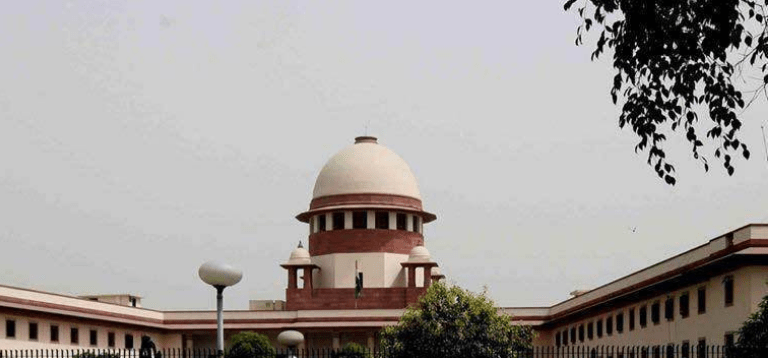
The Supreme Court ruled that a defendant cannot be remanded in custody unless he has appealed the first extension of the pre-trial period, granted the second extension in his presence, and filed the charges within the extended period.
The Panel of Justices M. R. Shah and Justice C. T. Ravikumar noted:
when two extensions granted by the Court which are not challenged and at the time when the default bail application was made on 10.05.2022 there was already an extension and even thereafter, also there was a second extension which was in presence of the accused and thereafter, when the chargesheet has been filed within the period of extension, the accused is not entitled to be released on statutory/default bail as prayed.”
The bench accepted the High Court’s final conclusion and refused the defendant’s bail.
Brief facts
The defendant was arrested on January 29, 2022. The investigation officer (IO) requested an extension of the period to complete the investigation beyond 90 days under Art. 30-day extension on April 22, 2022. The extension was served on the defendant on April 23, 2022.
The investigator re-applied for an additional extension, which was granted by the district court on May 22, 2022 in the presence of the defendants.
The defendant applied for his release on bail in the Trial Court on 10 May 2022, arguing that at the time of the O.I. of the first extension, was not in the presence of the Defendant and therefore the Defendant earned the right to bail in absentia on May 10, 2022. The defendant appealed to the Trial Court, which was dismissed by judgment and order dated September 23, 2022.Therefore, the defendant appealed against the judgment under appeal and the decision of cassation before cassation.
Advocate Mehmood Pracha acted on behalf of the applicant, i.e. the defendant, while Attorney General Tushar Mehta on behalf of the defendant, i.e the State of Gujarat.
Issues
The question put to the court was whether the defendant was entitled to statutory/untimely bail under section 167(2) of the crpc on the ground that at the time when the extension of time for completing the investigation was prayed by the investigating agency and granted by the Trial Court the accused was not kept present?
Arguments
The defendant’s lawyer, Mehmood Prach, argued before the court that the public prosecutor’s office had admitted that the applicant had waived an appearance before the court of first instance during the consideration of his application for the first extension of time.
He referred to the Supreme Court judgments in Hitendra Vishnu Thakur and Ors. V. State of Maharashtra and Ors. (1994) 4 SCC 602, which required the respondent to be notified at the time of considering a request for an extension of the investigation period.
He also relied on the Supreme Court’s ruling in Jigar aka Jimmy Pravinchandra Adatiya v. State of Gujarat 2022 (SC) 794, which reiterated that the defendant’s failure to appear at the time of the extension of the investigation period renders such extension unlawful and the defendant the Right gives to legal binding.
Against the appeals, Gujarat State Attorney General Tushar Mehta said that the Supreme Court in the Sanjay Dutt case explained the decision in the Hitendra Vishnu Thakur case (above) and ruled that the only condition was that the defendants appear in the joke in court. 167(1) crpc, and the defendant is not entitled to a written notice justifying the extension.
He further argued that the Supreme Court’s decision in the Jigar case (above) required grand jury review because the Supreme Court failed to consider Article 465 of the CrpC in that decision.
The Attorney General appealed to the Supreme Court ruling in Rambeer Shokeen v. State (2018) 4 SCC 405, which ruled that defendants only have the right to delay release if a request for an extension of the pre-trial period or a charge has been denied. was not submitted within the prescribed time limit.
Ruling
The Supreme Court relied on the Constitutional Court’s decision in Sanjay Dutt v. State via CBI, Mumbai (II) (1994) 5 SCC 410, which ruled that it is not necessary for the designated court to inform the accused before granting an extension of the investigation, which means that the accused must be present in court must be when there is an extension of the request.
The Court noted that the Supreme Court’s position in the Hitendra Vishnu Thakur case (above) that the defendant must be informed in order to oppose the extension was not accepted by the Constitutional Court in the Sanjay Dutt case (above).
The court observed:
The court ruled that the applicant was not entitled to be released from his bail because, when he informed the defendant the same day after the first extension was granted, he had not unreasonably contested the extension and/or had no complaint about it of the illegality and/or unlawfulness of this extension.
Thus, the Court dismissed the appeals filed by the appellant-accused.
Cause Title- Qamar Ghani Usmani v. The State of Gujarat
Written by -Anushka yadav student of the ba.llb 2nd semester at Rnb global University bikaner Rajasthan




0 Comments