
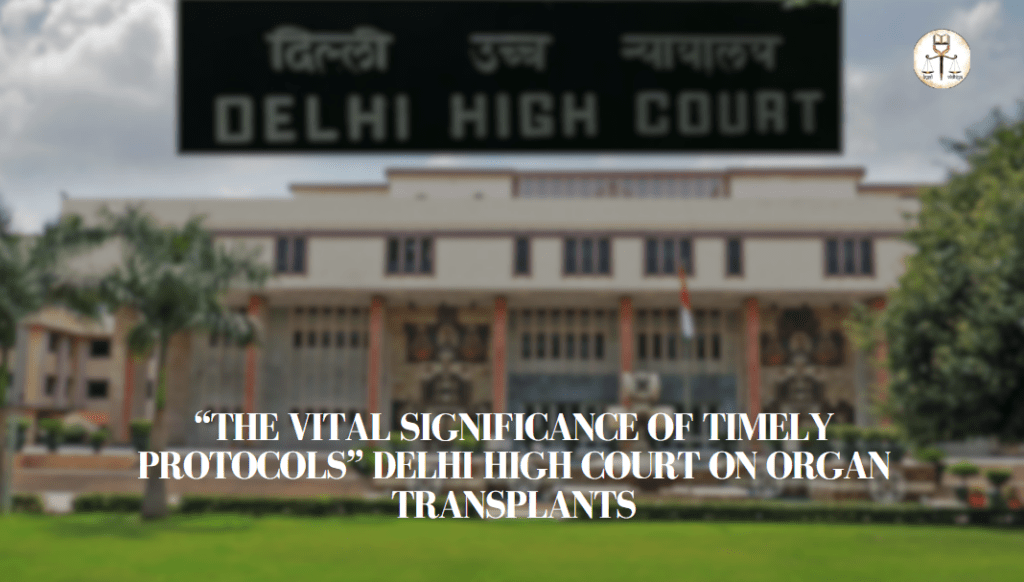
In a pivotal ruling, the Delhi high court has emphasized the critical importance of a time-bound approach in organ transplantation protocols, citing its significance in upholding the integrity of the process and safeguarding the right to health enshrined in the constitution.
Under the stewardship of justice prathiba m. Singh, the court has directed the centre to streamline the organ transplantation process in consultation with pertinent stakeholders.
The court’s directive stresses the need for swift processing of applications, verification of documents, completion of necessary paperwork, and interviews by the authorization committee before organ donation. It strongly advocates that the entire process, from submission to decision, should ideally be confined within a 6 to 8 week timeframe.
Highlighting the repercussions of non-adherence to timelines, the court noted extended waiting periods of 2 to 3 years in certain cases, which stand in violation of the transplantation of human organs and tissues act alongside its rules. These delays result in considerable mental and physical anguish for donors, recipients, and their families.
“a time-bound approach is crucial to uphold the integrity and effectiveness of organ transplantation protocols, aligning with the right to health as per article 21 of the constitution,” affirmed the court.
The judgment mandates the presentation of its findings before the secretary, ministry of health and family welfare, urging the establishment of specific timelines for all steps involved in the consideration of applications for organ donation, in accordance with the 1994 act and 2014 rules, following consultations with relevant stakeholders.
This ruling stemmed from a petition filed by an individual seeking approval for a renal transplant due to end-stage chronic kidney disease. Regrettably, the petitioner passed away during the pending formalities.
Justice Singh delineated precise timelines, stipulating that the application for organ donation should be processed within 10 days, document verification completed within 14 days, and necessary responses from the donor or recipient addressed within a week to finalize documentation. Adherence to these deadlines is deemed crucial, with any granted extensions to be strictly followed.
Moreover, the court mandated that interviews should be scheduled within 2 weeks after 4 to 6 weeks of receiving the application. The authorization committee is tasked with conducting these interviews of the donor and recipient, ensuring a judicious decision-making process.
Emphasizing the importance of prompt decision-making, the court underscored that the complexity of the process should not dissuade organ donation. It highlighted that the act and rules governing organ donation aim to regulate rather than deter this humanitarian cause, crucial for the welfare of society at large.
CASE NAME: AMAR SINGH BHATIA V. SIR GANGA RAM HOSPITAL W.P.(C) 3590/2020 & CM APPL. 12775/2020
NAME: GAYATHRI MANOJ, BBA, LLB(HONS) , COLLEGE: PRESIDENCY UNIVERSITY, BANGALORE , INTERN UNDER LEGAL VIDHIYA.
Disclaimer: The materials provided herein are intended solely for informational purposes. Accessing or using the site or the materials does not establish an attorney-client relationship. The information presented on this site is not to be construed as legal or professional advice, and it should not be relied upon for such purposes or used as a substitute for advice from a licensed attorney in your state. Additionally, the viewpoint presented by the author is of a personal nature.





0 Comments