
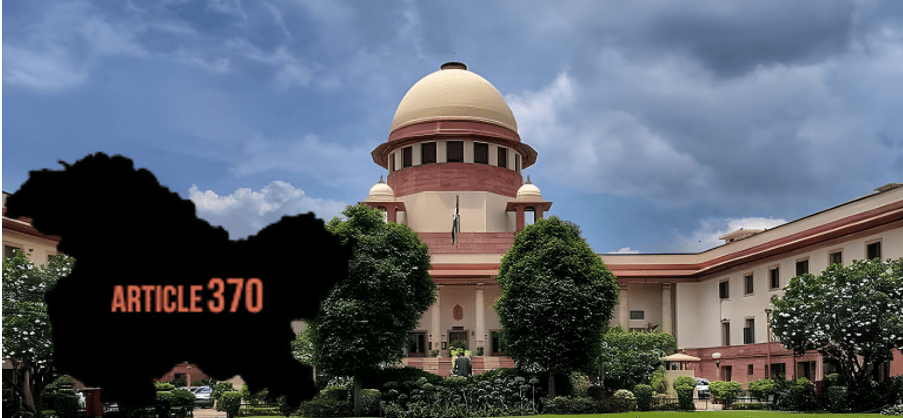
Keywords: Constitution, Supreme Court, MP, Article 370
Article 370 of the Indian Constitution granted special autonomous status to the region of Jammu and Kashmir. It allowed the state to have its own constitution, a separate flag, and significant autonomy over all matters except foreign affairs, defence, and communications. This provision had been a subject of debate and controversy for years, with some arguing for its abrogation or modification, while others defended its preservation.
In August 2019, the Indian government, led by the Bhartiya Janata Party (BJP), made a historic decision to revoke Article 370 and bifurcate the state of Jammu and Kashmir into two union territories – Jammu & Kashmir and Ladakh. This move was met with both support and opposition from various political parties and individuals. Legal challenges and petitions were filed in response to the government’s decision. These cases made their way through the Indian legal system, and various aspects of the abrogation of Article 370 were debated in the courts.
A recent twist has come to light regarding the prominent issue of abolition of Article 370 before the apex court of the country. National Conference Party leader, Mohammad Akbar Lone has challenged the abrogation of Article 370. The Supreme Court on Monday notified the leader to file an affidavit stating that he “unconditionally accepts” that Jammu and Kashmir is an integral part of India and he owes allegiance to the Constitution.
The MP was accused of raising slogans saying, ‘Pakistan Zindabad’ by the centre. To defend Mr. Lone, Mr. Kapil Sibal came forth stating that, ‘He has sworn an oath as a Member to the Constitution of India. He is a citizen of India… How can he say otherwise.’ Kapil Sibal, a prominent lawyer and politician affiliated with the Indian National Congress, has been known for representing clients in various high-profile cases. His involvement in legal matters related to Article 370 or any other case is not surprising given his legal expertise and political background. However, the Chief Justice of India contended otherwise, asking Mr. Sibal to file legally what they claim through verbal communications regarding Mr. Lone’s allegiance to the Constitution and acceptance towards Jammu and Kashmir being a part of India.
This issue witnesses various confrontations and involvement of citizens of India. Namely, the Kashmiri Pandits took initiative and spoke on the matter and even went to the extent of questioning Mr. Akbar’s identity. They vehemently opposed Mr. Akbar Lone and criticised him for going against the abrogation of Article 370. The bench of the apex court took note of such statements as well as reports published in the news and held that, ‘These statements coming from senior leaders have its own effect. If no apology is given, it would encourage others. This will have an effect on steps taken to bring normalcy in Jammu and Kashmir.’
NAME: RIDHI MITTAL, SYMBIOSIS LAW SCHOOL, INTERN (Legal Journalism)



0 Comments