
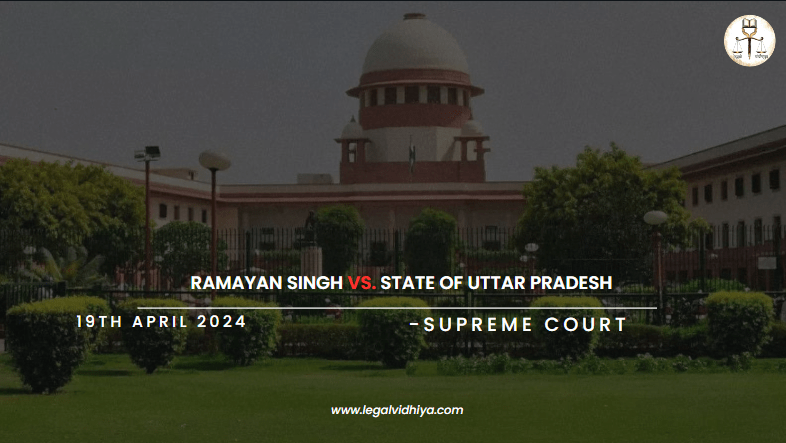
| CITATION | 2024 SCC ONLINE SC 355 |
| DATE OF JUDGMENT | 19th April 2024 |
| COURT | Supreme Court of India |
| APPELLANT | Ramayan Singh |
| RESPONDENT | State of Uttar Pradesh |
| BENCH | Justice Sanjay Karol, Justice Satish Chandra Sharma |
INTRODUCTION
The case of Ramayan Singh vs State of Uttar Pradesh is a significant legal matter that unfolded in the Indian judicial system. In this case, an appeal was filed in an attempt to overturn an Allahabad High Court of Justice ruling. On April 19, 2024, the Indian Supreme Court rendered a decision in this matter. A Supreme Court ruling followed a protracted legal struggle involving grave criminal accusations of murder, criminal conspiracy, riots, and other connected offenses. Ramayan Singh, the appellant and original complaint was involved in a case where serious criminal charges were brought against the accused individual. The incident occurred on January 2, 2022. The legal proceedings involved an application under section 439 of the code of criminal procedure, 1973 which was granted to one of the accused, leading to an appeal by the appellant against this decision.
FACTS OF THE CASE
- Ramayan Singh, the appellant filed a First Information Report (FIR) on January 3, 2022 alleging that on January 2, 2022, he along with his uncle Jitendra Singh (the deceased) and driver Rahul were returning from Bankati Bazaar, where their vehicle was stopped by accused persons, including Vivek Pal @ Vikki Pal (Respondent No.2) and Punit Pal.
- The accused verbally abused the deceased, shattered the vehicles windows with iron rods, dragged the deceased out and physically assaulted him with iron rods, hockey sticks and bats with an intention to kill him.
- After stealing the deceased gold chain and mobile phone, the accused fled the scene. The deceased succumbed to his serve injury on February 10, 2022 at Sahara Hospital in Lucknow. The inquest report recorded on February 10, 2022 noted injuries to the deceased head, hand and knee.
- The postmortem revealed four series ante-mortem head injuries as the cause of death.
- The FIR stated that the accused persons attacked Jitendra Singh, resulting in his death.
- Vivek Pal @Vikki Pal and Punit Pal were also prosecuted under the Uttar Pradesh Gangsters and Anti-Social Activities (Prevention) Act, 1986.
- Ramayan Singh appealed against bail granted to Vivek Pal @ Vikki Pal by the Allahabad High Court on April 24, 2023. A similar appeal was filed against the bail granted to co-accused Punit Pal by the High Court on October 31, 2023.
ISSUES RAISED
- The primary issue revolves around the bail orders granted to the accused individuals by the High Court of Judicature at Allahabad. Whether this decision of granting bail to the accused individuals was right?
- Another significant issue is the compromise that led to the acquittal of Ramayan Singh by the Trial Court. Whether the circumstances surrounding this compromise and its legal implications are crucial aspects of the case?
- The gravity of the crime, which involved a broad daylight murder leading to the death of Jitendra Singh, is a central issue. What was the impact of this crime on the whole society?
- The prosecution of the accused individuals under the Uttar Pradesh Gangsters and Anti-Social activities, raises the questions about the application of specific laws and their implications on the case.
CONTENTIONS OF APPELLANT
- The Appellant raised several contentions challenging the judgement of the High Court. The appellant, who was also the original complainant, filed an appeal seeking to overturn the decision to grant bail to the accused person, Vivek Pal and Punitpal, under section 439 of the Code of Criminal Procedure.
- The Appellant’s contentions revolve around the severity of the crime and the impact on society, arguing that the accused individuals were involved in a grave assault, resulting in the death of the deceased.
- The appellant highlighted the violent nature of the incident where the accused verbally abused, physically assaulted and ultimately killed the deceased with iron rods, hockey sticks and bats.
- The appellant emphasized the seriousness of the crime, the conduct of the accused and the societal repercussions of the offence, leading to the closure of the market due to the accused’s influence in the area. Consequently, the appellant contended that High Court erred in granting bail to the accused individuals, Vivek Pal and Punit Pal, considering the circumstances and the impact of the crime on society.
CONTENTIONS OF RESPONDENT
- The High Court should grant them bail under section 439 of the Code of Criminal Procedure, 1973 as the investigation was still ongoing and the charge sheet had not been filed yet.
- The alleged incident occurred due to sudden provocation and extreme assault by the deceased Jitendra Singh and the appellant Ramayan Singh.
- The charges against them are not grave enough to deny them bail as no weapon was seized from them. And the ballistic expert was not examined by the prosecution.
- The alleged offences under sections 302 (murder), 307 (attempt to murder), 323 (voluntarily causing hurt), 324 (voluntarily causing her by dangerous weapon), 341 (wrongful restraint), 342 (wrongful confinement), 379 (theft), 506 (criminal intimidation) of the Indian Penal Code and Section 25 of the Arms Act are bailable in nature.
- The High Court should consider the settled principle of granting bail such as the nature and the gravity of the accusation, the severity of the punishment if conviction takes place, the danger of the accused absconding or tampering with evidence, the character and behaviour of the accused and the larger interest of the public and the State.
- The High Court should exercise its discretion judiciously and grant him bail as he is a young man with no prior criminal record, and has deep roots in society.
- The High Court should also consider that the co-accused has already been granted bail by a coordinate bench of the High Court in a similar case.
JUDGEMENT
The case of Ramayan Singh vs State of Uttar Pradesh, decided by the Supreme Court of India on April 19, 2024. The appellant sought to contest the decision of the High Court, granting bail to Vivek Pal and Punit Pal in a case involving a serious crime, specifically a daylight murder. The appeal challenged by the Appellant, the bail granted to the accused based on the gravity of the crime, the conduct of the accused and the societal impact of the crime, emphasising the accused involvement in the significant offence that disrupted the community. The court emphasized that the grant of bail involves the exercise of discretionary power, which ought not to be used arbitrarily, capriciously and injudiciously. The Supreme Court, in its judgement expressed disapproval of the High Court’s decision to grant bail to the accused, considering the seriousness of the crime, the behaviour of the accused individuals, and the broader implications of the offense on society. The court highlighted the accused involvement in a murder that led to the closure of a market for an extended period due to their influence in the area, leading to the overturning of the bail orders for Vivek Pal and Punit Pal. The Supreme Court relied on its previous judgement laying down the principles for granting bail, the seriousness of the offence, the accused’s criminal background and the high court’s failure to properly exercise its direction to overturn the bail orders. The court prioritized the interest of justice and societal impact over the accused temporary release. After judgement of the Supreme Court, the accused were remanded into custody., and the Trial court was instructed to swiftly conclude the trial within the year to uphold justice and maintain public order.
ANALYSIS
The case clarifies the principles for granting bail under section 439 of the Code of Criminal Procedure,1973. It emphasised the importance of considering the facts and circumstances of each case, including the severity of the offence, the evidence against the accused and the likelihood of the accused, tampering with evidence of fleeing. The judgement highlights the approach to be taken when dealing with co-accused in a single case, especially when the facts and questions involved are similar. It demonstrates how the court can hear such appeals together and dispose of them through a common judgement, ensuring consistency and efficiency in the judicial process. The case involves the prosecution of the accused under the Uttar Pradesh Gangsters and Anti-Social Activities (Prevention) Act, 1986, in addition to the CrPC. This aspect of the judgement served as a reminder to consider the applicability of special laws in criminal cases which can have significant implications for the accused and the prosecution. The judgement underscores the importance of the State’s role in supporting the appellant’s stand and the High Court’s duty to carefully consider the facts and evidence before granting bail. It emphasizes the need for the balanced approach, ensuring that the rights of the accused are protected while also considering the interests of justice and public safety.
CONCLUSION
This case involves a serious incident, where the accused were involved in a brutal assault on Jitendra Singh, resulting in his death. The evidence presented includes the First Information Report (FIR) filed by Ramayan Singh, eyewitness accounts, medical reports detailing the injuries sustained by the deceased and the accused criminal background. The accused was reported to have verbally abused the deceased, physically assaulted him with iron rods, hockey sticks and bats, and stole his belongings before fleeing the scene. The deceased succumbed to his injuries on February 10, 2022 leading to a criminal case against the accused individuals.
Before giving the judgement of this case, the Supreme Court cited the different case where it had enunciated certain parameters to evaluate the correctness of an order granting bail, which includes the nature of accusation, the severity of the punishment if conviction ensues, the prima facie case of the prosecution, the position and the status of the accused. The court prioritized the interest of justice and societal impact over the accused temporary release.
REFERENCES
This article is written by Priya Patel student of S.S Khanna Girls’ Degree College, Prayagraj. Intern at Legal Vidhiya.
Disclaimer: The materials provided herein are intended solely for informational purposes. Accessing or using the site or the materials does not establish an attorney-client relationship. The information presented on this site is not to be construed as legal or professional advice, and it should not be relied upon for such purposes or used as a substitute for advice from a licensed attorney in your state. Additionally, the viewpoint presented by the author is of a personal nature.

0 Comments