
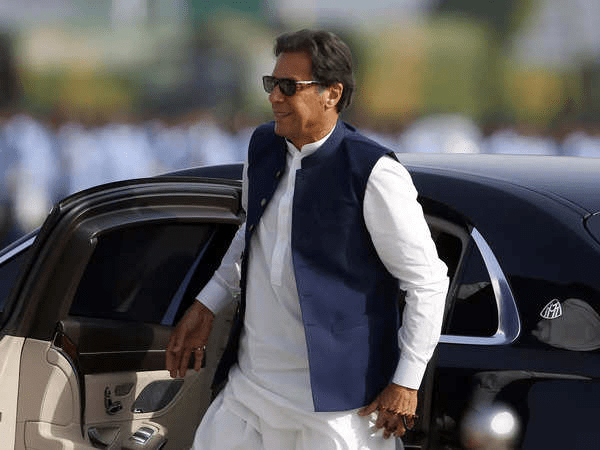
In a major blow to the hopes of Imran Khan’s party, the Islamabad High Court delivered its long-awaited verdict on Tuesday night, upholding the arrest of the former prime minister. The court ruled that the National Accountability Bureau (NAB) had fulfilled all legal requirements during the arrest, dashing the expectations of the Pakistan Tehreek-e-Insaf (PTI). The PTI had confidently asserted that the arrest was unlawful and that the Islamabad High Court would rule in favor of their party leader, Imran Khan. However, the court’s reserved judgment proved otherwise, solidifying the legality of Khan’s arrest.
The Islamabad High Court called upon high-ranking officials and police officers on Tuesday, in response to the dramatic arrest of former Prime Minister Imran Khan by paramilitary Rangers on corruption charges. The arrest took place right within the premises of the court, creating an intense atmosphere. However, the court opted to reserve its ruling, keeping the decision regarding the case pending for now. The summoning of top officials signals the court’s intent to thoroughly investigate and delve into the circumstances surrounding Khan’s arrest. The Islamabad High Court has yet to announce its final verdict in this matter.
Chief Justice Aamer Farooq of the Islamabad High Court (IHC) promptly addressed the arrest conducted by paramilitary Rangers while the Pakistan Tehreek-e-Insaf (PTI) party chief, Imran Khan, was present at the court premises to fulfill his biometric attendance requirement ahead of a corruption case hearing. The Chief Justice took immediate notice of the incident, acknowledging the gravity of the situation. This unexpected turn of events adds a new layer of complexity to the proceedings and highlights the heightened scrutiny surrounding Khan’s legal affairs.
Imran Khan, 70, Arrested in Islamabad After Rangers Breach Court Window Amidst Altercation
Imran Khan, the former cricketer-turned-politician, traveled from Lahore to the federal capital, Islamabad, only to face a dramatic arrest orchestrated by the Rangers. Breaking open a glass window, the paramilitary forces apprehended Khan, resorting to physical altercations with lawyers and the security personnel accompanying him.
This arrest follows just one day after the influential army accused Khan of making unfounded accusations against a senior officer of the intelligence agency, ISI. The timing of these events adds further intensity to the unfolding situation.
The Islamabad High Court (IHC) responded by summoning several officials, delving into the details and legality surrounding the arrest of an individual present within the court premises. After considering the arguments presented, the Chief Justice reserved judgment, leaving the final decision pending. The IHC’s reserved ruling carries significant weight as it seeks to navigate the complex circumstances surrounding Imran Khan’s arrest.
In response to Imran Khan’s arrest, the Chief Justice wasted no time, issuing orders to the interior secretary, Inspector General (IG) of Police Islamabad, and other officials, demanding their prompt appearance to address the situation. Expressing his “restraint” in handling the matter, Justice Farooq cautioned that he would summon the prime minister if the Islamabad police chief failed to comply.
Emphasis was placed by Justice Farooq on the need for officials to come to court and provide an explanation regarding the grounds for Imran’s arrest and the specific case involved.
IG Akbar Nasir Khan duly appeared before the court, stating that Khan had been arrested by the National Accountability Bureau (NAB) in connection with a corruption case involving him and his wife, Bushra Bibi.
Khan’s lawyer, Faisal Chaudhry, argued that the PTI chief had been unlawfully detained while present in the court premises to record his biometric attendance.
Barrister Gohar Khan, another member of Khan’s legal team, alleged that the cricketer-turned-politician was struck on the head with an iron rod and sustained injuries to his leg during the arrest.
Khawaja Harris, Khan’s additional lawyer, urged the court to take action against the NAB, citing the violation of the court’s sanctity due to Khan’s arrest within its premises.
After hearing the arguments from the lawyers, the Chief Justice summoned NAB officials and adjourned the session. When the court reconvened, the appearance of Director General NAB Rawalpindi, Mirza Irfan Baig, alongside Deputy Prosecutor General NAB, Sardar Muzaffar Abbasi, was observed. Abbasi defended the actions of the NAB, asserting that the anti-corruption watchdog had the legal right to arrest Khan, who had failed to cooperate in the investigation related to the case. The argument was made that an accused can be arrested from any location if resistance is encountered. Advocate Harris challenged the NAB’s stance, arguing that the arrest was carried out in violation of established rules, and therefore, the court should take appropriate action.
“The court must declare the arrest null and void due to its illegality, and order the immediate release of Imran Khan,” he insisted.
Following Khan’s dramatic arrest, supporters of the former prime minister stormed the Pakistan Army headquarters in Rawalpindi and the residence of the Corps Commander in Lahore.
Imran Khan has been confronted with numerous cases since his removal via a no-trust vote in April of the previous year. He has consistently dismissed these cases as political victimization by the ruling alliance.
Presently, Khan contends that he is facing more than 140 cases ranging from terrorism and blasphemy to murder, violence, and incitement of violence.
Written by – Sohini Chakraborty intern under Legal Vidhiya



0 Comments