
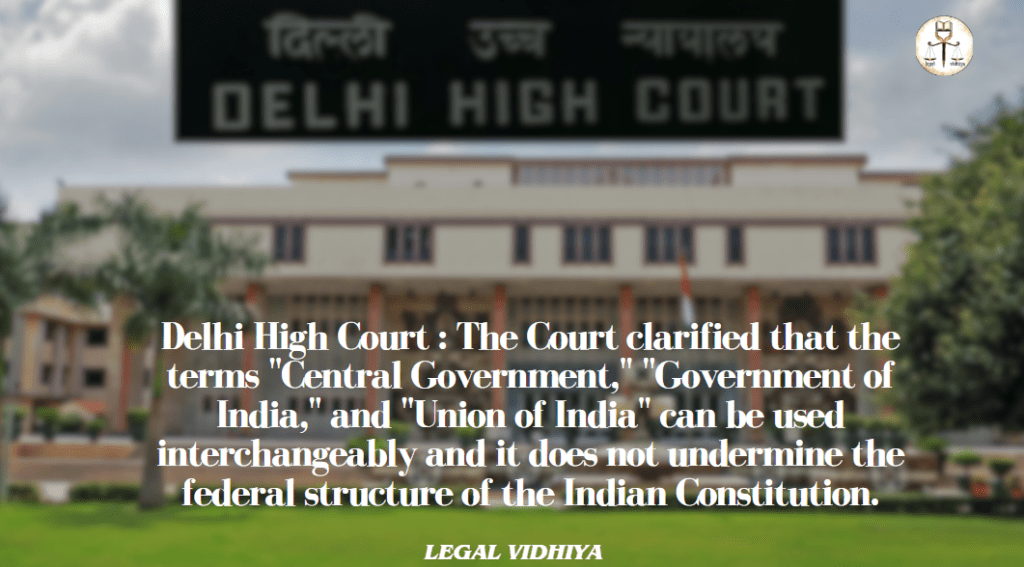
The Delhi High Court ruled that the use of the term “Central Government” instead of “Union Government” does not undermine the federal structure of the Indian Constitution. State governments are not subordinate to the Union government.
• The Court dismissed a PIL seeking to replace ‘Central Government’ with ‘Union Government’ in all laws and official communications.
• The petitioner argued that India being a ‘Union of States’ should not have a concept of a ‘Central Government’ as it existed under British rule. • The plea sought to strike down the definition of Central government in the General Clauses Act as unconstitutional.
• The Constitution of India uses the terms ‘The Union and its Territory’ and ‘Union of States’ but does not mention ‘Centre’ or ‘Central Government’ in any of its articles or schedules.
The High Court observed that the Constitution uses different expressions like “Union”, “Union of India”, “Government of India”, and “Central Government” to refer to the government of the country. The Court highlighted that Article 300 of the Constitution explicitly states that the “Government of India” can sue or be sued by the name of “Union of India”. The Court concluded that the term “Union of India” in Article 300 refers to the “Government of India”. The detailed order emphasized the importance of understanding the various expressions used in the Constitution to indicate the government of the country.
The Court’s interpretation clarifies that the “Government of India” is synonymous with the term “Union of India” as used in the Constitution
• The Court clarified that the terms “Central Government,” “Government of India,” and “Union of India” can be used interchangeably.
• The Court referred to the General Clauses Act, 1897, which defines “Central Government” to include “Government of India” and “Union of India.”
Perusal of the aforesaid makes the intent of the legislature very clear in that the expression “Central Government” includes the “Government of India”, which
expression includes “Union of India”. It may also be noted that the expression “Central Government”, “Union of India” as well as “Government of India” have been used vastly in various statutes and connote the Government of the country in interchangeable expressions. Thus, when the Constitution as well as other Statutes have applied various expressions to connote the Government of the country, this Court will not enter into the arena of legislation, which is not within the domain of this Court.
A division bench of Acting Chief Justice Manmohan and Justice Mini Pushkarna rejected the contention no merit is found in the present petition. The same is accordingly dismissed.
CASE NAME : Atmaram Saraogi v. Union Of India
NAME : Kavya Jaggi COURSE : B.B.A.LL.B 5th Semester , COLLEGE : Jai Narain Vyas University , Jodhpur , Rajasthan
Disclaimer: The materials provided herein are intended solely for informational purposes. Accessing or using the site or the materials does not establish an attorney-client relationship. The information presented on this site is not to be construed as legal or professional advice, and it should not be relied upon for such purposes or used as a substitute for advice from a licensed attorney in your state. Additionally, the viewpoint presented by the author is of a personal nature.



0 Comments