
The present case reveals that the convict i.e. the petitioner herein has been convicted and has been incarcerated for last about 14 years. He is about 41 years of age, whereas his wife is 38 years of age. During the course of arguments, learned counsel for the petitioner had pointed out that the accused and his wife need to undergo certain medical examinations and diagnostic tests conducted by a specialized hospital and may also require IVF treatment.
• Right to Procreate Covered Within the Ambit of Article 21 of Indian Constitution
While, Judiciary in Bharat, has always stubbornly refused to hold that prisoners have no fundamental rights, this Court following the same tradition as handed over by judges of the Hon’ble Apex Court and this Court respectfully takes the intent to interpret the constitutional rights in favour of upholding and including new situations and challenges holds that right to parenthood and procreation is fundamental right of a convict in peculiar circumstances of a case. Needless to say, the same have to be adjudged on the basis of facts and circumstances of each case. Furthermore, the judicial decisions have to be a fine and delicate combination of upholding the fundamental right of the convict in a given circumstance without loosing sight of realities of life and legitimate human desires and thus, in the process upholding the view that prisoners are humans too.
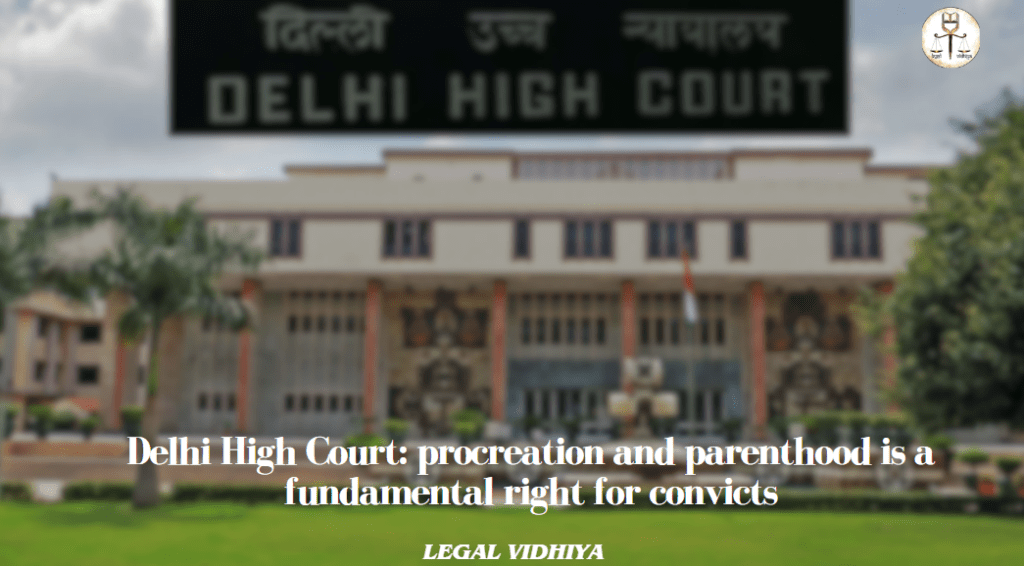
The Delhi High Court has ruled that the right to procreation and parenthood is a fundamental right for convicts, protected under Article 21 of the Constitution. However, this right is not absolute and depends on factors such as parental status and age. The court emphasized the need for a fair and just approach to balance individual rights and societal considerations.
The court acknowledged that being convicted and imprisoned restricts married life, but must consider the impact of denying parole on the convict’s future, as punishment aims to reform. Kundan Singh, serving a life sentence for murder, sought permission to have a child with his wife after 14 years in jail. Singh and his partner were denied parole to undergo medical tests and pursue IVF. However, Justice Sharma stated that the lack of specific grounds in the prison rules does not prevent the Constitutional court from granting relief based on interpretation and context. The Court ruled that it can interpret and adjudicate a prayer even if it is not specifically mentioned in the rules, based on the intent and content of the rules. Singh was granted parole for four weeks.
CASE NAME : Kundan Singh v. State Govt of NCT Delhi
Kavya Jaggi ,B.B.A.LL.B 5th Semester, Jai Narain, Vyas University , Jodhpur, intern under legal vidhiya.
Disclaimer: The materials provided herein are intended solely for informational purposes. Accessing or using the site or the materials does not establish an attorney-client relationship. The information presented on this site is not to be construed as legal or professional advice, and it should not be relied upon for such purposes or used as a substitute for advice from a licensed attorney in your state. Additionally, the viewpoint presented by the author is of a personal nature.



0 Comments