
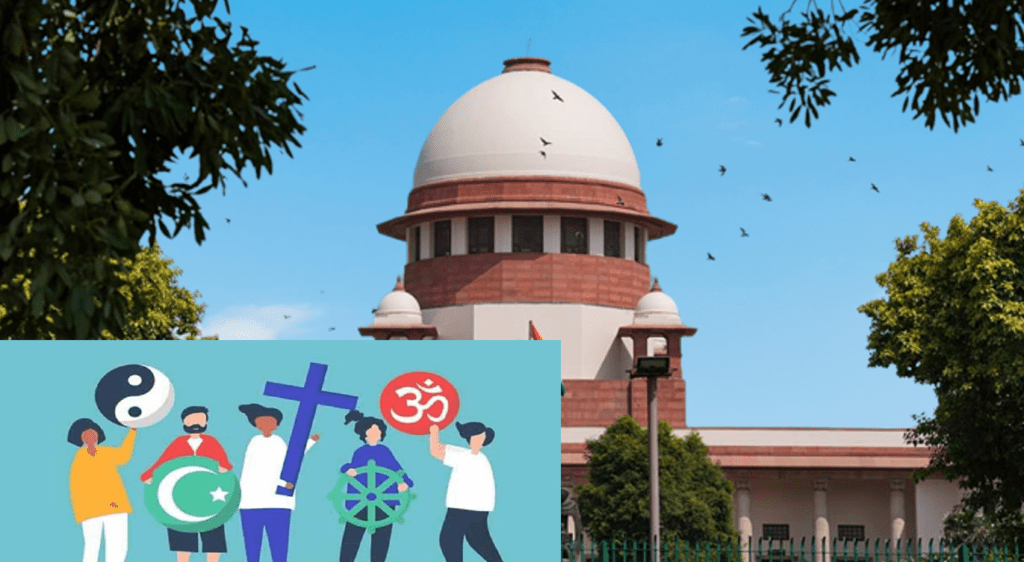
On Wednesday, the Supreme Court heard several petitions seeking that Dalits who have converted to Islam and Christianity be granted the same reservation advantages as the Schedule Cast community.
The Supreme Court decided to arbitrate on the matter on Wednesday, dismissing the centre’s request that it wait for the findings from the 3-member Commission before deciding on whether to grant Dalit Christians and Muslims reservation by incorporating them in the Scheduled Cast category. It stated that the case has been ongoing in the court for almost a decade.
Additional solicitor general K.M Nataraj, who was representing the Centre, submitted that the Ranganath Mishra Commission report of 2007, which held for inclusion of Dalits Christian and Muslim converts, had not gone into all aspects and is flawed. It did not conduct a field study or do a comparative analysis thus centre does not accept it.
The centre has argued that the court should wait for the new report by the commission headed by former Chief Justice of India K.G Balakrishnan as the centre has appointed him to examine the claims carefully this time.
While observing the fact that the Ranganath Mishra Commission has not gone into all aspects, Justice Amanullah told the centre” That the report is not that perfunctory. You should go through the report again, you are making a generalised statement on the report.”
Representing one of the petitioners Advocate Bhushan,said that the exclusion of the Muslim and Christian communities in the presidential order is discriminatory and should be void. Justice Kaul sumarising the petitioner’s statement said “What they are saying is that the person is carrying a tag even when they move to lslam or Christianity.”
Justice Amanullah observed why there is a need for protection under reservation when there is a provision of no untouchability in the Indian constitution.
Justice Amanullah observed: “That means social stigmas carried across, and religious stigma and social stigma are different things. I may convert religion for different purposes but social stigma continues that is why reservations came in for Scheduled Caste. Then why can’t the court determine whether under the Constitution such compartmentalise is permissible or not?
At the bottom level social stigma continue even after conversion……. we cannot close our eyes when we are considering all these matters.
The main question, in this case, is whether a person who historically belonged to a scheduled cast status but now has converted to a religion which is not under Schedule Caste religion mentioned under the presidential orders under Article 341 of the Indian Constitution. At present, as per the Constitution Order 1950, only those who are Hindu, Sikh and Buddhist can be granted scheduled caste status.
This case has been pending in the Court for almost 10 years and now on Wednesday, the petitioners argued that there is sufficient material in the court to consider the constitutional issues raised in the petition. The government asserted that the Balakrishna Commission’s report should be awaited. The other respondents raised several issues, amongst which one was the issue whether the caste system can be introduced into Islam and Christianity.
During the hearing, other issues which were flagged were
What is the effect of the commission inquiry which is rejected or not accepted by the government?
Whether the empirical data stated to have formed the basis of the report can be investigated for purposes of determination of the constitutional issue?
This matter has been posted for the next hearing on 11th JULY 2023.
While arguing from the petitioner side advocate Prashant Bhushan has emphasised that issue before the court, in this case, is a constitutional one.
“It was found that ones who converted to Christianity were not found to be suffering from the same harassment as the scheduIe caste Hindus, which was the basis for the presidentiaI order.” The Council representing the scheduled caste Hindus said.
Regarding the relevance of the Ranganath Mishra Commission report, Justice Kaul believed that there is no difficulty in considering the constitutional issue but the Court cannot rely on the inquiry which has been rejected by the Union government.
Can we take note of the empiricaI data from a report that has not been accepted by the centre? Centres say that they do not accept the report, so they are not even accepting the authenticity of the empirical date.
.Written by Vaishnavi Goel (BA.LLB), 6TH Semester, Punjab School of Law, Punjabi University, Patiala


0 Comments