
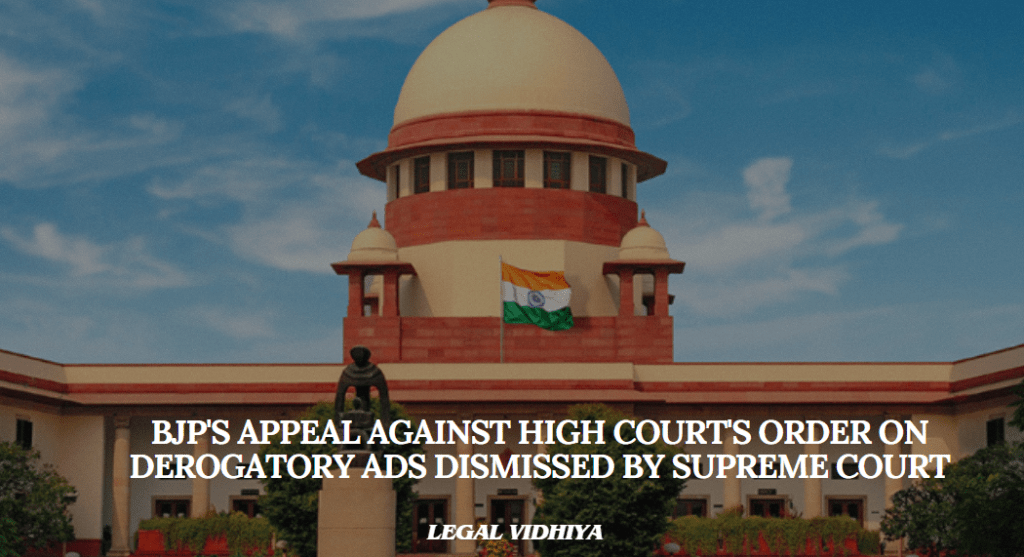
The Bharatiya Janata Party (BJP) has approached the Supreme Court in response to the Calcutta High Court’s recent ruling that restrained the party from printing certain derogatory advertisements against the Trinamool Congress (TMC) during the Lok Sabha Elections, 2024. The BJP’s Special Leave Petition was brought before a vacation bench comprising Justices Bela Trivedi and Pankaj Mithal for urgent consideration. However, the bench declined to entertain the matter on an urgent basis, suggesting the BJP approach the next vacation bench for a hearing.
Last week, a single bench of the Calcutta High Court, presided over by Justice Sabyasachi Bhattacharyya, deemed the advertisements in question as violative of the Model Code of Conduct (MCC) and guidelines set by the Press Council of India. The High Court also criticized the Election Commission of India (ECI) for its lack of action on the matter until a writ petition was filed. The court’s order restrained the publication of the impugned advertisements until the conclusion of the elections on June 4th or until further orders are issued.
The High Court’s ruling was further affirmed by a division bench comprising Chief Justice TS Sivagnanam and Justice Hiranmay Bhattacharya, who expressed concerns over the manner in which the contentious advertisements were disseminated.
The BJP’s attempt to seek relief from the Supreme Court against the High Court’s order met with a setback as the bench declined an urgent hearing. The matter is expected to be taken up in due course, as the electoral landscape in West Bengal continues to be closely watched by political observers.
Written by- pradyumn sharma.
Disclaimer: The materials provided herein are intended solely for informational purposes. Accessing or using the site or the materials does not establish an attorney-client relationship. The information presented on this site is not to be construed as legal or professional advice, and it should not be relied upon for such purposes or used as a substitute for advice from a licensed attorney in your state. Additionally, the viewpoint presented by the author is of a personal nature





0 Comments