
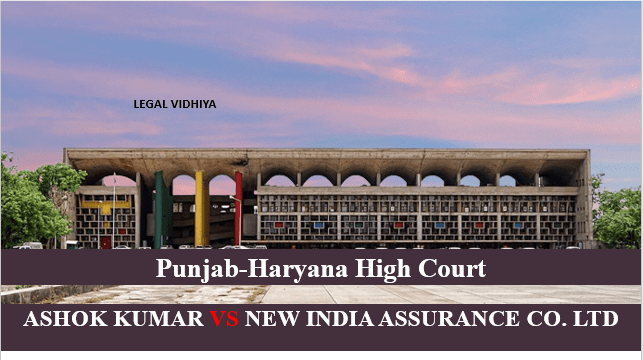
| Citation | FAO No. 588 of 2015 (O/M) |
| Date of Judgment | 30th March 2015 |
| Court | Punjab-Haryana High Court |
| Appellant | Ashok Kumar |
| Respondent | The New India Assurance Company Ltd. And others |
| Bench | HON’BLE MR. JUSTICE KULDIP SINGH |
| Referred | Award issued by motor accident claims Tribunal |
FACTS OF THE CASE
The case at hand revolves around an appeal filed by Ashok Kumar, the owner of a truck bearing Registration No. HR-37-A-0940, against an award issued by the Motor Accident Claims Tribunal located in Ambala. The award, dated 16th September 2014, granted a sum of Rs. 14,74,000/- but simultaneously conferred recovery rights to the insurance company. The underlying reason for this seemingly intricate arrangement lay in the suspicion surrounding the authenticity of the license held by the driver of the truck, who is referred to as respondent No. 2 in the legal proceedings. The crux of the issue pertains to the genuineness of this license.
To delve into the background, it’s crucial to note that the Tribunal took a proactive step in seeking verification of the driver’s license. A letter (Ex.R7) was sent directly to the District Transport Officer (DTO) in Thoubal, Manipur, requesting confirmation of the license’s validity. This meticulous approach stemmed from concerns regarding the legitimacy of the license, which, if found fake, could have considerable legal implications.
The authority’s report, along with supporting documents, confirmed that the license was not issued by them. The respondents failed to challenge this evidence.
ISSUE
The key issues in this appeal revolve around the validity of the license of the truck driver.
ARGUMENTS
The appellant’s legal representative has advanced arguments that warrant consideration. One of the key contentions relates to the quantum of the awarded amount. It is claimed that the awarded sum is excessive and, as a reasonable adjustment, 1/4th of this amount was deducted as personal expenses. This deduction was undertaken within the legal framework, taking into account the identification of five dependents associated with the case.
The contentious issue of “loss of love and affection” also arises, with the appellant’s counsel defending the Tribunal’s decision to grant compensation to the mother, father, and sister of the affected party. To support this stance, reference is made to legal precedent. The case of Sait Tarajee Khimchand and others Versus Yelamarti Satyam and others, as found in AIR 1971 Supreme Court 1865, and decisions by this Court in National Insurance Co. Ltd. Versus Santosh and others (1999 ACJ 1262) and United India Insurance Company Ltd. Versus Shanti Devi (2008 (2) Law Herald (P and H) 1464) are invoked to bolster the argument that the documents were properly presented as exhibits, even without the examination of witnesses.
JUDGMENT
After a thorough examination of the presented evidence, precedents, and contentions, the court renders its judgment. It underscores that the Tribunal’s direct request for verification of the license bears significant weight in the case. The report subsequently obtained from the DTO in Thoubal, Manipur, provides compelling evidence indicating that the license held by respondent No. 2 is indeed fake. This finding, coupled with the lack of counter-evidence from the appellant and the driver, effectively solidifies the conclusion that the license was counterfeit.
In view of this substantial evidence, the court dismisses the appeal on the grounds of its lack of merit. The court underscores that while the owner and the driver had the opportunity to counter the evidence brought forth, their decision not to present any counter-evidence, despite being possible, works against their case. Consequently, the court maintains the award granted by the Tribunal, upholding the recovery rights bestowed upon the insurance company.
In a broader context, this judgment underscores the significance of due process, the role of evidence, and the criticality of exercising one’s right to present counter-evidence in legal proceedings. It also highlights the implications of non-compliance in legal matters and the subsequent ramifications of failing to challenge substantial evidence that could sway the outcome of a case.
CONCLUSION
The court ruled that since the Tribunal directly requested verification of the license, the ensuing report itself held sufficient weight to declare the license as fake. The owner and the driver could have countered this evidence by providing their own evidence, but they chose not to. Consequently, the appeal was dismissed as lacking merit.
REFERENCES
https://indiankanoon.org/doc/198581427/
This article is Written by B S BADRINATH, of university law college, Intern at Legal Vidhiya.



0 Comments