
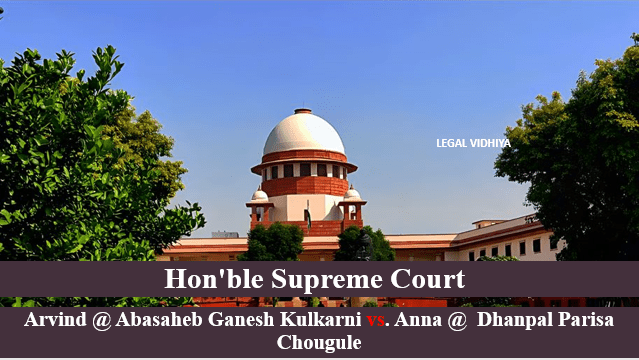
| Citation | 1980 AIR 645, 1980 SCR (2) 816 |
| Date of Judgment | 22 January, 1980 |
| Court | Supreme Court of India |
| Case Type | Civil Appeal Nos. 216-217 of 1970 |
| Appellant | ARVIND @ ABASAHEB GANESH KULKARNI & ORS. |
| Respondent | ANNA @ DHANPAL PARISA CHOUGULE & ORS. |
| Bench | O. CHINNAPPA REDDY, J. UNTWALIA, N.L. |
| Referred | Article 136 of the Constitution |
FACTS OF THE CASE
In this case Parisa Chougule executed two mortgage to favour of Ganesh Kulkarni for a sum of Rs. 1600/- and Rs. 1000/- to respected 10 item of his land and Both mortgages were possessory mortgages but the land was leased back to the mortgagor for a stipulated rent. After the death of Parisa the Bhupal, the Major son of Parisa executed a simple mortgage on the same land and borrowed 131/- Rupees.
Bhupal was purporting to act as the Manager of the joint family and the guardian of his minor brother executed a deed of sale in favour of Ganesh Kulkarni in respect of four out of the ten items of land mortgaged therefore the six of the items which were mortgaged were released from the burden of the mortgages. But After become Major of age by Anna and Dhanpal filed the suit against sale deed in out of which this appeal arises for a declaration that the sale deed was not for legal necessity and not for the benefit of the estate and therefore, not binding on them. They also prayed that joint possession of their two third share may be given to them.
ISSUE IN THE CASE
-There was no such compelling pressure on the estate as to justify the sale and therefore, enquiry regarding not need or possibility.
– Whether the sale deed was executed for legal necessity?
ARGUMENTS
In this case on April 15, 1930 Parisa Chougule executed a deed of mortgage in favour of Ganesh Dattatraya Kulkarni for a sum of Rs. 1600 in respect of single item of land and On August 25, 1933, again Parisa Chougule execute another deed of mortgage in favour of the same mortgagee for a sum of Rs. 1,000 in respect of ten items of land including the land previously mortgaged. Both the mortgages were possessory mortgages but the land was leased back to the mortgagor for a stipulated rent. Parisa Chougule died on June 15, 1934 leaving behind him three sons, Bhupal an adult and Anna and Dhanpal, minors.
Bhupal borrowed a further sum of Rs. 131 and executed a simple mortgage in respect of the very ten items. Bhupal purporting to act as the Manager of the joint family and the guardian of his minor brother executed a deed of sale in favour of Ganesh Dattatraya Kulkarni in respect of four out of the ten items of land mortgaged. The consideration for the sale was Rs. 3050 and was made up of the amounts of Rs. 1600 Rs. 1000 and Rs. 131/- due under three mortgages and a sum of Rs. 200 received in cash by Bhupal on the date of sale. Six of the items which were mortgaged were released from the burden of the mortgages. The family was also relieved from the burden of paying rent to the mortgagee under the lease back. Surely all this was for the benefit of the family.
Anna and Dhanpal filed the suit out of which this appeal arises for a declaration that the sale deed dated May 1, 1935 was not for legal necessity and not for the benefit of the estate and therefore, not binding on them. They also prayed that joint possession of their two third share may be given to them.
The Trial Court found that there was no such compelling pressure on the estate as to justify the sale and therefore, the sale was not for the benefit of the family and hence not binding on the two plaintiffs. A decree was granted in favour of the two plaintiffs for joint possession of two third shares of the lands subject to their paying a sum of Rs. 1733/5 and 4 ps. to the second defendant. The Assistant Judge
found that there was no evidence to show that the defendant made any bonafide enquiry to satisfy him-self that there was sufficient pressure on the family justifying the sale.
He however, held that the suit of the first plaintiff was liable to be dismissed as it was barred by limitation the first plaintiff as well as the second defendant preferred second appeals to the High Court. The High Court allowed the appeal filed by the first plaintiff and dismissed the appeal filed by the second defendant. The legal representatives of the second defendant have preferred these appeals after obtaining special leave from this Court under Article 136 of the Constitution.
The value of the land sold under the deed of sale was found by the Courts below to be Rs. 4000. Even if that be so it cannot possibly be said that the price of Rs. 3000 was grossly inadequate. It has further to be remembered that there were continuous dealings between the family of the plaintiffs and the family of the second defendant, over a long course of years. In those circumstances it is impossible to agree with the conclusion of the courts below that the sale was not binding on the plaintiffs.
JUDGEMENT
The Trial Court found that there was no such compelling pressure on the estate as to justify the sale and therefore, the sale was not for the benefit of the family and hence not binding on the two plaintiffs.
On appeal by the second defendant the Assistant Judge, Kolhapur found that there was no evidence to show that the defendant made any bonafide enquiry to satisfy him that there was sufficient pressure on the family justifying the sale.
We do not see how any question of enquiry regarding pressure on the estate would arise at all. Where ancestral property is sold for the purpose of discharging debts incurred by the father and the bulk of the proceeds of the sale are so accounted, the fact that a small part of the consideration is not accounted for will not invalidate the sale.
The courts below appeared to think that notwithstanding the circumstance that there was legal necessity to a large extent it was incumbent on the second defendant to establish that he made enquiry to satisfy himself that there was sufficient pressure on the estate which justified the sale.
REFERENCES
1 https://indiankanoon.org/doc/1886529/
2 https://lawplanet.in
3 https://dullbonline.wordpress.com/2017/08/07/arvind-v-anna-1980-2-scc-387-air-1980-sc-645/
This Article is written by Sachin Chopade from Dr. Babasaheb Ambedkar Marathwada University of Aurangabad, Maharashtra. Intern at Legal Vidhiya.





0 Comments