
Looking at the background:
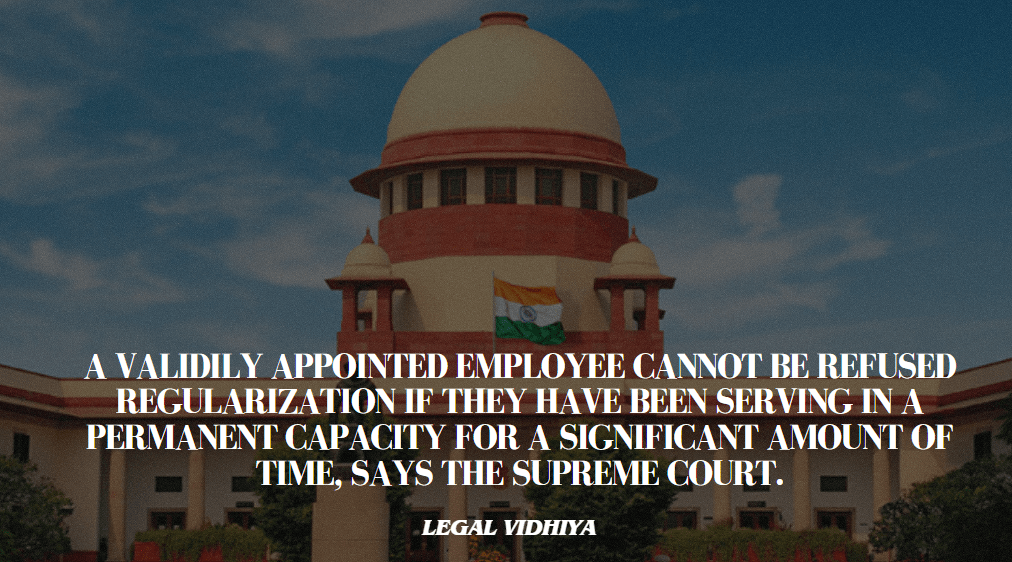
These appeals stem from the ruling rendered by the Allahabad High Court of Judicature in which the appellants’ writ petitions against the ruling of the Central Administrative Tribunal, Allahabad Bench, were dismissed. The appellants’ request for regularization and absorption into the positions of “Accounts Clerk,” against which they were temporarily appointed, was rejected by the Tribunal in its ruling. The appellants were hired for what was described as a temporary or scheme-based engagement, yet they have been in these roles continuously for more than 25 years, starting in 1992 and continuing to this day.
The appellants were first appointed to ex-cadre posts of Accounts Clerks following a selection procedure that included written exams and viva voce interviews, in accordance with a notification that dates back to 1991.
The appellants filed original applications with the Central Administrative Tribunal following the Divisional Railway Manager’s denial of their request for regularization. The Tribunal denied the appellants’ claims, ruling that since their appointments were only temporary and for a particular program, they were not eligible for regularization or absorption into permanent positions.
Subsequently, the appellants turned to the High Court, which upheld the Tribunal’s decision and denied their Writ Petitions. The High Court noted that the appellants’ employment under a temporary scheme could not grant them rights comparable to those of permanent employees and cited this Court’s decision in Secretary, State of Karnataka v. Uma devi, which established that temporary or casual employees lack a fundamental right to be absorbed into service.
The appellants have come before this Court, contending that the High Court erred in its decision by neglecting to acknowledge the substantive character of their responsibilities, which are more in line with regular employment than the contract or scheme-based positions for which they were first appointed. Moreover, their promotion by a Departmental Promotional Committee that was regularly constituted, the selection process they went through, and the fact that their service was continuous for more than 25 years supported their argument for regularization and demonstrated that the High Court had misapplied the rulings from the Uma Devi’s case to their circumstances.
Observations of the Apex Court:
After hearing the arguments from both parties, this Court is of the opinion that the fundamental nature of work and the rights associated with it cannot be only based on the original parameters of the job, even though the real work path has changed considerably over time.
The appellants’ ongoing employment in regular roles, carrying out tasks that are indistinguishable from those of permanent posts, and their selection via a procedure that is similar to regular recruitment represent a significant divergence from the transient and scheme-specific nature of their initial engagement.
Additionally, a Departmental Promotional Committee handled and oversaw the appellants’ promotion process. They continued service for more than 25 years in the absence of any evidence that their responsibilities were only temporary or of the length of their temporary engagement, calls for a review of their employment status.
Supreme Court’s Recognition of Umadevi’s case
The ruling in the Uma Devi’s case also made a distinction between “illegal” and “irregular” appointments, highlighting the significance. Even though some appointments were not made strictly in line with the prescribed Rules and Procedure, they cannot be deemed to have been made illegally if the regular appointment procedures, like conducting written examinations or interviews as in this case, were followed.
This Court finds substance in the appellants’ claims and maintains that their service circumstances, as they have changed over time, justify a reclassification from temporary to regular status in light of the previously listed grounds. The concepts of justice, fairness, and the purpose of employment legislation are violated by the refusal to acknowledge the substantive nature of their responsibilities and their continuous service comparable to that of permanent workers.
Consequently, the appeals are granted. The appellants have the right to be given consideration for regularization in their respective positions whenever the High Court’s decision is overturned. The respondents have three months from the day this decision was served to finish the regularization procedure.
CASE NAME: VINOD KUMAR BANDE & ORS.ETC versus UNION OF INDIA & ORS.
REFERENCES: www.livelaw.in
NAME: Riya Shukla; COURSE: LL.M.(ONE YEAR); COLLEGE: MUIT, Noida; INTERN UNDER LEGAL VIDHIYA
Disclaimer: The materials provided herein are intended solely for informational purposes. Accessing or using the site or the materials does not establish an attorney-client relationship. The information presented on this site is not to be construed as legal or professional advice, and it should not be relied upon for such purposes or used as a substitute for advice from a licensed attorney in your state. Additionally, the viewpoint presented by the author is of a personal nature




0 Comments