
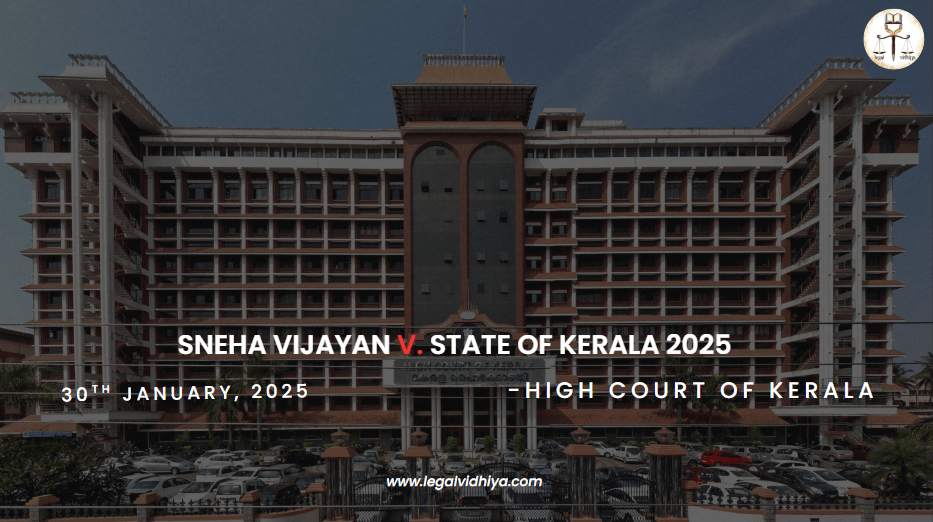
| CITATION | 2025: KER:7208 |
| DATE | 30 JANUARY 2025 |
| COURT NAME | KERALA HIGH COURT, ERNAKULAM |
| PLAINTIFF/APPELLANT/PETITIONER | SNEHA VIJAYAN |
| DEFENDANT/RESPONDENT. | STATE OF KERALA |
| JUDGES | JUSTICE P.B. SURESH KUMAR JUSTICE JOBIN SEBASTIAN |
FACTS OF THE CASE
1.Sneha Vijayan filed a petition before the Kerala High Court, challenging a preventive detention order issued against her under the Kerala Anti-Social Activities (Prevention) Act, 2007 (KAAPA).
2.She argued that the detention was unlawful and violated her constitutional rights, particularly due to serious procedural lapses during the process.
3.The main ground she raised was that the documents provided to her in support of the detention order were not readable.
4.These documents, including the First Information Statement (FIS), seizure mahazars, and witness statements, were crucial for her to understand the case against her.
5.Because the documents were illegible, she said she could not properly prepare or present a representation before the advisory board that reviews preventive detention cases.
6.She contended that this denied her the right to a fair opportunity to challenge the detention, as guaranteed under Article 22(5) of the Indian Constitution.
7.The State government responded by saying that all relevant materials had been properly served on the detenue.
8.The State also claimed that the documents were translated into Malayalam where needed and that Sneha had not suffered any real prejudice due to document quality.
9.It maintained that the detention process followed legal requirements and that her rights had not been violated.
10.The Court, however, focused on whether the documents served were not just delivered, but also understandable and readable.
11.The judges examined the actual papers and found that several of them were either unclear, faint, or completely unreadable.
12.The Court stressed that Article 22(5) is not satisfied merely by handing over papers—it requires that the person be meaningfully informed of the reasons for their detention and be given a fair chance to respond.
13.It held that the unreadable documents prevented Sneha from making an effective representation, and that alone was a serious constitutional violation.
14.The Court concluded that this was not a minor flaw but a fundamental procedural defect, which invalidated the legality of the detention order.
15.As a result, the Court declared the detention unlawful, noting that the denial of clear documents amounted to a denial of basic constitutional protections.
ISSUES OF THE CASE
1.Do illegible or poorly photocopied documents provided to the detainee constitute a violation of Article 22(5) of the Constitution?
2.Is it feasible to mount an effective defence against the detention order if the detained individual cannot read or comprehend the provided documents?
3.In the context of KAAPA, is it possible to uphold preventive detention when procedural safeguards like the right to legible documentation are not met?
JUDGEMENT
1. In this case, the Kerala High Court annulled the preventive detention order issued against Sneha Vijayan under the Kerala Anti-Social Activities (Prevention) Act, 2007 (KAAPA). The Court observed that her constitutional rights had been violated, particularly her right to be informed of the grounds of detention and to make an effective representation under Article 22(5) of the Indian Constitution. It stated that preventive detention is an extraordinary measure, and the procedural safeguards provided in the Constitution must be followed with strict discipline.
2. The central issue in this case was that many of the documents supplied to Sneha Vijayan—such as the First Information Statement (FIS), seizure mahazars, and witness testimonies—were either illegible or indistinct. These documents formed the core basis for the detention, and because they were unreadable, Sneha was unable to understand or respond meaningfully to the allegations made against her. The Court said that providing such poor-quality documents denied her the chance to exercise her fundamental right to defend herself.
3. The Court stressed that Article 22(5) requires that the detaining authority not only give the reasons for detention but must also ensure those reasons are communicated in a manner the detenu can actually comprehend. If the documents are so unclear that the person cannot understand them, it nullifies the entire purpose of this constitutional safeguard. The Court made it clear that the communication must be real and meaningful, not just a formality.
4. Under Section 7(2) of KAAPA, the State has a specific legal duty to provide the detenu with copies of relevant materials in a readable and understandable format. The Court found that this obligation was not met. It emphasised that such duties are not merely symbolic or procedural—they have a serious purpose. When the liberty of an individual is at stake, the smallest technical lapse can have deep consequences.
5. The Court relied on key precedents, including the cases of Abdul Sathar Ibrahim Manik and T.A. Abdul Rahman, which had clearly established that illegible documents and poor communication of detention grounds render the entire detention illegal. These earlier decisions highlighted that in preventive detention matters, fairness in procedure cannot be compromised, and any deviation from it must result in the invalidation of the detention order.
6. A significant argument made by the State was that Sneha Vijayan had signed a receipt acknowledging that she had received the documents. The Court dismissed this argument and clarified that receiving documents is not the same as understanding them. It cannot be assumed that by merely signing a paper, the detenu has waived her right to a fair process. Constitutional protections cannot be given up through such procedural acknowledgments alone.
7. The judgment made it clear that the fairness of the procedure is the only real safeguard in preventive detention cases, especially because there is no regular trial, no presentation of evidence in court, and no cross-examination. If the procedure itself is compromised, then the legitimacy of the entire detention order falls apart. That is what happened in this case.
8. The Court also examined the Malayalam translations of the documents provided to the detenu and found them equally unreadable. It ruled that translations must not only exist—they must serve the purpose of helping the detenu understand the case against them. Poor translations, like poor-quality documents, defeat the purpose of giving the person a fair chance to respond.
9. The State further argued that the issue of illegibility had been raised late in the legal process and that such delay should affect the outcome. The Court firmly rejected this claim. It ruled that constitutional violations are not erased by the mere passage of time. If a person’s fundamental rights have been breached, that breach must be addressed regardless of when it was pointed out.
10. The Court strongly reminded that preventive detention is not to be used casually. It is a serious and exceptional power that must be exercised only with careful adherence to the law. If a person’s liberty is being restricted without trial, then the process must be beyond question. Even minor errors become major when they affect basic freedoms.
11. The Court held that the State cannot excuse its failure by citing printing issues, translation delays, or administrative burden. The responsibility to ensure fair and complete communication of grounds for detention lies squarely with the State. The machinery of the State must function properly, especially when someone’s liberty is on the line.
12. The judges noted that both Article 21 (protection of life and personal liberty) and Article 22(5) had been violated. Sneha Vijayan was deprived of both access to material evidence and a meaningful opportunity to make a representation. This combination of procedural failures made her detention wholly unlawful.
13. Concluding the case, the High Court declared that the detention order was invalid and could not be sustained in law. It granted the writ petition and ordered Sneha Vijayan’s immediate release, unless she was detained under any other lawful provision. The judgment reinforced the principle that liberty cannot be compromised for administrative convenience and that constitutional protections must be upheld fully and fairly.
REASONING
1.The Kerala High Court thoroughly examined the documents served to Sneha Vijayan during her preventive detention and found that many of them were completely unreadable. These weren’t just background papers—they included critical documents like the First Information Statement (FIS), seizure mahazars, and key witness testimonies. These records were fundamental to the detaining authority’s reasoning, and their illegibility made it impossible for the detenu to understand the case against her.
2.The Court referred to key Supreme Court decisions such as Abdul Sathar Ibrahim Manik v. Union of India and T.A. Abdul Rahman v. State of Kerala to strengthen its reasoning. These judgments had clearly held that when essential documents are not legible, the detenu’s right to make an effective representation is seriously affected. The Court confirmed that such a failure directly violates Article 22(5) of the Constitution, which guarantees a person in preventive detention the right to be informed of the grounds for detention in a clear and comprehensible manner.
3.The State claimed that Sneha had acknowledged receiving the documents and therefore, the process was complete. However, the Court firmly rejected this line of argument. It stated that simply signing a receipt or acknowledging the delivery of documents does not mean that the person has understood what’s written in them. Rights under the Constitution cannot be taken away just because a formality was completed. What truly matters is whether the person had a real opportunity to comprehend and respond to the material provided.
4.The Court emphasized that the procedural safeguards found in both the Constitution and the KAAPA are not hollow formalities or technicalities. These protections exist to ensure that no one is detained without fair process and that personal liberty is not curtailed arbitrarily. Especially in cases where there is no trial or judicial examination of facts, these safeguards become the only defence a person has.
5.It was clarified by the Court that this was not a matter of small procedural errors. In the context of preventive detention, strict adherence to every procedural rule is absolutely essential. If these are not followed precisely, the detention cannot stand. The flaws in Sneha Vijayan’s case were significant enough to strike down the entire detention order.
REFERENCES
- Sneha Vijayan v. State of Kerala, 2025: KER:7208
- W.P. (Crl.) No. 1392 of 2024, Kerala High Court, decided on 30 January 2025
- Abdul Sathar Ibrahim Manik v. Union of India, 1992 SCC (Cri) 301
- T.A. Abdul Rahman v. State of Kerala, AIR 1990 SC 225
- https://www.casemine.com/judgement/in/679b78981f45f948644ff4a6
Written by Harsimran Kaur an Intern under Legal Vidhiya.
Disclaimer: The materials provided herein are intended solely for informational purposes. Accessing or using the site or materials does not establish an attorney-client relationship. The information presented on this site is not to be construed as legal or professional advice, and it should not be relied upon for such purposes or used as a substitute for advice from a licensed attorney in your state. Additionally, the viewpoint presented by the author is personal.

‘Social Media Manager’ and ‘Case Analyst’ of Legal Vidhiya.



0 Comments