
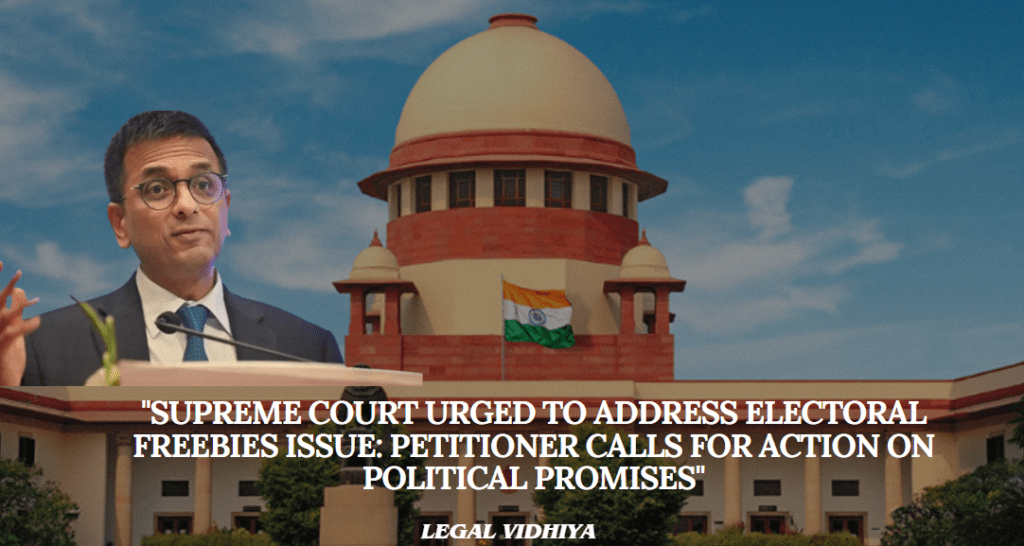
In a significant development on Wednesday, March 20, the Chief Justice of India (CJI) DY Chandrachud-led Supreme Court bench was petitioned to expedite the hearing of a crucial matter regarding political parties’ promises of electoral freebies. The petitioner, Ashwini Upadhyay, represented by Senior Advocate Vijay Hansaria, stressed the urgency of addressing the issue, emphasizing the absence of provisions in the Representation of The People Act, 1951 (RPA) empowering the Election Commission (EC) to de-register political parties.
Mr. Hansaria underscored the pressing need for the EC to have the authority to de-register political parties, particularly with 3061 parties currently registered. The CJI acknowledged the significance of the matter, affirming its importance and agreeing to retain the case on the board for further consideration.
The PIL filed by Ashwini Upadhyay seeks directives to the Election Commission of India (ECI) to curb political parties from offering freebies during election campaigns. Upadhyay argued that such promises, made without proper financial assessment, distort the electoral process by utilizing taxpayers’ money to sway voters and maintain power.
The petition urges the court to declare that the promise of irrational freebies from public funds before elections unduly influences voters, disrupts a fair electoral playing field, and violates constitutional articles pertaining to equality and public expenditure. Furthermore, it contends that such actions are akin to bribery and undue influence under relevant sections of the Indian Penal Code.
The plea has sparked a crucial debate on the integrity of electoral practices and the misuse of public resources for political gains. With the Supreme Court now considering the matter with heightened urgency, the outcome of this case could have far-reaching implications on electoral conduct and democracy in India.
Written by- Pradyumn sharma
Disclaimer: The materials provided herein are intended solely for informational purposes. Accessing or using the site or the materials does not establish an attorney-client relationship. The information presented on this site is not to be construed as legal or professional advice, and it should not be relied upon for such purposes or used as a substitute for advice from a licensed attorney in your state. Additionally, the viewpoint presented by the author is of a personal nature.





0 Comments