
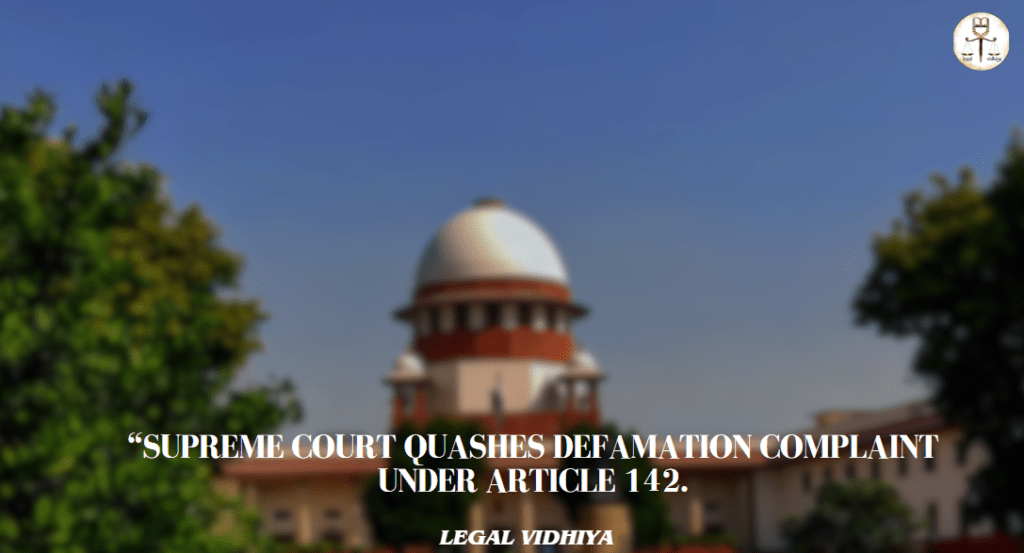
The Supreme Court of India has dismissed accusations of defamation against Tejashwi Prasad Yadav in Transfer Petition (Crl.) No. 846 of 2023. The allegations concerned remarks that Yadav claimed to have made against the Gujarati people. In a landmark court decision, Hareshbhai Pranshankar Mehta filed a complaint against Yadav as a result of the finding.
The accusation originated from statements Tejashwi Prasad Yadav made in public on March 22nd 2023, in which he mentioned about the financial scams and the Gujarati community. Hareshbhai Pranshankar Mehta filed a defamation complaint because he believed these remarks to be defamatory. The lawsuit started with a private complaint that Tejashwi Prasad Yadav and Hareshbhai Pranshankar Mehta registered, claiming defamation under Section 499 of the Indian Penal Code (IPC). Through his public remarks and which were covered by both broadcast and print media. Mehta accused Yadav of demeaning the Gujarati people and the state’s society.
The legal question was the applicability of Article 142 of the Indian Constitution, that empowers the Supreme Court to enforce justice, and if Yadav’s remarks qualified as defamatory as per Section 499 of the IPC. In addressing the important legal concerns pertaining to defamation statutes, freedom of expression, and sensitive comprehension, the judge had to find how Yadav’s utterances established an action for defamation and if changing it was sufficient to dismiss the case.
Tejashwi Prasad Yadav justified himself from a suit for defamation by saying his remarks were misunderstood and had not been intended to damage the name of the Gujarati community. In support of the complaint, petitioner Hareshbhai Pranshankar Mehta said that Yadav’s early remarks insulted the Gujarati community as a whole and created adverse impressions. Hareshbhai Mehta attempted to hold Tejashwi Yadav responsible based on the first reportedly defamatory comments, diminishing the central argument of the matter, ignoring Yadav’s justifications and retractions.
The constitutionality of an action for defamation on Tejashwi Prasad Yadav was evaluated by the Supreme Court in accordance with Article 142. Yadav’s apology of the statement as well as his thorough justification of the events were taken into account by the judge, which sought to ascertain the underlying meaning of his comments and assess if they were in fact disrespectful to the Gujarati community. The determination of the suitable answer to the defamatory case filed by Hareshbhai Pranshankar Mehta was made possible due in large part to this investigation. A key factor in the lawsuit being dismissed was the Supreme Court’s confidence in Article 142 and Yadav’s withdrawal process, showing the Court’s dedication to maintaining equity, justice, and a careful reading of remarks made in cases involving defamation.
The Indian Supreme Court rejected Tejashwi Prasad Yadav’s public defamation case due to his retractions of contentious remarks and his sincere gratitude for the Gujarati community. The court applied Article 142 of the Indian Constitution, considering Yadav’s conduct and motives. The court acknowledged Yadav’s rights to withdraw and defend his views, setting a standard for striking a balance between protection against defamation and the right to free expression. The jury considered the setting and motive underlying utterances to determine defamation complaints, ensuring a careful and impartial evaluation. The Supreme Court imposed directions for thorough justice by citing Article 142 of the Indian Constitution, emphasizing the judiciary’s responsibility to defend free expression and protect people and groups from unjustified reputational damage. The court ensured justice and fairness for all parties involved by focusing on context, purpose, and constitutional authorities.
General background
The Supreme Court of India issued a judgment in Transfer Petition (Crl.) no.846 of 2023 involving Tejashwi Prasad Yadav and Hareshbhai Pranshankar Mehta. The case centred on alleged defamatory statements made by Yadav regarding the Gujarati community, prompting a defamation complaint by Mehta. The Court focused on Yadav’s retraction of the statements and his clarification that they were not meant to defame Gujaratis. By invoking Article 142 of the Indian Constitution to ensure complete justice, the Court quashed the defamation complaint against Yadav. These ruling accentuates the delicate balance between freedom of speech and protection against defamation, establishing a precedent for nuanced interpretation of public statements in legal proceedings.
Case Name: Transfer Petition (Crl.) No. 846 of 2023 –
Tejashwi Prasad Yadav vs. Hareshbhai Pranshankar Mehta.
NAME: SHRIDEVI C. KOTKAR, B.A, LLB COLLEGE: AZIM PREMJI UNIVERSITY, BANGALORE, INTERN UNDER LEGAL VIDHIYA.
Disclaimer: The materials provided herein are intended solely for informational purposes. Accessing or using the site or the materials does not establish an attorney-client relationship. The information presented on this site is not to be construed as legal or professional advice, and it should not be relied upon for such purposes or used as a substitute for advice from a licensed attorney in your state. Additionally, the viewpoint presented by the author is of a personal nature.




0 Comments