
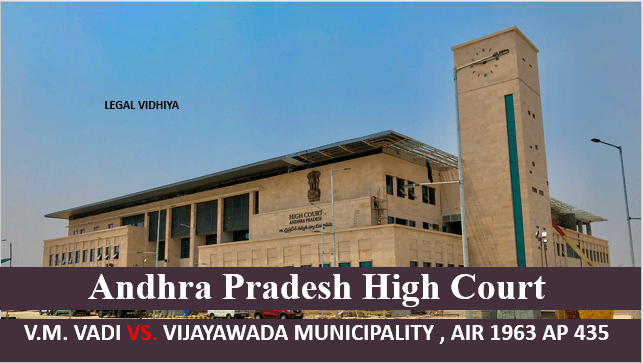
| Citation | AIR 1963 AP 435 |
| Date of Judgement | 18 December 1962 |
| Court | Andhra Pradesh High Court |
| Case Type | Civil Appeal |
| Plaintiff | V.m. Vadi |
| Respondent | Vijayawada Municipality |
| Bench | Kumarayya |
| Referred | Section 321(11) of the District Municipalities Act |
FACTS OF THE CASE
The lessee of Vibrated Cement Products , Vijayawada , of which his own son M.M. Vadi is the Proprietor. It appears that he had applied on 26-08-1952 , for permission as required under Schedule V and Rule 250 of the Madras District Municipalities Act , for installation of a 10 horsepower motor in Door No. 16/433 for the Vibrated Cement Products Plant. According to him his request was granted under Ex.A-3 and he obtained a working licence U/S 249 and Schedule V . The Municipality did not renew the licence but called upon the plaintiff first to produce the installation permit with him.
The licence was renewed must postulate that there was an installation permit and that the notice refusing the licence without giving the proper reason is illegal and void , and since he has stopped running the factory on account of the notice , the Municipality will be held liable for damages and will have to make payment to the plaintiff @ of Rs. 100/- per day. He again applied for a running licence on 6-7-1957. He sent another application , as no communication was received in response , the plaintiff after giving notice, dated 3-5-1957 , instituted the suit on 28-6-1957 , without even waiting for the Statutory period of the notice. He claimed damages for the loss of trading for the years 1956-57 and 1957-58 and brought his suit for a sum of Rs.7600/-.
ISSUES
Issues were settled by the learned Subordinate Judge , who held that the refusal to grant working licence for 1956-57 was not illegal and capricious and that the plaintiff was not entitled to any mandatory injunction nor to any damages for loss of his business .
Section 321(11) observed that it was open for the plaintiff to carry on the business if within 30 days the working licence was not granted and that, therefore, he had no cause of action against the defendant.
ARGUMENTS
In the instant case , the application was made for the issue of an installation permit in the year 1952 itself . On the said application of the plaintiff the Council had in fact approved of the installation of the Vibrated Cement products plant.
The plaintiff in reply no doubt stated that he had made an application in the year 1952 but mentioned at the same time that it was understood that the plans and application were misplaced and he submitted the plan therefore , in duplicate , so that necessary permits may be issued at an early date .
From the above discussion if it is clear that though the grant of installation permit could be presumed and a working licence could be issued or renewed . The plaintiff made grievance of the fact that it was not granted to him in time , he was threatened with prosecution . He cannot certainly lay a claim for damages . The claim for damages here is not based on Breach of Contract . It is said to be based on the law of tort .
JUDGEMENT
The plaintiff , who failed in his suit for recovery of damages of Rs. 7500/- for the loss of his business for the years 1956-57 and 1957-58 on account of alleged wilful neglect or refusal of the Vijayawada Municipality to grant him a licence , has come up to this court in appeal.
K.Ranganayakulu vs. Vijayawada Municipality , It is a case of gross negligence . It is clearly an act purporting to have been done in exercise of the authority conferred on the officer by law . It cannot be said that the officer was guilty of abuse of the power vested in him . If it was an error of judgement , the present remedy is misconceived . These could be corrected in appeal , which was open to the plaintiff , but he did not choose to prefer such remedy . It could not possibly give an occasion for a suit for damages . The suit for plaintiff is , therefore , liable for dismissal and in my opinion the learned Subordinate Judge was right in dismissing the same .
The result is that the appeal fails and it is dismissed with costs.
REFERENCE
This Article is written by Anshika Aggrawal of Shri Varshney College , Intern at Legal Vidhiya.





0 Comments