
BACKGROUND OF THE CASE
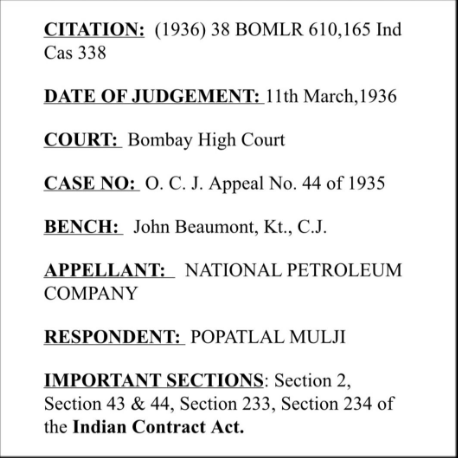
This case was heard in the BOMBAY HIGH COURT IN 1936. The case dealt with a dispute over joint liability for a debt.
The Case is an appeal from a decision given by Chitre,J. in which mainly the parties to the actual suit were:
1.Plaintiff – Popatlal Mulji
2. Defendant 1 – The National Petroleum Company
3. Defendant 2 – Ishwardas Ramchand
There was a Contract Between the Plaintiff and Defendant 2 on 22nd April,1933 and thereunder the Plaintiff was appointed selling agent on behalf of Defendant 2.
Under Cl. 15 the Plaintiff had to deposit with Defendant 2 a sum of Rs 1,000,which was to be returned to the plaintiff on termination of the agreement.
But on 21st June,1934 when the plaintiff gave notice of terminating his selling agency agreement, Defendant 1 who actually contracted with Defendant 2 by which all the assets of Defendant 2 were assigned to Defendant 1 was not willing to return the deposit of Rs 1000 to the Plaintiff and so he filed a suit for recovering the money.
The Trial Court in its Decree mentioned that The Plaintiff rests his case on his equitable right to sue for the money on a contract to which he was not a party (Privity to Contract), but under which he took an interest,and the Learned Judge Decreed in Favour of the Plaintiff.
FACTS OF THE CASE
The suit which has given rise to an appeal was brought by the Respondent (The plaintiff) against the Appellants, Defendant 1, and one Ishwardas Ramchand, Defendant 2.
The Material Facts were that prior to May 1934,defendant 2 was carrying on business in kerosene and petroleum in the name and style of the National Petroleum Company. On 22nd April 1933, he appointed the plaintiff as his selling agent in the territory of Cutch under an agreement, Ex. D. Under the agreement the plaintiff deposited a sum of Rs. 1, 000 with defendant 2 as security for the performance of his obligations under the agreement.
As the result of dealings between them a sum of Rupees 3, 649 became due to the plaintiff by defendant 2 in December 1933. In May 1934, the appellant company was formed and a certificate was issued by the Registrar of Companies on 17th July 1934 and the company then became entitled to commence business.
The Main Object of the Company was to take over the business of defendant 2 as a going concern. On 5th June 1934 an agreement was entered into between the appellants and defendant 2 by which the appellants took over the assets and liabilities of defendant 2 as from 1st April 1934. In June 1934 the plaintiff gave notice terminating the agency agreement, and in August 1934 he made a demand on defendant 1 for the payment of two sums, Rs. 3, 649 in respect of the dealings between him and defendant 2, and Rs. 1, 000, the amount deposited with defendant 2. Some correspondence took place, and thereafter the plaintiff drew certain bills of exchange in respect of these two sums, which were not honoured by the appellants. He then filed this suit as a summary suit. Defendant 2 applied for leave to defend the suit, which was granted on his depositing Rs. 3, 500 within two weeks; but as he failed to deposit the amount, an ex parte decree for the amount claimed by the plaintiff was made against him. Defendant 1, the appellants, were given unconditional leave to defend.
The Appellant, NATIONAL PETROLEUM COMPANY had sold goods to a third party on credit. The Respondent, POPATLAL MULJI, had guaranteed payment for the goods. When the third party failed to pay, the Appellant demanded payment from the Respondent.
ISSUES RAISED
1. Whether the Appellant was liable for the debt owed by a third party to the Respondent?
2. The nature of the guarantee given by the Appellant
3. The timing of the demand for payment.
4. The reasonableness of the demand for payment.
5. Whether the Appellant guarantee was unconditional or conditional?
6. Whether the Respondent had made a demand for payment within a reasonable time?
CONTENTION
Argument from Appellant’s Side
1.The Respondent was liable for the debt owed by a third party to the Appellant.
2. The Respondent had given an unconditional guarantee for the debt.
3. The Appellant had made a demand for payment within a reasonable time.
Argument from Respondent’s Side
1. The Respondent was not liable for the debt owed by a third party to the Appellant.
2. The Respondent had given a conditional guarantee for the debt.
3. The Appellant had not made a demand for payment within a reasonable time.
RATIONALE & JUDGEMENT
– The court held that the Respondent was liable for the debt owed by the third party to the Appellant.
– The Respondent had given an unconditional guarantee for the debt and had guaranteed payment regardless of when the demand for payment was made.
– The Appellant had made a demand for payment within a reasonable time.
INFERENCE
1.The case is an important precedent in Indian contract law as it deals with the liability of guarantors in India.
It explains the importance of Section 43 which mentions Joint Liability. “When two or more persons make a joint promise, the promisee may in the absence of express agreement to the contrary, compel any one or more of such joint promisors to perform the whole of the promise.”
2. The case highlights the importance of the timing of the demand for payment and the reasonableness of the demand for payment in determining the liability of guarantors.
REFERENCES
1)Indian Kanoon https://indiankanoon.org/doc/320742/
2)Lawyer Services
https://lawyerservices.in/National-Petroleum-Company-Limited-Versus-Popatlal-Mulji-1936-03-11
Case Analysis By Himadri Basu, LL.B Final Year Law Student from Gauhati University.




0 Comments