
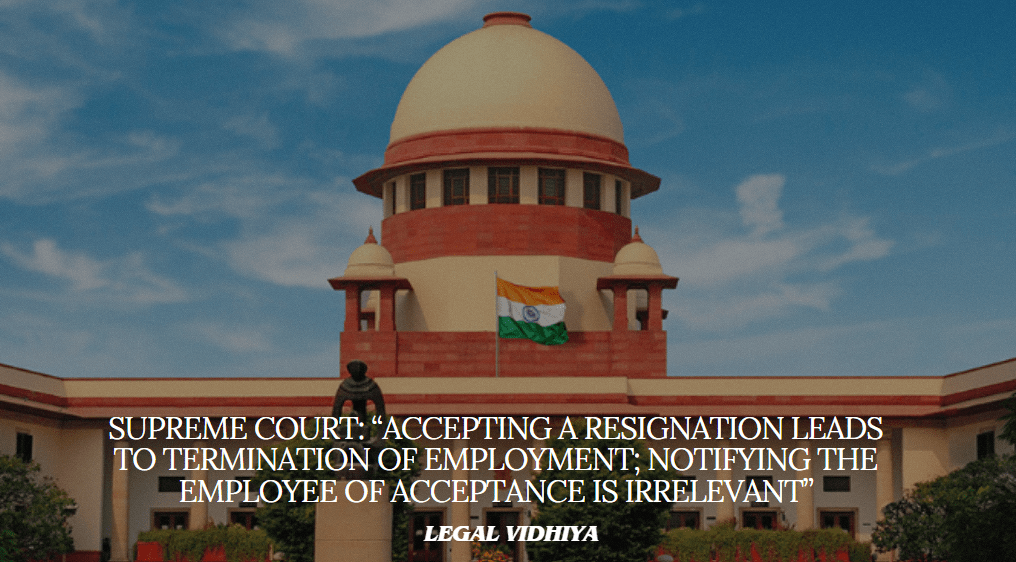
This lawsuit concerns the Maharashtra Employees of Private Schools (Conditions of Service) Regulation Act, 1977 and the rules that were created in accordance with it (henceforth referred to as the MEPS Act and Rules).
The case that the teacher’s employment was terminated after it sent a resignation letter to management was before the court. The appellant/teacher, however, argued that the school committee had wrongfully terminated his job because he had withdrawn the resignation letter shortly after writing it.
The Respondents are an educational society that manages or provides grants. The petitioner was appointed as an Assistant Teacher and was carrying out his responsibilities as such. The appellant submitted his resignation from the aforementioned position. However, he rescinded his resignation via post. When the appellant returned to the school, he said that’s when he was refused permission to sign the muster roll by the respondent and the appellant got a letter informing him of his termination from employment.
In an attempt to challenge his dismissal, the appellant went before the Tribunal, claiming among other things that the notice the respondents sent releasing him from their employment was unlawful and that all of the supporting paperwork was made up on the spur of the moment. Additionally, it was argued that because he had retracted his resignation, the respondents were unable to stop him from starting his job. Also, the appellant argued that he had not received a written notification from the respondents acknowledging the receipt of his resignation. He therefore begged that the order of termination of employment be overturned.
After reviewing the pleadings and supporting documentation, the Tribunal determined that the appellant had legitimately retracted his resignation and that the respondents had done so with malice. Had faked the committee resolutions, or the papers, that said the resignation was accepted. As a result, the Tribunal declared that the appellant’s termination was invalid and set it aside.
The High Court also declared that the Tribunal’s judgment that the papers were fake was unfounded and was devoid of any supporting evidence. As a result, the High Court overturned the Tribunal’s conclusions, deemed its ruling to be unsupportable, and granted the writ petition as requested.
CONTENTIONS OF THE PARTIES
The appellant contends that the High Court erred when it invalidated the well-reasoned Tribunal order because it failed to recognize that the school committee lacked the authority to make decisions and that only the management committee could. She would also argue that the High Court erred in failing to take into account the contradictory argument made by the administration regarding the resignation’s permission, specifically that the school committee accepted the resignation and, in a subsequent statement, it was argued that the resignation had the approval of the management committee.
In support of the impugned order and pleading for the appeal to be dismissed, learned counsel representing Respondents argued that the Tribunal erred in inferring adverse consequences regarding copies of the management and school committee resolutions that were not filed with a written statement. However, the documents were actually presented to the Tribunal during the evidence recording phase, and the High Court noted this fact.
OBSERVATIONS:
The High Court granted the writ petition for two reasons: (i) the resignation was accepted without notification until the withdrawal; and (ii) the employee was still allowed to report for duty following the acceptance of the resignation.
This Court overturned the High Court’s ruling and concluded that, as long as there was an acceptance prior to the withdrawal, the resignation is effective even if it is not communicated. Additionally, it is decided that once a public servant’s resignation has been approved by the relevant authorities, it cannot be revoked.
We do not identify any flaw in the contested decision, and it is not worth intervening in. Given that the two raised arguments have received negative responses, we uphold the High Court’s conclusions and, as a result, reject the current appeal without making a cost order.
CASE TITLE: SHRIRAM MANOHAR BANDE VERSUS UKTRANTI MANDAL & ORS.
NAME: Riya Shukla; COURSE: LL.M.(One Year); COLLEGE: MUIT, Noida; INTERN UNDER LEGAL VIDHIYA.
Disclaimer: The materials provided herein are intended solely for informational purposes. Accessing or using the site or the materials does not establish an attorney-client relationship. The information presented on this site is not to be construed as legal or professional advice, and it should not be relied upon for such purposes or used as a substitute for advice from a licensed attorney in your state. Additionally, the viewpoint presented by the author is of a personal nature



0 Comments