
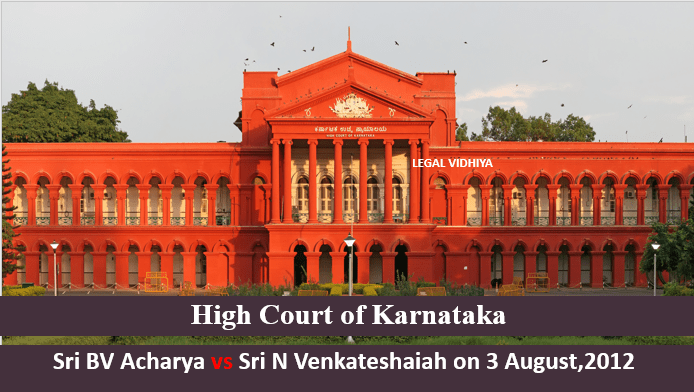
Sri BV Acharya vs Sri N Venkateshaiah on 3 August,2012
| Court | Karnataka High Court |
| Petitioner | Sri BV Acharya |
| Respondent | Sri N Venkatesaiah |
| Law & Provision | Section 156(3), 197 & 482 of the Code Of Criminal ProcedureThe Prevention Of Corruption Act, 1988 |
| Bench | Justice V Jagannathan |
| Citation | 3 August, 2012 |
Facts:
Sri. N. Venkateshaiah, the respondent, recorded a PIL (Public Interest Litigation) in the Karnataka High Court in the year 2009. The PIL was recorded against the development of a fairway by the Karnataka Golf Association, which was purportedly built on government land. Throughout the procedures, the then Advocate General of Karnataka, Sri. B.V. Acharya, offered specific expressions before the Court hearing the PIL. The respondent, Sri. N. Venkateshaiah, claimed that these articulations were derisive and offended the respect of the court. The respondent filed an application against the petitioner under Section 15(1) of the Contempt of Courts Act, 1971. The respondent contended that the assertions made by the appellant were planned to bring down the power of the court and subsequently comprised hatred of the court. The candidate, then again, contended that his proclamations were just a reaction to the charges made by the respondent in the PIL. The candidate further argued that his explanations did not mean to make any affront or influence the nobility of the court. This Case is a significant case decided by the Karnataka High Court. The Petition was submitted in accordance with Section 482 of the 1973 Criminal Procedure Code by B.V. Acharya, who was also the Advocate General of Karnataka. The Respondent, Sri. N. Venkateshaiah served as a guardian judge at the Karnataka High Court. The argument included a charge against the replier for the offense of contempt of court.
Issue:
The main issues in the case were the legality of a specific act and how the law should be interpreted.
Arguments:
The plaintiff’s literate senior counsel argued that the court held 156(3) of the Code of Criminal procedure has to apply their sanity, and displaying links to questions to study in that segment is certainly not an empty tradition, it is a counter-fixture created by Sri’s educated senior executives. Opposition Ramesh Gupta said that in some cases information is not required when a magistrate or special judge submits a case for investigation under section 156(3) of the Criminal Procedure Code. Therefore, it is necessary to consider the legal position in this regard. The following dispute set forward by the learned senior advice is that, in regard to a portion of the charges submitted in the question, writ petitions were forthcoming in which C.B.I. a request was sought, yet the court underneath continued to allude the matter for examination albeit the topic of the grievance was likewise held onto by a prevalent court. Concerning the issue of the two complaints, it is argued that the second complaint can be maintained even if the first one is dismissed. In this instance, the learned Special Judge’s order itself indicates that the first complaint was withdrawn following a memo filed, so there is no question of two complaints.
Judgement:
After hearing arguments from both sides, the Karnataka High Court ruled in favor of the supplicant. The court held that the proclamations made by the aspirant did not add up to abomination of court. The court saw that the aspirant had simply answered the claims made by the respondent in the PIL. The court also held that the articulations made by the petitioner made no poke or impact the pride of the court. The court cited the Supreme Court’s decision in P.N. Dudavs, “Statements made in good faith and in the discharge of the duty of the advocate do not constitute disdain”. As a result, the argument is made that this court should not intervene in accordance with Section 482 of the Criminal Procedure Code or Articles 226 & 227 of the Indian Constitution with respect to the challenged Special Judge’s order. Regarding the petitioner’s senior counsel’s reliance on the Supreme Court’s decision in Subramanian Swamy’s case, learned counsel Sri Shivananda Raj argues that the Supreme Court was preoccupied with the issue of when a sanction order must be issued, so the decision does not apply to the current situation and the petition should be dismissed.
References:
This Article is written by Rama Singh, student of Deen Dayal Upadhyaya Gorakhpur University, Gorakhpur and an intern at Legal Vidhiya.





0 Comments