
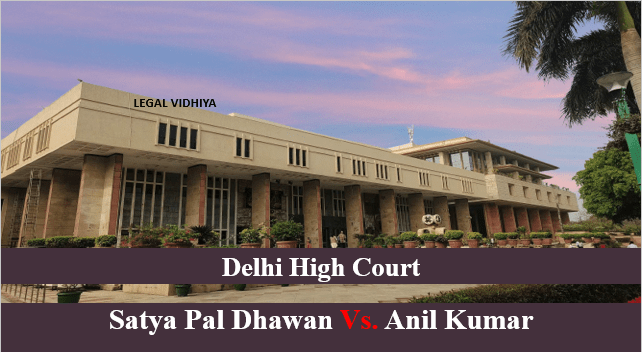
| CASE NAME | Satya Pal Dhawan vs Anil Kumar |
| CITATION | Neutral Citation: 2023: DHC: 760 |
| CORAM | Justice Swarana Kanta Sharma |
| DATE OF JUDGMENT | 17th October 2023 |
| CASE NO | CRL.REV.P. 875/2018 , CRL.M.(BAIL) 1599/2018 |
| COURT | High Court of Delhi |
| PETITIONER | Satya Pal Dhawan |
| RESPONDENT | Anil Kumar |
| LEGAL PROVISION | Section 138 & 139 of Negotiable Instruments Act 1881 |
INTRODUCTION
The Criminal Revision Petition filed for questioning the verdict for dishonouring a cheque according to Section 138 of the Negotiable Instruments Act 1881; which also includes issues related to legally enforceable debt, repayment claim, and presumption under Section 139 of the Negotiable Instruments Act 1881. The Delhi High Court also ruled Cheque Signer’s Obligation to Challenge the Presumption. The Delhi High Court upheld the accused’s conviction under Section 138 of the Negotiable Instruments Act (NI Act) for granting a cheque which returned due to insufficient funds, finding that the accused has not taken any action regarding the return of the cheque prior to or following the time the legal notice was served.
SYNOPSIS OF FACTS
The petitioner and the complainant had a friendly relationship. The petitioner had asked the complainant for a friendly loan of Rs. 1,50,000 due to his monetary difficulties. This sum was given to the accused in cash by the complainant. The accused sent a cheque for Rs. 1,50,000 to settle the debt in return. However, the cheque got bounced because there weren’t enough funds when the complainant attempted to deposit it. The complainant filed a case against the petitioner stating that he did not pay back the money within the allotted time even after receiving a statutory demand notice. On behalf of the petitioner, a petition under Section 397 read with Section 401/482 of the 1973 Code of Criminal Procedure has been filed, requesting to set aside of a judgment dated September 12, 2018, issued by the learned Additional Sessions, wherein the petitioner’s Criminal Appeal was dismissed out. further the petitioner was convicted for the offence under Section 138 of Negotiable Instruments Act 1881 by learned Metropolitan Magistrate in a judgment dated March 9, 2018. Additionally, by virtue of an order dated September 13, 2018, the petitioner was sentenced to three months in prison and a fine of Rs. 2,60,000, of which Rs. 2,40,000 is to be paid as compensation to the complainant and the remaining Rs. 20,000 is to be deposited with the State by the convict; if the State receives no payment for this, the convict will be subject to an additional two months of simple imprisonment.
ISSUES FOR CONSIDERATION
- . The legally enforceable debt or liability in favour of the complainant did not exist as the petitioner had already paid the amount he had taken from the complainant.
- The amount taken from the complainant was in cash and was returned in cash by the petitioner, which was in respect of installation of an ATM shop at the shop of the complainant. The cheque would still be valid in spite of this. The accused would still have the burden of providing evidence to demonstrate that the cheque did not satisfy any obligation or liability.
CONTENTION BY PETITIONER
The counsel for the petitioner claimed that the complainant had no legally enforceable debt or liability. It was further argued that the petitioner’s wife’s property was sold to recover the amount they had taken. Furthermore, the debt or liability had to be legally recoverable in order to be subject to Section 138 of the NI Act; in this instance, this requirement was met because the petitioner had already returned the relevant sum. After analysing the argument, the Bench observed that the presumption under Sections 118(a) and 139 of the NI Act had arisen and that the aforementioned cheque had been issued by the petitioner in payment of a legally enforceable debt. This was because the petitioner acknowledged that he was the person who had signed on the cheque. The accused/petitioner made a statement that was recorded under Section 313 of the Cr.P.C. in which he acknowledged signing and filling out the entire contents of the disputed cheque and including that he had taken out an amount of Rs.1,50,000/-. from the complainant, He added that the accused had returned the specified sum in cash. it was also mentioned that even after the liability was discharged, the complainant had not returned his cheque.
CONTENTION BY RESPONDENT
The counsel for respondent claims that the learned MM and learned ASJ, after carefully reviewing the evidence in the record, rendered comprehensive rulings that addressed each aspect of the petitioner’s defence and correctly found the petitioner guilty of the crime under Section 138 of the NI Act. It is said that during his examination, the complainant provided evidence to support his claims. It is further argued that the accused has admitted to himself that he borrowed money from the complainant and that he filled in the signatures and other details on the cheque. Furthermore, it is declared that there is no substantial evidence to back up the petitioner’s claim that he returned the complainant’s money, so it cannot be regarded as a reason to release him of his responsibility to the complainant.
JUDGEMENT RENDERED
This Court notes that both of the lower courts correctly pointed out that the burden of proof lay entirely with the accused in the event that the accused entered a plea of repayment. This Court observes that the petitioner has not produced any convincing evidence to meet this burden of proof. As a result, the presumption under Section 139 of the NI Act was left unchallenged. As a result, it is assumed that the accused produced the disputed cheque in order to repay the Rs. 1,50,000 that the complainant had claimed. Considering the previously mentioned discussions, this Court observes that the petitioner has not been able to prove that the learned ASJ’s ruling is inadequate. As a result, both the current petition and the application that is still pending are dismissed. The petitioner is hereby ordered to surrender to the learned Trial Court concerned within 15 days in order to serve the substantive sentence that was awarded to him by order dated 13.03.2018, and to pay the remaining fine/compensation as determined by the learned MM.
RELATED CASE LAWS
- Bir Singh vs. Mukesh Kumar (2019) 4 SCC 197 held that if a signed blank cheque is voluntarily presented to a payee, towards some payment, the payee may fill up the amount and other particulars. This alone does not invalidate the cheque. It remains the defendant’s burden to prove by presenting evidence that the cheque is not intended to discharge a debt or liability.
- Basalingappa vs. Mudibasappa (2019) 5 SCC 418, held that once the execution of cheque is admitted Section 139 of the Act mandates a presumption that the cheque was for the discharge of any debt or other liability. Section 139 establishes a rebuttable presumption, meaning that the burden of proof rests with the accused to establish a reasonable defence.
CONCLUSION
According to a single judge bench of Justice Swarana Kanta Sharma states that the present petitioner received a legal notice from the complainant requesting that his liability be discharged after the cheques were returned as dishonoured. Regarding this, it is important to remember that the petitioner acknowledged receiving the legal notice but chose not to respond to it. Thus, despite believing the complainant’s claim to be untrue, the petitioner had not challenged it and had not requested the return of the cheque. The Bench proceeded on stating, “Issuing cheques is an important undertaking. If a cheque hasn’t been issued to settle a legally binding debt, the accused should take the proper action to get his cheque back. It will be presumed that the accused has failed to reject the presumption if he is unable to provide evidence supporting the issuance of the cheque and the reason, he did not request its return. The Bench further noted that both courts had correctly pointed out that if the petitioner claimed to have reimbursed the sum, it was his entire responsibility to prove that he had done so to the complainant. The presumption of Section 139 of the NI Act remained unrebutted because the Bench determined that the petitioner had not produced any convincing evidence to meet this burden.
REFERENCES
- https://indiankanoon.org/
- https://www.verdictum.in/
“THIS ARTICLE IS WRITTEN BY R.S.KANIMOZHI STUDENT OF SATHYABAMA INSTITUTE OF SCIENCE AND TECHNOLOGY – SCHOOL OF LAW, CHENNAI; INTERN AT LEGAL VIDHIYA.”
Disclaimer: The materials provided herein are intended solely for informational purposes. Accessing or using the site or the materials does not establish an attorney-client relationship. The information presented on this site is not to be construed as legal or professional advice, and it should not be relied upon for such purposes or used as a substitute for advice from a licensed attorney in your state. Additionally, the viewpoint presented by the author is of a personal nature.




0 Comments