
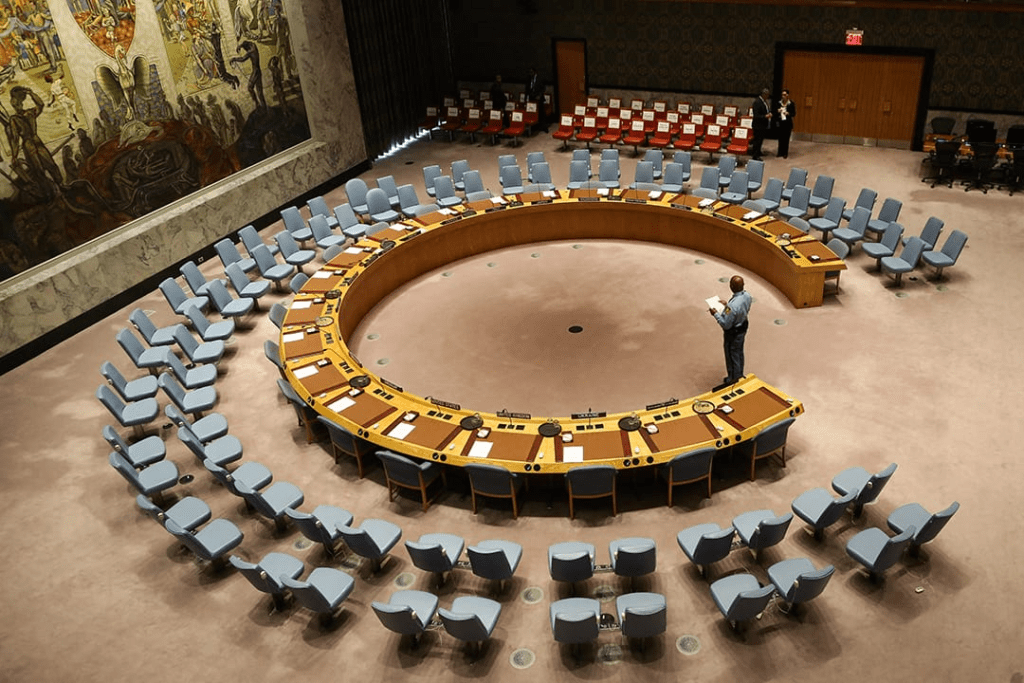
This article is written by Mithila Ravinutala of OP Jindal Global University, an intern under Legal Vidhya
ABSTRACT
The United Nations Security Council was designed to prevent global conflict through collective action backed by great-power cooperation. Yet after eighty years, it has become what it was meant to prevent: an instrument of deadlock that allows the most powerful nations to block accountability for atrocities they commit or enable. This article examines the veto power’s transformation from a negotiated political compromise in 1945 into a tool of systematic obstruction, tracing how Russia and China have cast vetoes to protect allies committing mass atrocities while the United States has wielded veto power to shield Israel from scrutiny. The article identifies the constitutional paradox: meaningful reform requires Charter amendment, but amendment requires approval from those whose power would be constrained by the amendment a logical impossibility that explains why the Council remains frozen despite decades of calls for change. Rather than treating this as an insoluble problem, this analysis evaluates competing reform proposals (full abolition, supermajority overrides, General Assembly empowerment) with honest assessment of their constitutional feasibility and practical effectiveness. We conclude that comprehensive reform remains possible through a phased approach combining immediate transparency and accountability measures, medium-term expansion of Council membership and voting reforms, and gradual Charter revision aimed at partially rather than fully constraining veto power. This strategy acknowledges political reality: no permanent member will voluntarily surrender all veto authority, but enlightened self-interest might lead great powers to accept convertible veto power, renewable seats without veto, or bounded veto limited to matters of vital national security.
KEYWORDS
UN Security Council, veto power, Charter reform, collective security, R2P (Responsibility to Protect, veto override mechanisms, institutional legitimacy, great-power governance.
INTRODUCTION
The founding moment of the United Nations reveals a profound contradiction that continues to shape global governance today. The Charter, signed in San Francisco in 1945, was explicitly written to prevent the failures of its predecessor, the League of Nations, which collapsed precisely because powerful nations could block collective action when their interests were threatened. The architects of the UN believed they had solved this problem: they created the Security Council with enforcement power and gave permanent seats to the great powers of the day, the United States, Soviet Union, United Kingdom, France, and China. But they built into that solution the seeds of future paralysis. To secure great-power participation, the UN negotiators granted permanent members veto power: the ability to block any substantive Council action. This was presented as a necessary political compromise, no major power would accept membership in an organization that could bind it against its will. The logic seemed sound in 1945. The Soviet Union was a wartime ally. The victorious powers believed they would cooperate in peacetime just as they had against Nazi Germany. Nobody imagined that the alliance would fracture within two years into competing ideologies and geopolitical spheres that would render the Security Council non-functional for entire Cold War decades.
What happened next was predictable: great powers used the veto not to protect themselves from external threats but to shield allies from accountability. The United States vetoed actions against Israel. The Soviet Union protected Syria and other allies. China wielded veto power to shield fellow authoritarian regimes. France occasionally joined in protecting national interests. The veto transformed from a shield into a sword, a weapon wielded not against external aggression but against the Council’s own stated purpose: responding to threats to international peace and security.
The consequences have been catastrophic and measurable. In Syria, Russia and China cast sixteen vetoes over a decade, preventing the Council from authorizing humanitarian intervention while the death toll reached 250,000. In Myanmar, China blocked investigations into genocide against the Rohingya. In Palestine, the United States has vetoed resolutions dozens of times, preventing Council action on the Israeli-Palestinian conflict. In Ukraine, Russia blocked condemnation of its own invasion. These are not theoretical failures. They are documented cases where the veto power enabled or protected atrocities that the Council was supposed to prevent.
The question facing the international community today is no longer whether the Security Council needs reform. That question was settled decades ago. The real question is whether reform is politically possible when the very nations whose veto power causes harm possess constitutional power to block any attempt to remove it. This article examines that paradox, evaluates proposed solutions, and advances a realistic pathway toward meaningful institutional transformation.
THE VETO POWER: ORIGINS AND CONSTITUTIONAL PARADOX
The veto power was not an oversight in the UN Charter. It was a deliberate, hard-negotiated political bargain. The five permanent members demanded absolute protection against any Council action that might threaten vital national interests. The logic behind this demand reflected deep historical experience: each of the permanent members had suffered through military alliances that bound them to outcomes they could not control. The Soviet Union had endured being isolated by Western powers. The United States worried about being dragged into European conflicts. France and Britain, exhausted by two world wars, wanted guarantees that they would not be forced into unwanted military commitments. China, still in the throes of civil war, wanted protection from external interference in its internal conflicts. The Charter drafters faced a genuine dilemma: either accept permanent-member veto power and secure great-power participation, or reject the veto and guarantee that at least one permanent member would refuse to join. They chose the former, believing it was better to have an imperfect institution with great-power participation than a more democratic institution that would be abandoned by powerful states. This reveals something crucial about international institutions: they are never as democratic or egalitarian as we might wish because powerful actors will not accept institutional arrangements that constrain their power without offering equivalent constraints on others. The veto was a manifestation of that reality in 1945. It remains so today.
But embedded within the Charter’s veto mechanism is a constitutional trap that has made meaningful reform nearly impossible: the amendment provisions themselves require veto power to change veto power. Articles 108 and 109 of the Charter establish that any Charter amendment must be approved by a two-thirds majority of the General Assembly AND ratified by all five permanent members. This creates what we might call a Kafkaesque Catch-22: the very nations whose veto power causes harm possess constitutional power to block any attempt to remove or constrain that power.
The permanent members clearly negotiated for “veto power over veto power itself”, control over any mechanism that might limit their control. This was not accidental. The diplomatic records show explicit discussion of this point: the permanent members wanted not just ability to block Council actions they opposed, but also protection against ever losing that ability through Charter amendment.
The consequence is that meaningful reform of the veto power cannot occur through formal Charter amendment as long as any permanent member opposes it. Russia will not vote to constrain its own veto power. China will not ratify changes that reduce its international status. The United States has opposed Charter reform when it appeared that U.S. veto power might be constrained. This is not unique to any single permanent member; it reflects a universal principle of power: those who possess it rarely consent to surrendering it.
This constitutional bind explains why the Council has remained essentially unchanged for eighty years despite decades of calls for reform. The obstacles are not technical or even primarily ideological. They are structural: reform requires the consent of those whose interests would be harmed by reform.
The Charter’s Article 27 attempts to distinguish between substantive matters (which require all five permanent members’ approval) and procedural matters (which require only nine affirmative votes and cannot be vetoed). This distinction seemed clear to the drafters: substantive matters would include decisions about whether to authorize military action or impose sanctions, while procedural matters would cover things like whether a meeting should be scheduled or how the Council’s agenda should be organized.
But in practice, the line between substantive and procedural has become blurred in ways that have only deepened the dysfunction. Permanent members have contested whether particular votes are substantive or procedural, effectively engaging in what scholars call “hidden veto”, threatening vetoes that discourage other nations from even proposing resolutions because they know powerful states will use procedural objections to block them. This has created a chilling effect where many potential Council actions never even reach a formal vote because the outcome is predetermined.
VETO ABUSE IN THE CONTEMPORARY WORLD
When examining veto abuse, Syria inevitably emerges as the paradigmatic case, not because it is unique, but because the numbers are staggering and the humanitarian consequences are measurable. Since the Syrian civil war erupted in March 2011, Russia and China have cast sixteen vetoes on Security Council resolutions intended to hold the Assad regime accountable or authorize humanitarian intervention. Between March 2011 and July 2020, Russia alone cast thirteen vetoes on Syria-related resolutions, often in coordination with China. These vetoes prevented the Council from imposing sanctions on the regime for systematic torture and extrajudicial executions. They blocked authorization for cross-border humanitarian aid to civilian populations besieged and starving. They prevented investigation and referral of chemical weapons use to the International Criminal Court.
The human cost was measured in hundreds of thousands of lives. Approximately 250,000 Syrians were killed through the first decade of war. What makes Syria instructive is not merely that vetoes occurred, but the pattern: the death rate increased precisely as the Council’s paralysis became evident and international accountability appeared impossible. When Russia cast its fourth veto on an ICC referral in May 2014, the killing rate had already tripled compared to the early months of the conflict. The regime, having witnessed the Council’s inability to act, escalated. Critically, these were not vetoes cast to protect Russian or Chinese territorial integrity or direct security interests. Russia’s concern was maintaining its Mediterranean naval base at Tartus and preserving its relationship with a key Middle Eastern ally. China’s concern was preventing the precedent of Council intervention against an established state that might later be invoked against China itself. These were geopolitical and strategic interests, not security threats to the veto-casting nations themselves. Yet the veto power allowed them to be treated as equivalent to the existential interests that theoretically justified veto power in the first place.
Research by Oxfam examining vetoes cast on twenty-three protracted conflicts over the past decade reveals a troubling pattern of concentration rather than proportional distribution. Of thirty vetoes cast on these conflicts, twenty-seven were concentrated on just three broad issue areas. The analysis shows that veto power is not distributed across global crises proportional to humanitarian need. Instead, it is concentrated on conflicts where great powers have strategic interests. Equally significant is the temporal pattern: nearly one-quarter of all vetoes cast in the twenty-first century occurred in just three years,2022 through 2024. This suggests that veto abuse is increasing, not decreasing, as geopolitical competition intensifies. Rather than becoming a relic of Cold War antagonism, veto power has become an increasingly weaponized tool as major powers compete for global influence.
The Syria case, however stark, is not isolated. In Palestine, the United States has vetoed numerous resolutions condemning Israeli actions or calling for international investigation of alleged violations. In Myanmar, China has blocked investigations into mass atrocities against the Rohingya Muslim minority. In Ukraine, Russia vetoed a General Assembly resolution condemning its own invasion. What these cases share is a common pattern: veto power being wielded not to prevent external intervention in a great power’s own territory, but to shield allies or prevent scrutiny of geopolitical clients. The veto has become systematically used for purposes far beyond those the architects envisioned.
WHY THE VETO VIOLATES CORE PRINCIPLES OF DEMOCRATIC GOVERNANCE
The most fundamental criticism of the veto concerns democratic principle. The United Nations has 193 member states. The veto power concentrates unchecked authority in the hands of 5 of those nations. Any one of the five can block action supported by the other 192 nations and by the Council’s own majority. This is not merely undemocratic; it is anti-democratic, rule by the few against the will of the many.
The analogy to corporate governance helps clarify the severity of this violation. Imagine a corporation where five major shareholders could each veto any decision approved by every other shareholder. This would rightly be recognized as a system designed to enable domination and prevent accountability. Yet this is precisely the system that governs international peace and security in the United Nations. The five permanent members, representing about 1.4 billion people (roughly 17% of global population), can dictate outcomes for the remaining 6+ billion people on Earth. This produces profound legitimacy problems. Citizens of nations subject to great-power manipulation increasingly see the UN as an instrument of geopolitical domination rather than an institution serving universal principles. Countries repeatedly vetoed by permanent members experience the Council as illegitimate. The institution loses credibility when it becomes obvious that its decisions reflect power dynamics rather than impartial application of principles.
The Responsibility to Protect (R2P) principle, endorsed by all UN member states at the 2005 World Summit, holds that when a state manifestly fails to protect its population from genocide or crimes against humanity, the international community has a responsibility to intervene. This principle represents consensus about humanitarian obligations that transcend state sovereignty.
The veto power directly contradicts R2P’s implementation. A permanent member can block humanitarian intervention even as a state commits genocide. Russia and China have blocked investigations into potential genocide in Myanmar. Russia has blocked referrals of Syrian atrocities to the International Criminal Court. The United States has shielded Israel from accountability mechanisms. The principle that international community has responsibility to protect vulnerable populations cannot coexist with veto power that prevents implementation of that responsibility. The principle of R2P gains legitimacy from the idea that there are some violations so grave, genocide, crimes against humanity, that they override traditional sovereignty protections. If one nation can block response to mass atrocities, then R2P becomes purely rhetorical: affirmed in principle but blocked in practice.
This contradiction is not abstract. Over 100 UN member states endorsed the Franco-Mexican Political Declaration on Suspension of Veto Powers in Cases of Mass Atrocities (2015), which asks permanent members to voluntarily refrain from vetoing humanitarian interventions when genocide or crimes against humanity are occurring. The fact that this needed to be requested through a separate political declaration rather than being embedded in the Charter reflects the fundamental inadequacy of the existing system.
Beyond these specific principles lies a broader institutional legitimacy problem: the UN’s entire system depends on member states accepting its authority as legitimate. When one nation can single-handedly block action supported by overwhelming majorities, procedural justice evaporates. The Council appears not as guardian of collective security but as instrument of great-power domination.
This perception has consequences. Smaller nations, repeatedly blocked by permanent members, increasingly pursue alternatives to the UN system. Regional organizations, bilateral arrangements, and ad-hoc coalitions of willing nations form outside UN structures. The rise of non-Western forums reflects eroding faith in UN institutions perceived as skewed toward traditional power structures. The veto thus becomes self-undermining: by preventing meaningful action, it erodes the Council’s legitimacy and creates incentives for nations to ignore it entirely. An institution that cannot address existential global threats becomes irrelevant. And an institution that becomes irrelevant no longer serves the function its veto power was meant to protect.
EVALUATING REFORM PROPOSALS
The most straightforward reform would simply eliminate the veto. A Council without permanent members and without veto power would function as a true collective security body where decisions reflected the will of the majority rather than the consent of the five most powerful nations. This reform would address every normative criticism of the current system: it would be democratic, it would enable humanitarian intervention, it would restore the Council’s legitimacy as an impartial body. This reform is also completely impossible.
As established in Section 2.2, any Charter amendment eliminating the veto requires approval from all five permanent members, the very nations whose power would be eliminated. No permanent member has demonstrated willingness to voluntarily surrender its veto power. The P5 would not trade their most valuable asset for abstract principles of democracy or efficiency. The logical impossibility is not a temporary barrier but a permanent structural constraint: as long as veto power exists, those who wield it can block its elimination.
Supermajority Override
An alternative reform would allow a supermajority of the General Assembly to override a Council veto. Ukrainian President Zelensky prominently endorsed this mechanism in 2023, arguing that it would prevent a single nation from blocking accountability for its own aggression. This approach has historical precedent in the 1950 “Uniting for Peace” resolution, which granted the General Assembly authority to convene and take action when the Council is deadlocked by veto.
Under the Uniting for Peace mechanism, the General Assembly can recommend collective measures, including force, when the Council is failing to act. However, these recommendations are non-binding, and the mechanism has fallen into disuse. A modern reform would make General Assembly overrides binding on member states, effectively transferring primary responsibility for peace and security from the Council to the Assembly when deadlock occurs.
This approach confronts powerful objections from permanent members. A binding override mechanism would reduce veto power from absolute to merely delaying, diminishing permanent-member status and influence. France, China, Russia, and others are unlikely to accept this diminution. The political barriers are substantial: any binding override system would require either formal Charter amendment (blocked by veto) or credible threat that the Assembly will act unilaterally (which the organization has historically proven unwilling to do).
Partial Approaches
Some scholars propose requiring not just veto by a single nation but agreement among at least two permanent members to override a single nation’s veto. This would prevent a supermajority from acting entirely against great-power interests while requiring some consensus among P5 members. Alternatively, proposals suggest that veto power should be limited to matters directly affecting a nation’s vital security interests, with humanitarian intervention and accountability matters exempted. These partial approaches are constitutionally more feasible than full abolition (they require no Charter amendment if based on customary international law evolution) but politically difficult to implement. They also create definitional problems: who determines what constitutes “vital security interests” or “humanitarian matters”? The ambiguity that plagued the original Charter distinction between substantive and procedural matters would reappear.
A REALISTIC PHASED REFORM FRAMEWORK
The preceding analysis reveals an uncomfortable truth: no single reform proposal simultaneously satisfies democratic legitimacy, constitutional feasibility, and practical effectiveness. Comprehensive reform is needed that combines multiple mechanisms, each addressing distinct dimensions of Council dysfunction.
Immediate Implementation:
Strengthen the Liechtenstein Veto Initiative: Establish formal requirements that nations casting vetoes provide written justifications explaining specifically how the blocked resolution threatens vital national security interests. These justifications would be recorded and published, creating transparency and accountability. This is not binding but formalizes norm-setting and increases political costs of veto use.
Establish a Veto Codex: Create a formal record of customary international law principles limiting veto use. Permanent members would be expected to respect these principles, with the General Assembly empowered to issue statements condemning grave violations. While not binding, this would formalize evolving norms and shift the burden: rather than veto requiring justification, veto casting without justification would be marked as violation of accepted custom.
Create Institutional Accountability Mechanisms: Establish a Permanent General Assembly Standing Committee on Council Accountability to monitor veto use, publish statistics on blocked resolutions, and produce annual reports assessing whether the Council is fulfilling its mandate. This provides visibility and creates institutional pressure for more restrained veto use.
Medium-Term Charter Reforms:
Convert Some Permanent Seats to Renewable Non-Veto Terms: If and when permanent members become willing to negotiate Charter amendments, several modifications could be pursued. One option: gradually convert permanent seats to renewable 10-15 year terms without veto power. Current permanent members would retain veto power as a transitional compromise, but future seats would be non-veto positions. This would gradually reduce veto power’s concentration while acknowledging great-power interests in Council membership.
Implement Two-P5 Veto Requirements for Specified Matters: Require agreement among at least two permanent members (rather than just one) to veto resolutions on human rights violations or crimes against humanity. This substantially reduces single-nation obstruction on humanitarian matters while preserving veto on matters affecting vital security interests.
Expand Council Membership: Add semi-permanent seats representing underrepresented regions (Africa, Asia, Latin America) without veto power. This enhances representative legitimacy while preserving P5 special status and reducing the Council’s appearance as instrument of exclusively Western power.
The most difficult dimension of reform is not technical but political: building consensus among great powers that institutional change serves their long-term interests. Currently, permanent members benefit from status quo, so they have little incentive to change it. However, circumstances might shift this calculus. As the Council becomes increasingly irrelevant to genuine global threats, climate change, pandemics, migration, economic instability, even permanent members might recognize that an exclusive club of declining legitimacy serves their interests poorly. The emergence of non-Western forums and regional arrangements could make great powers recognize that an inclusive UN system serves their interests better than an exclusive club increasingly delegitimized by smaller nations. Additionally, as younger generations of leaders come to power in permanent-member nations, their calculations about national interest might change. Leaders who inherit veto power as status quo may be more willing to negotiate its modification than leaders who fought to secure it.
CONCLUSION
The UN Security Council veto represents perhaps the most fundamental tension in international governance: the conflict between the principle of sovereign equality and the reality of unequal power. The current system attempts to manage this tension by concentrating decision-making authority in the hands of powerful states while formally maintaining the fiction that all UN members participate equally. For eighty years, this compromise has survived despite repeated crises. But survival is not legitimacy. The Council faces a legitimacy crisis that threatens the entire UN system. Humanitarian crises go unaddressed because nations with veto power use them to protect allies. Accountability remains elusive. The institution appears not as guardian of collective security but as instrument of great-power domination.
The question is not whether this system can persist indefinitely but what will replace it. Will reform be negotiated proactively by enlightened great powers, or will the institution collapse and be replaced by new arrangements negotiated after institutional failure? Will the General Assembly be empowered to act when the Council is paralyzed, or will nations ignore the UN entirely?
Meaningful reform is neither possible through complete veto abolition nor necessary to wait for distant evolution of great-power norms. Rather, a phased strategy combining immediate transparency mechanisms, medium-term expansion and democratization, and long-term comprehensive Charter revision could gradually transform the Council into a more legitimate institution while preserving great-power voice. No permanent member will voluntarily surrender all veto power. But they might accept convertible veto power, renewable seats without veto, or substantially limited veto restricted to vital security matters. They might accept expansion to include semi-permanent seats representing underrepresented regions. They might accept binding General Assembly authority when the Council is paralyzed for specified periods. These compromises would not create perfect democracy. But they would create a more legitimate institution reflecting contemporary geopolitical reality and more capable of addressing humanitarian catastrophes. In global governance, as in domestic democracy, perfect justice is impossible but substantial improvement remains within reach through sustained, strategic reform. The United Nations was founded on the principle that humanity could cooperate for peace and security. Eighty years of veto abuse suggests that principle requires institutional reconstruction. The question now is whether the world will undertake that reconstruction proactively or wait until crisis forces it. History suggests institutions change only when the cost of persistence exceeds the cost of transformation. For the Security Council, that moment may be approaching. The nations of the world would be wise to shape that transformation rather than be overwhelmed by it.
REFERENCES
- Syrian Network for Human Rights. (2020). “Russia and China’s Arbitrary Veto Use: 16 Vetoes Contributed to Killing Nearly a Quarter of a Million Syrians.” Report documenting vetoes 2011-2020.
- Oxfam International. (2024). “Vetoing Humanity: How a Few Powerful Nations Hijacked Global Peace.” Analysis of vetoes on Palestine, Syria, Ukraine.
- Charter of the United Nations, June 26, 1945. Articles 1-2, 27, 108-109.
- Russell, Ruth B. & Muther, Jeannette E. (1958). “A History of the United Nations Charter: The Role of the United States 1940-1945.” Documenting veto negotiations.
- Mihăilescu, Christine. (2017). “The Hidden Veto: Informal Obstruction in the UN Security Council.” Yale Journal of International Law, 42, 301-340.
- General Assembly Resolution 377(V). (1950). “Uniting for Peace.” Establishing alternative Council mechanisms.
- World Summit Outcome. (2005). GA Res. 60/1, paragraphs 138-139. Endorsing Responsibility to Protect.
- Political Declaration on Suspension of Veto Powers in Cases of Mass Atrocities. (2015). Signed by 104+ member states; updated signatories 2022-2025.
- Global Centre for the Responsibility to Protect. (2020). “Failure to Protect: Syria and the UN Security Council.”
- Khalil, Mona Ali. (2022). “Reforming the UN Security Council: Toward a More Effective Global Security Institution.” UNA-UK Publication.
Disclaimer: The materials provided herein are intended solely for informational purposes. Accessing or using the site or materials does not establish an attorney-client relationship. The information presented on this site is not to be construed as legal or professional advice, and it should not be relied upon for such purposes or used as a substitute for advice from a licensed attorney in your state. Additionally, the viewpoint presented by the author is personal.




0 Comments