
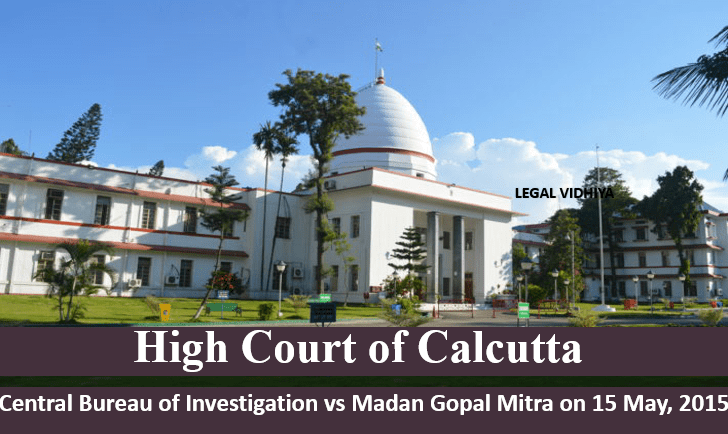
Central Bureau of Investigation vs Madan Gopal Mitra on 15 May, 2015
Overview of the Case
Citation CRR No.1501
Date of Judgment 15.05.2015
Court HIGH COURT OF CALCUTTA
Case Type CRIMINAL REVISIONAL JURISDICTION
Petitioner Central Bureau of Investigation
Respondent Madan Gopal Mitra
Judge: R. K. Bag, J.
FACTS:
Applications under sections 407 and 482 of the Code of Criminal Procedure 1973 were filed by the petitioners with the Central Bureau of Investigation in the hope of a criminal or other transfer. 2015 Case No. 3258 Petitions of the other side of the court judge’s training sessions for bail according to paragraph 439 of the Criminal Procedure Law
Briefly, on May 9, 2014, the Supreme Court transferred the proceedings of the following cases registered at various police stations in West Bengal and Orissa from the State Police Department to the Central Police Department:
The complainant’s Central Bureau of Investigation (CBI) started an investigation and arrested the opposite party on December 12, 2014. Complaints were filed against the opposite party on February 18, 2015 for offenses under Sections 120B/420/409 of the Indian Penal Code and Sections 4 and 6 of the Prize Distribution (Prohibition) Act, 1978. Bail was denied to the opposite party by Alipore Sessions Judge Learned on February 11, 2015. On February 12, 2015, the opposite party filed CRM No. 1363 of 2015 in the High Court seeking priority to the bail application. The bail hearing was postponed to March 3, 2013. The hearing of the bail application has been adjourned again to April 7, 2015 and the final hearing date will be April 16, 2015. The hearing on April 16, 2015 was not held because a district court judge refused to hear the case.
Mr. Sekhar Basu, senior counsel for Learned, appearing for the opposite party, raised a preliminary objection to the maintainability of the application for criminal transfer or other transfer under section 407 of the Code of Criminal Procedure. Case No. 3258 of 2015 by the judge of Alipore session. By comparing the provisions of Article 24 of the Law of Civil Procedure and comparing the provisions of Article 24 of the Law of Civil Procedure with the provisions of Article 407 of the Law of Criminal Procedure, Mr. Bass argues that “others” in Article 24 of the Law of Civil Procedure “lawsuit” obviously lacks the provisions of the article 407 of the Criminal Procedure Code.
ISSUES:
Whether respondent is liable under 407,439?
Whether respondent get the maintenance through section 407 of CrPC?
Argument by petitioner:
Mr. Raghavacharyulu Learned, Special Investigator appearing for the appellant, said the CBI considered the definition of “investigation” under Section 2(g) of the Criminal Procedure Code to include a trial other than a trial conducted under the Criminal Code. does not take It is within its scope. Court proceedings. According to Raghavacharyulu, the bail order was registered under section 439 of the Criminal Procedure Code as criminal etc. Case No. 3258 of 2015 was transferred to the High Court by the Learning Sessions Judge of Alipore under Section 407 of the Code of Criminal Procedure before hearing and decision. With reference to the provisions of section 407(1)(c) and 407(1)
Mr. Raghavacharyulu tried to impress me with crimes and other criminal activities. A case pending before a Learned Sessions Judge falls within the purview of a “special case” and can be transferred for “purposes of justice”. Mr. Raghavacharyulu pointed out that as provided in Section 407(1)(4) of the Code of Criminal Procedure, the High Court had voted against the bail application of the opposite party by transferring the case from the Sessions Judge to this Court. He argued that he could judge., because the word “test” in that paragraph means judgment. Mr. Raghvacharyulu also noted that the petitioner’s request for criminal transfer or otherwise was as follows: This case is also based on Article 482 of the Criminal Procedure Code, which can be invoked by the Supreme Court to prevent abuse of proceedings and ensure the goals of justice.
Argument by Respondent:
Mr. Sekhar Basu, senior counsel representing the accused, raised a preliminary objection to the maintainability of the application for criminal transfer or other transfer under section 407 of the Code of Criminal Procedure. Case No. 3258 of 2015 by the judge of Alipore study session. By comparing the provisions of Article 24 of the Law of Civil Procedure and comparing the provisions of Article 24 of the Law of Civil Procedure with the provisions of Article 407 of the Law of Criminal Procedure, Mr. Bass argues that “others” in Article 24 of the Law of Civil Procedure “lawsuit” obviously lacks the provisions of the article 407 of the Criminal Procedure Code. Bass argued that the bail application under Section 439 of the Code of Criminal Procedure does not fall within the ambit of “investigation” or “trial” as defined in Section 407(1)(a) of the Code of Criminal Procedure. According to Bass, Article 407 of the Criminal Procedure Code allows the transfer of a case only if the victim is concerned that a fair and impartial “investigation” or “trial” cannot be conducted in the criminal courts. It is said that it can only be activated when it goes to the Supreme Court
Bass specifically argued that the word “investigation” in Section 407 of the Code of Criminal Procedure does not include adjudication of bail applications. The summary and contents of Mr. Basu’s submission are criminal and other charges. Case No. 3258 of 2014, which is awaiting bail according to Section 439 of the Criminal Procedure Law and is undergoing training sessions in the judges’ court, cannot be transferred by the Supreme Court based on the provisions of Section 407 of the Criminal procedure.
JUDGEMENT:
Further, as per records, the learned Sessions Judge after receiving a report from the Superintendent of SSKM IPGMER Hospital, Kolkata on April 29, 2015 fixed the date of hearing of the opposite party’s bail application from May 13, 2015. It is clear that this order has been postponed till May 11, 2015. Submitting a request in this regard by the opposite party. The learned Sessions Judge did not inform the petitioner CBI before the date of hearing, which was fixed on 29th April, 2015. CBI special investigator Learned appeared before Justice Learned Sessions in connection with the hearing of another case, and Justice Learned Sessions considered his presence to proceed with the hearing on the bail application. From May 13, 2015 to May 11, 2015, the opposite party.
In my opinion, the above would give rise to a reasonable apprehension in the CBI petition that he would not receive a fair trial from the learned Sessions Judge, Alipore, in the criminal or other sessions. Case No. 3258 of 2015. Whether or not the above are considered procedural errors or fraud on the part of the Learned Sessions Judge, the CBI has found that the petitioner will not receive a fair hearing from the Learned Sessions Judge. It can cause a reasonable fear that Alipore. I want to clearly explain the transfer of criminals and others above. Judge Learned Sessions’ complaint to the court should not be seen as a condemnation of impartiality. Referee training sessions, Alipore. The principles of judicial administration require that justice should not only be done but also be seen to be done, and fair justice has raised reasonable concerns for the petitioners, the CBI, of the learned Sessions Judge Alipore. I, due to my authority in Article 407 read as Section 482 of the Code of Criminal Procedure regarding criminal transfers and other transfers. Case No. 3258 of 2015 was referred by the Sessions Judge of Alipore Court to the High Court in the Calcutta City Sessions Court for administration of justice.
Records also show that on April 29, 2015, Judge Sessions granted bail to another defendant on criminal and other charges. Case No. 1736 of 2015 was taken up before the learned Sessions Judge despite the fact that the bail application of the accused was pending in the Calcutta High Court and also required a judicial and disciplinary trial. The conditions are possible until the Supreme Court hears the accomplice’s application for cancellation of bail. Raghavacharyulu said the relaxation of his bail conditions was due to his transfer from Calcutta to raise funds for his club, not because of a medical emergency.
CONCLUSION:
As a result, the amendment of the Penal Code was approved. Offenders & Others Case No. 3258 of 2015, pending in the Court of Sessions Judge Learned, Alipore, was transferred from his Court to the Court of Chief Justice Learned, City Sessions Court, Calcutta. Sessions Judge Alipore has been directed to transfer the case to the Chief Justice Learned Sessions Court, Calcutta within three days from the date of delivery of the order. I deeply appreciate the assistance rendered to the Court by learned counsel on both sides.
The Department will send a plain text copy of the order signed by the Assistant Records (Court) to Mr. Learned Sessions, Alipore, South 24 Parganas City, and Mr. Learned, Chief Judge, Sessions Court, Calcutta City, for information and request necessary action.
REFERENCES:
https://indiankanoon.org/doc/15328037/
This article is written by Naman Jain of Galgotias University, Intern Under Legal Vidhiya.


0 Comments