
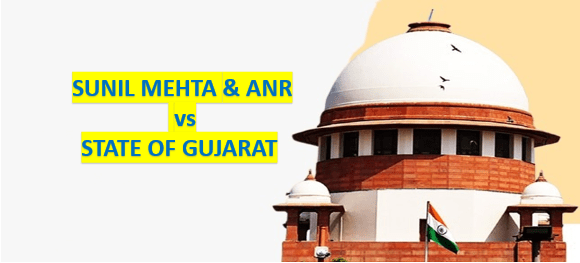
BACKGROUND FACTS:
In this very case, a complaint was registered concerning the commission of the offences under sections 406, 420, and 114 read with Section 34 of the Indian Penal Code on the part of the respondent’s company with the Chief Judicial Magistrate, Gandhi Nagar, Gujarat. The police alleged the case to be of civil nature henceforth, and the magistrate, within his power under Section 156(3), upon the inquiry under Section 202 of the Criminal Procedure Code, ordered the police to proceed as per the charges alleged.
Trial Court’s Observation:
The appellants brought the summoning order into question before the high court. The matter reached the trial court at the stage of adducing evidence on behalf of the prosecution, and the complainant, with a memo, told the court that the evidence annexed with the complaint was to be considered for the purpose of framing charges. The respondent in the trial court contended that the appellant has not led any evidence under Section 244 of the code; hence, depositions recorded before the magistrate under Section 202 cannot be taken as evidence for framing of charges, while the magistrate set the contention aside and framed charges under Sections 406, 420, read with Section 34 of the IPC. Pertaining to the same, the appellants filed a revision before the session judge at Gandhi Nagar, which was allowed taking compliance with Section 245(2) of the CrPC into consideration, setting the order of the magistrate aside, and sending the matter back to the trial court for said compliance of the provisions in view of the judgement of the supreme court in Ajoy Kumar Ghose v. State of Jharkhand [i] and Anr.
Matter Before the High Court:
This revision allowance has led the respondents to file a special criminal application before the High Court of Gujarat, and the High Court observed that the witnesses of the complainant were examined and evidence was recorded. Therefore, the accused had an opportunity to cross-examine the witnesses, but he did not avail himself of the same; hence, it cannot be held that procedure was not followed, and relying on the judgement of the session judge seems to be flawed.
In the Supreme Court of India:
The Honourable Supreme Court of India noted that the reasoning of the High Court appears to be erroneous as it considered the depositions of the witnesses of the complainant prior to the appearance of the accused before the magistrate as evidence under Section 202 of the CrPC. It also considers that the accused can examine the witnesses, as the depositions were recorded. The Apex Court further notes that Chapter XV of the CrPC deals with complaints made to magistrates, and at this stage there is no requirement to notify the accused about the reasons for not taking cognizance and give him the opportunity to cross-examine the witnesses.
Furthermore, the court distinguishes chapter XIX into two parts: first, cases instituted upon a police report; and second, cases instituted upon a police report otherwise. Section 244 forms the second part of the chapter and provides for the court to record and peruse all evidence for the prosecution and to examine it. Section 245 of the same chapter provides for the magistrate
to discharge the accused if unrebutted evidence warrants his conviction. The magistrate even discharged him at a prior stage as per Section 2 of the same provision.
Further, the magistrate is required to follow the procedure of Section 246 if he does not discharge the accused. The magistrate may form the charges thereon if such evidence appears that would allow reasonable grounds to presume that the offence is triable under the chapter. There is no doubt while observing sections 244 to 246 that when an accused appears, the prosecution is to be heard and all evidence is to be recorded. The expression “when such evidence has been taken” contains profound value as significant evidence of prosecution leading to the framing of the charge. There is nothing in this chapter or any provision of the CrPC that suggests taking the deposition of a witness into consideration while taking cognizance by the magistrate.
Respondent’s Concern:
Mr. U.U. Lalit, counsel on behalf of the respondent, contends that Section 244 does not expressly and exclusively provide a right for the cross-examination of the prosecution witnesses by the accused. Further, this provision does not make any difference between evaluating evidence at the stage of cognizance of the matter and summoning the accused or that adduced after the accused appeared before the magistrate under Section 244 of the CrPC. He points towards Section 246(4), which provides for the magistrate to ask about the wish of the accused to cross-examine; this provision offers cross-examination after the framing of charges and not before. Thus, Section 3 forms the appropriate meaning of the evidence for the purpose of Section 244 of the CrPC.
Observations:
It is prudent to say that the evidence referred to in sections 244, 245, and 246 on a plain reading and under the Evidence Act may be admissible if the same is proved and established under the Evidence Act; this also includes the right of parties against whom such evidence is brought to cross-examine the witness.
Evidence under Chapter XIX must be recorded in the presence of the accused, and if he could not cross-examine the evidence or witness, his interest would be in jeopardy. The aim of recording evidence under Section 244 is to give the accused an opportunity to hear the matter of evidence and to defend it by cross-examining the witness to make his evidence’s veracity visible to the court. A court may discharge the accused if no such evidence or consideration arises to frame the charges.
Whether the case against the accused is liable to be formed or not can only be decided in front of the accused, providing him with a right to cross-examine, and if not, then he must be discharged under Section 245 of the CrPC. In order to find the truth, it is pertinent to give the accused the opportunity to cross-examine, as the cardinal principle of the Constitution rests on the principle of natural justice. The life and liberty of the person are recognised as superior rights and cannot be curtailed without giving him the chance to defend himself against one who opposes him with testimony and evidence.
It was observed that the right of cross-examination granted to the accused under sections 244 to 246 cannot prejudice the case of the complainant or cause him injustice, while such denial to the accused may result in harm to the accused and justice. If, after the framing of charges,
the accused can cross-examine the prosecution witness, then the intent of Section 246(4) does not prohibit the accused from cross-examining the witness before the framing of the charges.
The apex court found itself in consonance with the view of Ajoy Kumar Ghose (supra), where the trial court framed charges against the accused without the prosecution having any evidence. This court ruled that the trial court was not correct with the procedure, as Section 246(1) provides that charges must be framed after taking some evidence from the complainant into consideration.
The apex court clarified the position of the expression “or at any previous stage of the case” in Section 246(1), as it did not imply that a magistrate can frame charges against an accused even before any evidence is led by the prosecution. The apex court took the view of Sambhaji Nagu Koli v. State of Maharashtra [ii], in which it was held by the Bombay High Court that the Magistrate may be pleased to frame the charges even before the all-prosecution evidence, but at least there is some evidence. The charges cannot be framed on the basis of the nullity of the evidence on the part of the prosecution. The learned single judge relied upon the judgement of Abdul Nabi v. Gulam Murtaza Khan. [iii]
The apex court recognises the accused’s right to cross-examine as a salutary right against the prosecution witnesses at the stage of 244(1). Through this right, the accused can show, by cross-examination, that there is no justifiable ground for him to face trial. In the interpretation of this section, it is inferable that prejudice and injustice may result if the accused loses his right to cross-examination at this stage.
The apex court takes note of Harinarayan G. Bajaj v. State of Maharashtra, in which the court reiterated the position of Ajoy Kumar Ghose (supra) and held that the right of the accused to cross-examine the prosecution witness is a valuable right. It is only through cross examination that he can show that there is no need for a trial against him. The denial of this right would be prejudicial to his interests.

Judgement:
The Honourable Apex Court held that the High Court committed an error in its judgement while intervening with the order of the trial court. The High Court has wrongfully ignored the fact that the accused had an opportunity to cross-examine or that he did not avail himself of the opportunity when the witnesses were under examination under Chapter XV of the CrPC.
The Apex Court allowed the appeal with a cost of 50000 rupees, set aside the order of the High Court, and restored the order of the session judge.
[i] (2009) 14 SCC 115
[ii] 1979 Cri LJ 390 [iii] 1968 Cri LJ 303 (AP)
written by Swarnim Tripathi, Lloyd School of Law





0 Comments