
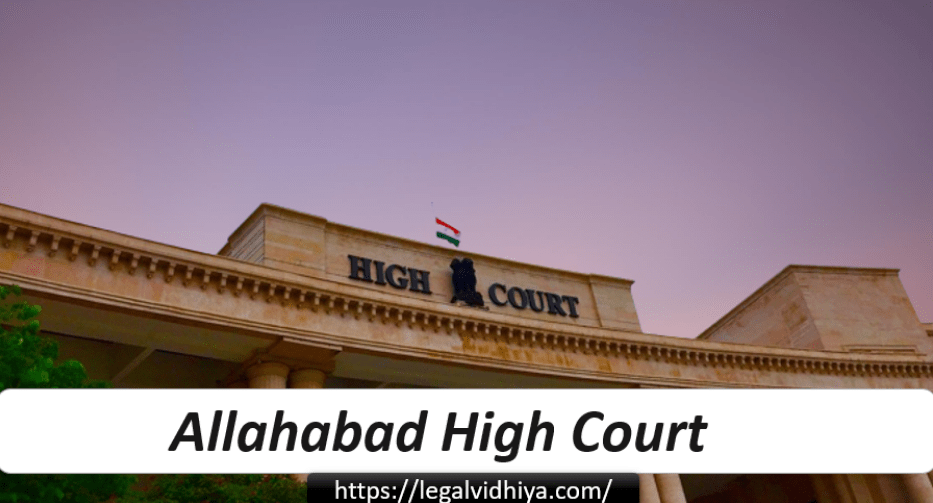
The Allahabad High court in a recent case rejected the decision given by the trial court on the justification of less testimonies by the witnesses. In it, the Allahabad High Court set aside the sentence of the death penalty imposed on a man accused of killing his mother-in-law and brother-in-law by setting them ablaze as the Court noted that his guilt had not been established beyond reasonable doubt.
The division bench consisting of Justice Ashwani Kumar Mishra and Justice Syed Aftab Husain Rizvi said these words in a joint statement: “We find in the facts of the case that the court below has not subjected the testimony of witnesses to scrutiny and has accepted the prosecution case on its basis. The law with regards to the evaluation of the dying declaration has also not been applied correctly in the facts of the present case.”
The facts of the case go like this.
The allegations against the accused were that on June 17, 2003, he came to the house of the deceased persons (mother and brother-in-law) to enquire about the whereabouts of his wife and daughter. When the family members informed him that two of them had not come to the house, he started abusing them and at about 1.00 in the night, he poured petrol and set ablaze the deceased persons. Both persons were taken for treatment to the hospital where the mother-in-law of the accused died on the spot and his brother-in-law died during his treatment. Importantly, the Court heavily relied upon the dying declaration of Deepchand (brother-in-law of the accused). The Trial Court, based on evidence led in the matter, concluded the motive behind committing the act was the desire of the accused to keep his daughter with himself as his mistress, and since this was objected to by her in-laws and the wife, the accused ultimately killed his mother-in-law and brother-in-law. The Court had opined that since the wife of the accused had got her daughter married on the date of the incident and apparently the accused was enraged by such an act, he committed the “ghastly” act resulting in the brutal death of two persons. The trial court, therefore, found the charges under Sections 302, 504 IPC to have been proved against the accused-appellant and he was awarded a sentence of the death penalty.
In response to this the High Court Having analyzed the entire case of the prosecution, the evidence produced by it and the arguments advanced by the counsels, at the outset, observed that the testimony of witnesses was limited to the statement of fact about the accused coming to the house of the deceased and making inquiries about his wife and daughter and nothing was said about what the contents or exchange of words between the witnesses and accused, which enraged him to the extent that he later on, killed two of his in-laws. The Court also found substance in the arguments advanced by the Amicus curiae Rajarshi Gupta that the motive (that the accused wished to keep his daughter with himself) was introduced later, to portray a horrific picture of the accused as being a person who wanted to keep his own daughter and thereby to suggest that he could go to any extent to commit a brutal and barbaric. Further, the Court also did not find much truthfulness in the testimony of PW1 and PW2 regarding the facts narrated by them. Similarly, testimonies of PW3 and PW4 were also discarded by the Court. Regarding the evidence of the dying declaration of deceased brother-in-law, the Court found several material contradictions in the same (as recorded by the Magistrate) viz-a-viz the statement recorded by the Investigating Officer.
Lastly, in Jugal vs. State of U.P. 2023 LiveLaw (AB) 283 [CAPITAL CASES No. – 3809 of 2015 with Reference No.10 of 2015] the finding that the law about the evaluation of the dying declaration had not been applied correctly in the facts of the present case, the Court granted him the benefit of the doubt and allowed his appeal paving the way for his release noting that he has already undergone 10 years of imprisonment.
DIVYA SALGAONKAR, 3rd YEAR BLS, COLLEGE NAME: VES COLLEGE OF LAW intern under legal vidhiya
Plagiarism Report



0 Comments