
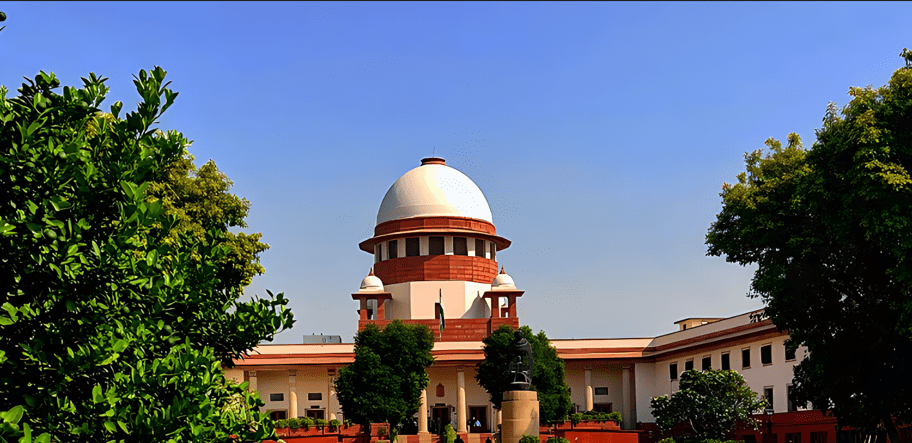
In a recent ruling, the Supreme Court of India provided important clarifications regarding the application of the three-month limit under Article 22(4)(a) of the Constitution in cases of preventive detention. The Court dismissed an appeal challenging a preventive detention order issued under the Andhra Pradesh Prevention of Dangerous Activities of Boot-leggers Act, Dacoits, Drug Offenders, Goondas, Immoral Traffic Offenders and Land Grabbers Act, 1986.
The appellant had contested the order, arguing that if the State Government intends to detain a person for the maximum duration of twelve months, a preliminary detention order must be issued for three months, followed by three extensions, as interpreted in the case of Cherukuri Mani v. Chief Secretary, Government of Andhra Pradesh. However, the Supreme Court disagreed with this interpretation.
The Court clarified that the three-month time limit prescribed by Article 22(4)(a) applies only to the period before the Advisory Board’s report is obtained. After receiving the Board’s opinion, the State Government has the authority, as per Section 12 of the Act, to either confirm the detention order, extend the detention for a maximum of twelve months as outlined in Section 13 of the Act, or release the detainee without delay.
The Supreme Court emphasized that Article 22(4)(a) is applicable at the initial stage of passing the order of detention by the State Government or an officer, and not at the stage subsequent to the report of the Advisory Board. It clarified that the period of three months mentioned in Article 22(4)(a) relates to the initial period of detention until the receipt of the Advisory Board’s report, and does not influence the duration of detention after the confirmatory order is passed by the State Government.
The case before the Supreme Court involved a detention order spanning twelve months, which was challenged on the grounds that it might be jurisdictionally incorrect and contradictory to the mandate of sub-section (2) of Section 3 of the Act. The Court held that the period mentioned in Section 3(2) refers to the period of delegation of powers by the state to the District Magistrate/Commissioner and is not relevant to the duration of detention itself.
Furthermore, the Court discussed the implications of specifying the period of detention in a detention order. It cited the precedent set by a Constitution Bench in the case of Makhan Singh v. State of Punjab, stating that the period of detention should be determined only after the Advisory Board returns a report justifying the detention. Fixing the period of detention in the initial order itself would be against the scheme of the Act.
Addressing another issue in the case, the Court considered whether the mere registration of four First Information Reports (FIRs) under the Andhra Pradesh Prohibition Act, 1995, could establish sufficient grounds to prove that the appellant’s actions as a boot-legger were prejudicial to public order. The Court concluded that the demarcation between matters of law and order and those concerning public order is often complex. It highlighted that the impact of an act on public order should be assessed based on the potential consequences of the act in the context of the surrounding circumstances.
The Court affirmed that while the sale of liquor may not ordinarily be an activity prejudicial to public order, if it poses a danger to public health, it becomes a matter of concern. In this case, the detaining authority had explicitly stated that the sale of liquor by the appellant posed a health risk. The Court emphasized that the sufficiency of material to justify detention is within the subjective judgment of the detaining authority and not for the courts to decide based on an objective basis.
In its conclusion, the Supreme Court dismissed the appeal and upheld the judgment of the Andhra Pradesh High Court, providing significant clarifications on the application of the three-month limit under Article 22(4)(a) of the Constitution in cases of preventive detention.
Case title: Pesala Nook Raju v. Govt of Andhra Pradesh
Citation: 2023 LiveLaw (SC) 678
Written By: Shriya Ayalasomayajula, Nyaya Vidya Parishad, Intern at Legal vidhiya




0 Comments