
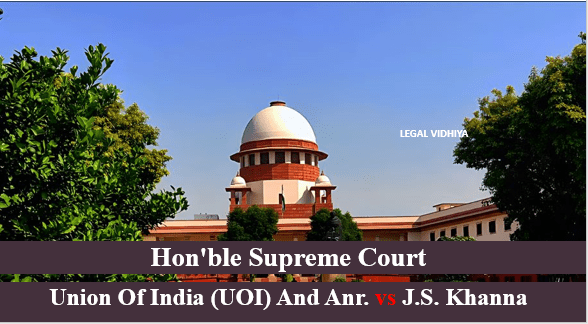
Citations: 1972 CriLJ 849, (1972) 3 SCC 873, 1972 (4) UJ 119 SC
Date of Judgement: 21 October, 1971
Court: Supreme Court of India
Case Type: Appeal Against Orders of Statutory Bodies
Appellant: The Union of India and Others
Respondent: Lt. Col. J.S. Khanna, ani Res. Major Lala
Bench: I D Shelat, S Roy
Referred: Sections- 120B IPC, Prevention of Corruption Act 5, 5(1), 6, 6(1),6(1)(a), 5(2) 197(1)(a), 173 CrPc
Facts:
Lt. Col J.S Khanna and Res Major Lala, were Chief Engineer, Tusker Project at Tezpur attached to the headquarters. Their duties were to ensure supplies of goods such as motor spare parts, required for military trucks and other vehicles conveying troops, materials, etc to forward areas in Assam and NEFA. These two officers were responsible for placing orders with a firm called Manik Motor Works, manipulation in obtaining supplies before orders in relations to them were placed, and in some other cases, even before issuing of quotation enquiries and obtaining in answer to such enquires quotations as relevant rule in connection with supplies.
They paid exorbitant prices for such materials and the quotations obtained by them were opened which is contrary to the rules, without then keeping a second officer present, that at the instance of Manik Motor Works Res. Lala introduced the name of M/s. Auto Stores (non-existent firm) in the list of approved firms with the object of showing that the quotations of Manik Motor Works were lower than those of other suppliers, and lastly, that the two were guilty of fabricating certain quotations said to have been given by firms such as the United Motor Works and Darrang Transport Go.
These two officers and five others were said to be liable for that they along with those others entered into a criminal conspiracy with the object of cheating and defrauding the Government of India, and with that end of fabricating documents and of accepting supplies in breach of the rules governing them. There were nevertheless statements of the representatives of United Motor Works and Darrang Transport Co., according to which neither of the two firms had tendered any quotations. Those statements also showed that there was no firm of the name of Auto Stores in Tezpur.
Special Judge held the accused was punishable under Section 173 of the CrPC, and a prima facie case had been made out thereupon framed 13 charges against J.S Khanna and Lala and five others under Section 120B of IPC, Section 5(2) with Section 5 (1)(d) of the Prevention of Corruption Act 1947 and 420, 468 and 109 of IPC.
Issues:
- If these entries were genuine in the exercise books and the statement of Gupta was accepted, the question is, could this commission said to have been paid to Lala be alleged?
- Is it possible for either of the two respondents to discover that those quotations were forged ones?
- It may be observed that these quotations had gone, according to the procedure, before the accounts section and were there accepted without any objection. If that was possible in the accounts section, was that not possible also before the two respondents?
Arguments:
Some goods were purchased after making spot enquiries and without following the usual procedure of quotations, receiving them, opening them in the presence of two officers and then selecting the firm from whom the article should be purchased. Might be possible that the goods might have been required immediately especially in an emergency like the one which was then prevailing and an officer might find it difficult, if not impossible, to go through the routine, possible in peace time. No inference of fraud could, therefore, be drawn from the fact of spot enquiries.
In some cases, supplies were made even before the date of orders, the date when delivery had to be made. This fact might again excite suspicion. But a closer scrutiny dispels such a suspicion. If an article was needed urgently, a spot inquiry of its availability could be made and an oral order placed. The dealer would send a credit voucher and the article in question. We saw a few of such vouchers & found that none of them mentioned the price as the price was not at that stage fixed. The price it appears, was fixed later on and it was then that a written supply order was issued to the dealer. That was why in some cases the dates in the vouchers were earlier than those of the supply orders. Such a procedure might not be in accord with the rules prescribed for purchases. But a breach of that procedure does not surely mean fraud or any other criminality.
When the investigating officer together with two punch witnesses went to search the residential part of the premises occupied by Manik Motor Works, accused Manik Chand was found coming from the rear balcony. Three exercise books were recovered from a drum kept in that balcony. The search party seized them as also three rough cash books maintained in Hindi. In one of the exercise books, there were entries showing payment of various amounts, as commission to res. Lala.
Judgement:
The Special Judge drew up charges on footing of a conspiracy to defraud the Government, although he has only seen the prima facie case against the two respondents. Even then, there had to be some material before the Special Judge which could point towards a conspiracy in which the two respondents had joined. There is no link to whether Lt. Col J.S Khanna and Res Major Lala with the person tendered those quotations, it is very difficult that they were conspirators who had joined with rest of the accused to defraud the Government. Under such circumstances, the Apex Court was unable to agree with contention of Mr Mukherjee that the High Court was in error in coming to the conclusion that no prima facie case had been made out against them, the Apex Court was unable to agree with contention of Mr Mukherjee that the High Court was in error in coming to the conclusion that no prima facie case had been made out against them
Conclusion:
In the above discussed case, the lack of creating the link between the two officers and the person tendered those quotations the Apex Court was indecisive to whether it should really punish the two officers or not, because the allegations on them were not entirely proven and were serious offences, at such, no rush can be made of good use. At such these allegations weren’t relied upon and the appeal which was on the two officers was dismissed in no time.
References: https://indiankanoon.org/doc/648546/
https://www.casemine.com/judgement/in/5609ab78e4b014971140c967
This article is written by Siddhant Raj of University of Allahabad, Intern in Legal Vidhiya.




0 Comments