
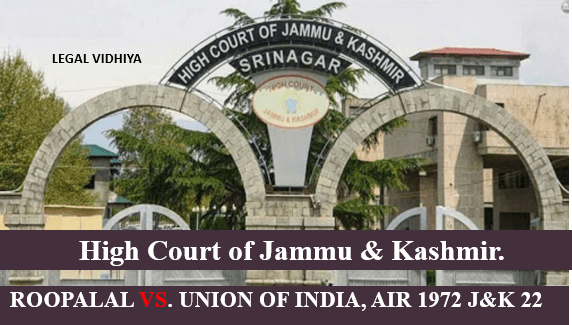
ROOPALAL VS. UNION OF INDIA, AIR 1972 J&K 22
| Citation | AIR 1973 HP 14. |
| Date of Judgment | 27TH November, 1972. |
| Court | High Court of Jammu & Kashmir. |
| Case Type | Civil Writ Petition Challenging the constitution. |
| Appellant | Rooplal. |
| Respondent | Union of India. |
| Bench | Justice Jagdish Sahai & Justice S.M.Fazl Ali. |
| Referred | Section- 2 of Jammu & Kashmir Civil Services Rules, 1956. |
FACTS OF THE CASE
The petitioner was a government employee who had been compulsorily retired under the above mentioned provision, he challenged his retirement on the grounds that it violated his fundamental rights under the constitution of India with the reference with the equality, right to protection of life, personal liberty.
ISSUES
- Issue before the court arose was whether Section 2 of the Jammu & Kashmir Civil Services Rules was violative of appellant, as court needed to examine whether the provision was in line with the given principles?
ARGUMENTS
The petitioner argued that the provision was discriminatory as it provided the government with arbitrary powers to retire employees based solely on age or years of service; he contended that this violated the right to equality under Article 14 of the constitution. Also argued that the provision also affected the personal liberty under Article21 and right to work under Article19(1)(g).
The respondent the Union of India justified the provision by stating that it was a reasonable restriction on the right of the employees in the interest of the efficiency of the public administration.
JUDGEMENT
The court held that Section 2 of the Jammu and Kashmir Civil Services Rules, which allowed for compulsory retirement, was in violation of the petitioner’s fundamental rights. The provision was found to be arbitrary, as it did not lay down any objective criteria for determining when an employee should be retired. This lack of clarity and discretion resulted in the potential for abuse of power by the government.
The court further held that the principles of natural justice, which require a fair hearing before reaching a decision, had not been followed in the case of the petitioner. The court emphasized that the right to be heard is a fundamental aspect of the principles of natural justice, and it cannot be dispensed with.
Based on these findings, the court declared Section 2 of the Jammu and Kashmir Civil Services Rules as unconstitutional and struck it down.
In conclusion, the Rooplal vs. Union of India case analyzed the constitutional validity of compulsory retirement provisions for government employees. The court found such provisions to be violative of fundamental rights and the principles of natural justice. This case set an important precedent in ensuring fairness and objectivity in determining compulsory retirement.
REFERENCES
https://indiankanoon.org/doc/1043771/
This Article is written by Bhumika H Brahmbhatt of JG Institute of Law, Intern at Legal Vidhiya.





0 Comments