
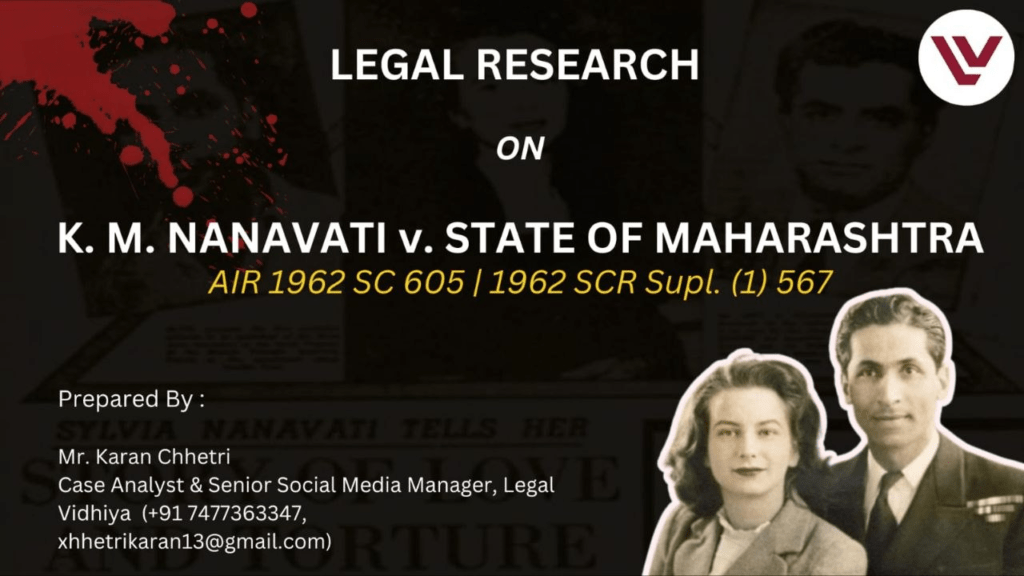
A critical legal research publication on K. M. Nanavati v. State of Maharashtra, analyzing murder, grave and sudden provocation, jury trial, and judicial review in Indian criminal jurisprudence, by Mr. Karan Chhetri.
EXECUTIVE SUMMARY
K. M. Nanavati v. State of Maharashtra [AIR 1962 SC 605] stands as one of the most consequential decisions in Indian criminal law. Decided by a five-judge bench of the Supreme Court in 1962, the case arose from the shooting of Prem Bhagwandas Ahuja by Commander Kawas Manekshaw Nanavati, a naval officer, on 27 April 1959 at Ahuja’s Bombay residence, after Nanavati’s wife confessed to an adulterous relationship.
The case raised fundamental questions about premeditation and provocation, the boundary between murder under Section 300 IPC and culpable homicide under Section 299 IPC, and the structural integrity of the jury system. The facts were straightforward on the surface — a naval officer killed his wife’s lover — but concealed deep legal complexity.
The trial traversed three judicial tiers. At the Sessions Court, a jury returned a ‘not guilty’ verdict by 8:1. Sessions Judge R.B. Mehta, finding the verdict perverse, referred the case to the Bombay High Court under Section 307, CrPC, 1898. The High Court convicted Nanavati under Section 302 IPC and sentenced him to life imprisonment. The Supreme Court affirmed this conviction in full.
Principal Legal Issues
Six issues were central to the proceedings: (i) the propriety of the reference under Section 307 CrPC; (ii) whether the act constituted murder or culpable homicide under the IPC; (iii) the applicability of Exception 1 to Section 300 IPC (grave and sudden provocation); (iv) the sufficiency of the prosecution’s evidence; (v) whether premeditation was established; and (vi) the constitutional validity of the Governor’s subsequent pardon.
Main Findings
The conviction was legally correct. Nanavati’s conduct in the hours between the provocation and the killing — dropping his family at a cinema, obtaining a service revolver from his naval vessel under false pretences, and driving across Bombay to Ahuja’s apartment — established premeditation beyond any reasonable doubt. This chain of deliberate acts fatally undermined the provocation defence, which requires an unmediated, instantaneous link between provocation and act.
The Supreme Court affirmed that Exception 1 was inapplicable: the provocation lacked the essential element of suddenness, and words alone, even if insulting, do not generally constitute grave provocation under Indian law. The jury’s verdict was perverse — driven not by evidence but by public sentiment and the Blitz magazine campaign portraying Nanavati as a wronged hero.
The broader significance of the case lies in its role as the proximate cause of the abolition of the jury trial system. The Code of Criminal Procedure, 1973, omitted all jury provisions, ending an institution proven incompatible with the social and institutional conditions of Indian democracy. The Governor’s subsequent pardon of Nanavati, while constitutionally valid, raised uncomfortable questions about social privilege and the equal application of criminal law.
II. INTRODUCTION
2.1 Historical and Contextual Setting
Few criminal cases in Indian legal history have combined dramatic facts, profound legal questions, and sweeping institutional consequences as effectively as Nanavati’s case. The events arose in the social milieu of post-independence Bombay — a cosmopolitan city at the crossroads of modernity and tradition. The principals were drawn from the upper echelons of Bombay’s social elite: Commander Kawas Manekshaw Nanavati, a Parsi naval officer with an unblemished service record; his wife Sylvia, a British national; and Prem Bhagwandas Ahuja, a wealthy Sindhi businessman who had developed an intimate relationship with Sylvia.
The facts carried the hallmarks of classical tragedy: marital betrayal, wounded honour, violent resolution, and the subsequent collision of law with public sentiment. The case became a national spectacle, driven in large part by Blitz magazine’s portrayal of Nanavati as a wronged hero and Ahuja as a villainous seducer. This framing animated the jury’s emotionally charged verdict — a verdict that ultimately sealed the fate of the jury system in India.
The case simultaneously operates on several legal and sociological levels: as a study in the provocation doctrine; as an examination of direct and circumstantial evidence in homicide cases; as an institutional referendum on jury trial in a developing democracy; and as a revealing episode in the politics of executive clemency.
2.2 Significance in Indian Criminal Law
The legal significance of this case is multi-dimensional. On substantive criminal law, the Supreme Court’s judgment remains one of the most authoritative expositions of the distinction between murder under Section 300 IPC and culpable homicide under Section 299 IPC. The Court’s analysis of Section 300’s four clauses, the general exceptions in Chapter IV, and Exception 1 in particular has been a foundational reference in Indian criminal jurisprudence for over sixty years.
On evidence law, the interplay of direct testimony, circumstantial evidence, forensic findings, and quasi-confessional statements raises enduring questions about the standard of proof in capital cases. On procedure, the case is the most celebrated application of Section 307, CrPC, 1898, and the Supreme Court’s endorsement of the Sessions Judge’s reference established vital precedent on the scope of appellate superintendence over jury findings.
At the institutional level, the case catalysed the abolition of jury trials through the Code of Criminal Procedure, 1973. The Law Commission of India and Parliament drew directly on the Nanavati verdict as empirical justification for that reform.
2.3 Scope and Structure of the Report
This report provides a comprehensive legal analysis of the case. After articulating research objectives and methodology, it proceeds to a chronological reconstruction of the material events. It then identifies the principal legal issues, surveys applicable statutory and constitutional provisions, and assesses the prosecution’s evidence category by category.
Arguments advanced by both sides are examined in detail, followed by analysis of the judicial reasoning at each tier of adjudication. The critical analysis evaluates the correctness of the judgments, identifies evidentiary gaps and procedural concerns, and locates the case within its broader doctrinal context. The report concludes with an assessment of the case’s enduring impact and concrete suggestions for reform.
III. OBJECTIVES OF THE STUDY
This research report is guided by the following analytical objectives:
- To undertake a critically analytical examination of the facts, circumstances, and legal issues in K. M. Nanavati v. State of Maharashtra [AIR 1962 SC 605].
- To examine the distinction between murder under Section 300 IPC and culpable homicide under Section 299 IPC with reference to the judicial interpretation in this case.
- To critically analyse the scope and applicability of Exception 1 to Section 300 IPC (grave and sudden provocation), and evaluate whether it was correctly rejected by the appellate courts.
- To assess the adequacy and admissibility of the prosecution’s evidence — direct, circumstantial, forensic, and confessional — under the Indian Evidence Act, 1872.
- To evaluate the propriety of the Sessions Judge’s reference under Section 307, CrPC, 1898, and determine whether the jury verdict was legally perverse.
- To examine the institutional implications of the case, particularly its role in precipitating abolition of the jury system through the CrPC, 1973.
- To critically evaluate the judicial reasoning at the Sessions Court, Bombay High Court, and Supreme Court levels.
- To identify evidentiary gaps, investigative deficiencies, and procedural concerns that may have affected trial fairness.
- To assess the constitutional implications of the Governor’s pardon of Nanavati under Article 161 of the Constitution.
- To formulate evidence-based suggestions for legislative and institutional reform in criminal procedure, evidence law, and judicial administration.
IV. RESEARCH METHODOLOGY
4.1 Nature of Research
This report is doctrinal in nature, relying on the analysis of primary legal materials — statutory provisions, judicial decisions, and constitutional text — supplemented by secondary sources including legal treatises, academic commentaries, law review articles, and Law Commission Reports. The doctrinal method is appropriate for a moot court report of this character, since the primary objective is to elucidate, analyse, and critically evaluate the legal rules, judicial reasoning, and doctrinal consequences of the case.
The doctrinal approach is complemented by analytical legal research — not merely describing the existing law but evaluating whether the principles were correctly identified, interpreted, and applied. Where warranted, comparative observations are drawn from English criminal law, which served as the source of the relevant Indian statutory provisions.
4.2 Sources of Data
Primary sources include: (i) the five-judge bench judgment of the Supreme Court in K. M. Nanavati v. State of Maharashtra [AIR 1962 SC 605; 1962 SCR Supl. (1) 567]; (ii) the Bombay High Court judgment in the same matter; (iii) the Indian Penal Code, 1860; the Code of Criminal Procedure, 1898; the Indian Evidence Act, 1872; and the Constitution of India.
Secondary sources include legal textbooks by K.D. Gaur, R.V. Kelkar, and Ratanlal and Dhirajlal; the Law Commission’s Fourteenth Report (1958); journal articles and case commentaries; and select academic works on the jury system and the provocation doctrine.
4.3 Limitations
The trial court record — including witness depositions and the jury charge — is not available in its entirety in the public domain. Analysis of Sessions Court proceedings is therefore based on their recapitulation in the High Court and Supreme Court judgments. Additionally, as a doctrinal study, this report does not undertake empirical research on public attitudes or media coverage, though these are referenced as contextual observations where relevant.
V. FACTUAL BACKGROUND OF THE CASE
5.1 The Principal Parties
Commander Kawas Manekshaw Nanavati was a decorated officer of the Indian Navy, serving as Second-in-Command of INS Mysore at Bombay. Born in 1925 into a distinguished Parsi family, he had an unblemished service record and was socially prominent in Bombay’s upper-class circles. He had married Sylvia, a British national, and the couple had three children. The deceased, Prem Bhagwandas Ahuja, was a wealthy Sindhi businessman who had over time developed an intimate relationship with Sylvia Nanavati.
5.2 Discovery of Adultery — Events of 27 April 1959
On the morning of 27 April 1959, Nanavati returned from a naval voyage. That morning, Sylvia confessed to conducting an adulterous affair with Ahuja and disclosed that she was emotionally deeply involved with him. Rather than confronting Ahuja immediately, Nanavati maintained composure, drove his wife and three children to a cinema hall, and dropped them there. He then drove to INS Mysore, approached the duty officer under the pretext of a scheduled trip, and was issued a .38 calibre service revolver with six rounds. He loaded the weapon and placed it in a brown envelope.
5.3 Commission of the Offence
Armed with the loaded revolver, Nanavati drove to Ahuja’s apartment at Cuffe Parade, entered the building, and made his way to Ahuja’s bedroom. A confrontation took place. Three shots were fired; two struck Ahuja, who died at the scene. The precise verbal exchange within the bedroom was contested at trial. Nanavati’s account was that Ahuja responded to his inquiry about marrying Sylvia with the dismissive remark that he was not going to marry ‘every woman he slept with.’ The prosecution disputed this exchange as a basis for provocation.
5.4 Post-Offence Conduct and Surrender
After the shooting, Nanavati did not flee. He drove to the nearest police station and voluntarily surrendered to the Deputy Commissioner of Police (DCP), reportedly stating, ‘I have shot a man.’ The defence cited this immediate surrender as evidence of transparent conduct, while the prosecution characterised it as consistent with the behaviour of a man who had acted with premeditation and was prepared for the legal consequences. The fact that Nanavati surrendered to the DCP rather than a local station raised procedural questions about the admissibility of statements made at that stage.
5.5 Police Investigation
The Bombay Police examined the crime scene at Cuffe Parade and collected forensic evidence, including the revolver and cartridge cases. A post-mortem confirmed death by gunshot wounds. Statements were recorded from domestic servants in Ahuja’s apartment and from the naval officer who had issued the revolver. A central focus of the investigation was whether the revolver had been procured under false pretences, which went directly to the question of premeditation.
5.6 Trial at Sessions Court, Bombay
Nanavati was charged under Section 302 IPC for murder. The case was tried before Sessions Judge R.B. Mehta with a nine-member jury. The trial attracted intense public interest, fuelled by Blitz magazine’s sustained campaign portraying Nanavati sympathetically and Ahuja disparagingly. After the Sessions Judge charged the jury on the applicable law, the jury returned a verdict of ‘not guilty’ by a majority of 8:1.
5.7 Reference to Bombay High Court
Sessions Judge Mehta, upon reviewing the jury’s verdict against the evidence, concluded it was perverse — that no reasonable jury, properly directed, could have returned it. Under Section 307, CrPC, 1898, he declined to act on the verdict and referred the matter to the Bombay High Court, setting out his detailed reasons. This reference embodied the principle that judicial integrity cannot be subordinated to popular sentiment.
5.8 Bombay High Court and Supreme Court
The Bombay High Court, examining the reference, convicted Nanavati under Section 302 IPC and sentenced him to life imprisonment. Nanavati appealed to the Supreme Court, which dismissed the appeal in a landmark judgment [AIR 1962 SC 605]. Subsequently, the Governor of Maharashtra granted a pardon to Nanavati under Article 161 of the Constitution. Nanavati emigrated to Canada, where he died on 1 January 2003.
VI. LEGAL ISSUES INVOLVED
Issue I: Jurisdiction and Propriety of Reference under Section 307 CrPC, 1898
The first and threshold issue is whether Sessions Judge Mehta was legally justified in declining to act upon the jury’s ‘not guilty’ verdict and referring the case to the Bombay High Court. This requires examination of the conditions precedent to exercising the reference power, the applicable standard of ‘perversity,’ and the nature of the High Court’s jurisdiction upon receiving such a reference. The issue raises the deeper question of whether a judge may legitimately override a jury’s factual determination.
Issue II: Classification of the Offence — Murder (Section 300 IPC) or Culpable Homicide (Section 299 IPC)
The substantive heart of the case is whether Nanavati’s act constituted murder within Section 300 IPC, or merely culpable homicide not amounting to murder under Section 299 IPC. This requires analysis of the four clauses of Section 300 — each defining a distinct form of intentional killing constituting murder — and a determination of the mental element present at the time of the act, particularly whether Nanavati intended to cause death or knew death was the probable consequence.
Issue III: Applicability of Exception 1 to Section 300 IPC — Grave and Sudden Provocation
Closely connected to Issue II, this question is whether Exception 1 to Section 300 IPC applies to reduce the offence from murder to culpable homicide. Exception 1 requires the provocation to be both grave and sudden, such that the offender is deprived of self-control, and requires the killing to follow immediately upon the provocation. The critical factual question is whether the extensive time gap between Sylvia’s confession and the shooting, and the deliberate preparatory steps taken by Nanavati in the interim, negated the ‘sudden’ element essential to the defence.
Issue IV: Sufficiency of the Prosecution’s Evidentiary Case — Proof Beyond Reasonable Doubt
The fourth issue concerns the quality of the prosecution’s evidence — the reliability and corroboration of direct testimony, the completeness of the circumstantial chain, the admissibility of confessional statements, and the role of forensic evidence. Each must be assessed against the criminal standard of proof: beyond reasonable doubt.
Issue V: Proof of Premeditation and the Significance of Preparatory Acts
Whether the prosecution established premeditation beyond reasonable doubt is analytically central to the case. The preparatory acts — dropping the family at the cinema, obtaining the revolver under false pretences, and driving to Ahuja’s apartment — are individually and collectively relevant. Premeditation and sudden provocation are mutually exclusive; establishing the former forecloses the latter.
Issue VI: Constitutional Validity of Executive Clemency
The sixth issue concerns whether the Governor’s pardon under Article 161 was constitutionally valid, institutionally appropriate, and consistent with Article 14’s guarantee of equality before the law. This engages the scope of the pardoning power, the permissible grounds for its exercise, and whether the pardon was motivated by legal considerations or by extraneous social and political factors.
VII. APPLICABLE LAWS
7.1 Indian Penal Code, 1860
Section 299 — Culpable Homicide
Section 299 defines culpable homicide as causing death: (i) with the intention of causing death; (ii) with the intention of causing bodily injury likely to cause death; or (iii) with knowledge that the act is likely to cause death. Culpable homicide is the genus of which murder is the aggravated species, as authoritatively explained in State of Andhra Pradesh v. Rayavarapu Punnayya [AIR 1977 SC 45].
Sections 300, 302, 304 — Murder and Punishment
Section 300 defines murder as culpable homicide satisfying one of four conditions: (i) intent to cause death; (ii) intent to cause bodily injury known to likely cause death of the particular person; (iii) intent to cause bodily injury sufficient in the ordinary course of nature to cause death; or (iv) knowledge that the act is so imminently dangerous that it must in all probability cause death, committed without any excuse for incurring the risk.
Exception 1 to Section 300 provides that culpable homicide is not murder where the offender, whilst deprived of self-control by grave and sudden provocation, causes the death of the person who gave the provocation or of any other person by mistake or accident. The exception requires: (a) suddenness — an instantaneous reaction, not brooded upon; (b) gravity — sufficient to deprive a person of ordinary temperament of self-control; and (c) the act must be done while still under the immediate influence of such provocation. Section 302 prescribes death or life imprisonment for murder. Section 304 provides lesser punishment for culpable homicide not amounting to murder.
7.2 Code of Criminal Procedure, 1898
Section 307 — Power to Disagree with Jury
Section 307 permitted a Sessions Judge who disagreed with the jury’s verdict, finding it erroneous in fact, to make a reference to the High Court. On receiving such a reference, the High Court could try the case itself, acquit or convict, or order a retrial. This provision embodied a significant qualification upon the finality of jury verdicts and was the procedural mechanism through which the Nanavati case reached the High Court.
Sections 268–269 and Section 318
Sections 268–269 regulated jury composition for sessions trials, requiring not fewer than nine jurors in murder cases. Section 318 required the Sessions Judge to charge the jury on the applicable law. The adequacy of the charge to the jury was examined at the appellate stages.
7.3 Indian Evidence Act, 1872
Section 25 renders confessions made to a police officer inadmissible against the accused. Section 27 permits admission of information given by an accused in custody that leads to discovery of a fact. Section 8 makes an accused’s conduct relevant as evidence of intention. Section 6 (res gestae) was relevant to statements made immediately after the offence. Sections 101–104 govern the burden and standard of proof in criminal cases.
7.4 Constitutional Provisions
Article 21 (right to life and personal liberty) was engaged in the context of the capital sentence and executive clemency. Article 20(3) (right against self-incrimination) was relevant to the admissibility of Nanavati’s statements to investigating officers. Article 14 (equality before the law) was engaged by the Governor’s pardon, raising questions about whether the criminal law was applied differently to persons of elevated social standing. Articles 72 and 161 confer the pardoning power on the President and Governors respectively.
VIII. ANALYSIS OF EVIDENCE
8.1 Direct Evidence
8.1.1 Eyewitness Testimony of Household Staff
The most significant direct evidence came from domestic servants at Ahuja’s apartment. Their testimony established: (i) Nanavati’s arrival at the apartment that afternoon; (ii) his possession of a weapon; (iii) the firing of shots; and (iv) Ahuja’s death immediately thereafter. However, none of the servants were present in the bedroom at the moment of shooting, so they could not directly testify to the verbal exchange or the precise circumstances in which the shots were fired.
This gap was of limited practical significance given the strong circumstantial evidence of premeditation. While the eyewitness accounts established the fact of killing beyond doubt, the contested questions — whether Ahuja provoked Nanavati by insulting words, and whether Nanavati acted with sudden passion or calculated intent — had to be resolved primarily through the circumstantial record.
8.1.2 Testimony of the Naval Officer
A naval officer from INS Mysore testified that Nanavati obtained the service revolver by citing a purpose consistent with his duties, effectively deceiving the issuing officer. The official register confirming the weapon’s issuance was produced in evidence. This testimony was highly probative on premeditation: a man acting purely in the heat of passion does not typically pause to execute a calculated deception in order to arm himself before going to confront his target.
8.2 Circumstantial Evidence
Circumstantial evidence in the case was extensive. Per the principles in Sharad Birdhichand Sarda v. State of Maharashtra [AIR 1984 SC 1622], the circumstances must be established by cogent evidence, must be consistent only with guilt, and must be incompatible with innocence. The following circumstances were material:
8.2.1 The Interval Between Provocation and Act
The chronological sequence of 27 April 1959 is perhaps the most compelling circumstantial evidence. After Sylvia’s disclosure, Nanavati: (i) calmly drove his family to a cinema; (ii) drove to INS Mysore; (iii) obtained the revolver under false pretences; (iv) loaded it; and (v) drove across Bombay to Ahuja’s apartment. This occupied well over an hour. Each step was deliberate and purposive. The provocation defence requires uninterrupted deprivation of self-control from the moment of provocation to the killing — a requirement plainly inconsistent with this methodical chain of conduct.
8.2.2 Deliberate Choice of Weapon and Ammunition
Procuring a service revolver, deliberately loading it with live rounds, and concealing it in an envelope throughout the journey to Ahuja’s apartment is strong evidence of formed intention to cause death. The selection of a lethal weapon and its careful preparation for use bespeak calculated deliberation, not spontaneous emotional reaction.
8.2.3 Knowledge of Location
Nanavati proceeded directly to Ahuja’s bedroom without apparent hesitation, indicating familiarity with the domestic arrangements of someone he had known socially for a considerable period. While the evidentiary weight of this observation alone is limited, it forms part of the cumulative circumstantial picture.
8.3 Forensic Evidence
8.3.1 Post-Mortem and Ballistic Analysis
Post-mortem examination confirmed that Ahuja sustained two gunshot wounds, individually and collectively sufficient in the ordinary course of nature to cause death. Cause of death was haemorrhage and organ damage from the gunshot injuries. Ballistic analysis confirmed the weapon had been discharged three times and that the fatal shots came from the revolver issued to Nanavati at INS Mysore. The forensic linkage between weapon, cartridge cases, and wounds was established beyond reasonable doubt.
8.3.2 Forensic Limitations
The forensic analysis, while sufficient to establish the fact and mechanism of death, did not resolve the contested narrative of the bedroom encounter. The precise positions of the men, whether a struggle preceded the shooting, and the sequence of shots could not be conclusively established. These limitations must be understood in the context of forensic science as it existed in 1959. Even within those limitations, the defence could not sustain any version of events that would have warranted acquittal.
8.4 Confessional and Quasi-Confessional Statements
8.4.1 The Surrender Statement to the DCP
Nanavati’s reported statement on surrendering — ‘I have shot a man’ — is admissible as evidence of conduct under Section 8 of the Evidence Act. The courts characterised it as conduct and demeanour, not a formal confession (which would be inadmissible under Section 25). The statement was relevant as part of the same transaction under the res gestae doctrine (Section 6).
8.4.2 Nanavati’s Account of Events
The account attributed to Nanavati — including Ahuja’s alleged insulting remark — was not independently corroborated by any eyewitness or documentary evidence. Both the High Court and the Supreme Court found that even accepting this account at its highest, it did not meet the legal threshold for grave and sudden provocation. The narrative of a sudden verbal provocation was irreconcilable with the systematic preparatory conduct that preceded it.
IX. ARGUMENTS ADVANCED
9.1 Arguments of the Prosecution
9.1.1 The Act Constituted Murder within Section 300 IPC
The prosecution argued that shooting Ahuja three times with a loaded service revolver constituted murder satisfying at minimum Clauses (1) and (3) of Section 300. Under Clause (1), Nanavati acted with the clear intention of causing death, as demonstrated by the deliberate procurement of a firearm, the targeted journey to Ahuja’s residence, and firing at close range. Under Clause (3), two direct gunshot wounds were sufficient in the ordinary course of nature to cause death, and Nanavati — a trained naval officer familiar with firearms — knew this. Every element of actus reus and mens rea was established by the combined direct, circumstantial, and forensic evidence.
9.1.2 Exception 1 was Inapplicable
On provocation, the prosecution advanced three arguments. First, the provocation was not ‘sudden’: Nanavati had received Sylvia’s disclosure earlier that morning, and the long interval of deliberate activity between disclosure and killing negated suddenness. Second, even if Ahuja made an insulting verbal remark, words alone do not constitute grave and sudden provocation under Indian law — citing Rajinder Kumar v. State of Punjab [1966 Cr.LJ 1317] where the Supreme Court held that verbal statements alone are insufficient. Third, the preparatory conduct was fundamentally incompatible with acting without self-control. A man who calmly drops his children at a cinema, procures a firearm under false pretences, and drives across the city to confront his target cannot credibly claim to have been without rational control at the moment of killing.
9.1.3 The Jury Verdict was Perverse
The prosecution supported the reference under Section 307 CrPC and argued the verdict was plainly perverse. No reasonable jury, properly directed on the law and evidence, could have acquitted on these facts. The verdict was the product of public sympathy for a decorated naval officer and the orchestrated media campaign by Blitz — a stark demonstration of the jury system’s structural vulnerability to extra-judicial influences.
9.2 Arguments of the Defence
9.2.1 The Act was Impulsive, Not Premeditated
The defence argued Nanavati had not acted with cold premeditation but was driven by emotional devastation, wounded honour, and the gravity of Ahuja’s contemptuous response. The discovery of adultery had plunged Nanavati into severe emotional turmoil, and upon encountering Ahuja’s dismissive remark — that he would not be marrying Sylvia — Nanavati was suddenly deprived of self-control. The defence emphasised the psychological reality that emotional devastation from betrayal does not dissipate instantly; the accumulated anguish could be characterised as a continuing state of provocation that erupted upon Ahuja’s contemptuous reply.
9.2.2 The ‘Reasonable Man’ Standard
The defence argued that a decorated naval officer whose marriage and honour had been violated would respond as an honourable man. Drawing on English authorities including R v. Bedder [1954] 1 WLR 1119 and Mancini v. DPP [1942] AC 1, the defence submitted the ‘reasonable man’ standard should be applied with sensitivity to the accused’s particular circumstances and characteristics.
9.2.3 The Revolver was Obtained for Self-Defence
The defence contended — with limited credibility, as both higher courts found — that the revolver was taken as a precautionary measure for self-protection, not with intent to kill. This argument was directed at the absence of premeditated intent and supported by the observation that only three shots were fired and Nanavati surrendered immediately rather than fleeing.
9.2.4 The Jury Verdict Represented Legitimate Factual Determination
The defence challenged the reference by the Sessions Judge, arguing the jury’s verdict was the product of a genuine assessment of the evidence and that the Sessions Judge had impermissibly substituted his own view. The power of reference under Section 307 CrPC was said to be intended for extreme cases of manifest irrationality, and the jury’s conclusion was at least plausible given the evidence of provocation and emotional disturbance.
9.2.5 Character Evidence
The defence relied on Nanavati’s service record, his immediate voluntary surrender, his evident distress, and the nobility of his motives as evidence inconsistent with cold-blooded premeditated murder. A man who planned a killing would typically flee or conceal his act; Nanavati’s immediate surrender to police was argued to be conduct inconsistent with deliberate criminal intent.
X. JUDICIAL REASONING
10.1 Sessions Court — Sessions Judge R.B. Mehta
10.1.1 The Jury Charge
Sessions Judge Mehta directed the jury on the elements of murder under Section 300 IPC and the conditions for Exception 1. The charge explained that the provocation must be both grave and sudden, must have deprived the accused of self-control at the moment of the act, and the killing must have occurred while still under the direct influence of the provocation. The jury was directed that preparatory conduct — specifically, the deliberate procurement of a weapon — was relevant to the question of premeditation.
10.1.2 The Reference under Section 307 CrPC
Upon reviewing the 8:1 verdict against the full evidentiary record, the Sessions Judge concluded the verdict was ‘perverse’ — no reasonable body of jurors, properly directed, could on this evidence have acquitted. His reasoning rested on four grounds: the deliberate procurement of a loaded revolver was inconsistent with unpremeditated passion; the time interval negated the ‘sudden’ element; the alleged verbal exchange with Ahuja, even taken at face value, was legally insufficient as grave and sudden provocation; and the verdict appeared influenced by public sentiment and media coverage rather than evidence.
10.2 Bombay High Court
10.2.1 Jurisdiction on Reference
The Bombay High Court held that upon a reference under Section 307, CrPC, it exercised original jurisdiction — not merely a review of the Sessions Judge’s determination of perversity. It was therefore entitled and obligated to independently assess all evidence and arrive at its own conclusion on guilt or innocence.
10.2.2 Analysis of the Provocation Defence
The High Court subjected the provocation defence to rigorous scrutiny. On suddenness, the considerable time interval between Sylvia’s confession and the shooting, and the numerous deliberate acts in between, conclusively negated the ‘sudden’ element. Relying on the English principles in Mancini v. DPP and R v. Duffy [1949] 1 All ER 932, the Court affirmed that a ‘cooling time’ during which the accused acts purposively is fatal to the defence.
On gravity, the High Court found that while marital infidelity was a matter of personal distress, the verbal exchange attributed to Ahuja was insufficient in law to constitute grave provocation. The law does not permit a person to take a life merely because of an insulting verbal reply, however offensive.
10.2.3 Conviction under Section 302 IPC
The High Court convicted Nanavati under Section 302 IPC and sentenced him to life imprisonment, finding the act was done with intention to cause death (Clause (1) of Section 300) and that the injuries were sufficient to cause death in the ordinary course of nature (Clause (3)). The jury verdict was perverse in precisely the sense the Sessions Judge had determined.
10.3 Supreme Court of India — Five-Judge Bench
10.3.1 Validity of the Reference
The Supreme Court upheld the reference under Section 307 CrPC. It held that a verdict is perverse when no reasonable jury, properly directed on law and evidence, could have returned it — a threshold met here given the weight of evidence establishing premeditation and the absence of any legally sustainable basis for acquittal.
10.3.2 Rejection of the Provocation Defence
On provocation, the Court articulated four key principles: (i) provocation must be both grave and sudden — the absence of either is fatal; (ii) the test is partly objective (the standard of a reasonable person) and partly subjective (actual deprivation of self-control); (iii) words alone generally do not constitute grave provocation; and (iv) the killing must be the immediate and direct consequence of the provocation, without any intervening deliberation.
Applying these principles, the Court found the provocation entirely lacking in suddenness. The extensive interval of deliberate activity between the provocation and the killing was conclusively inconsistent with a claim of lost self-control. The procurement of the loaded revolver demonstrated deliberate exercise of rational faculties — Nanavati planned, calculated, and executed the killing. Exception 1 was inapplicable and the conviction under Section 302 IPC was correct.
10.3.3 Observations on the Jury System
The Court made important observations on the jury system that proved prophetic of its abolition. It noted that the system, designed to bring community judgment to bear on criminal guilt, was susceptible to distortion by popular passion, prejudice, and external influences such as media campaigns. A jury returning a verdict not on evidence but on sympathy for the accused fails in its fundamental constitutional function. The perverse Nanavati verdict was cited as a stark demonstration of this systemic vulnerability.
XI. CRITICAL ANALYSIS
11.1 Was the Judgment of the Courts Correct?
11.1.1 Correctness of the Conviction under Section 302 IPC
The conviction of Nanavati under Section 302 IPC was legally correct. The evidence established beyond reasonable doubt that: (i) Nanavati intentionally caused Ahuja’s death by firing a loaded revolver; (ii) the act was done with intent to cause death, or with knowledge that death was a likely consequence; (iii) the act satisfied Clauses (1) and (3) of Section 300; and (iv) no exception — general or specific — applied on the facts.
The rejection of Exception 1 was doctrinally rigorous. The ‘sudden’ element was negated by the extensive, deliberate sequence of acts between disclosure and killing. The ‘gravity’ element, even if conceded in respect of Sylvia’s confession, was not independently supplied by Ahuja’s verbal response — an insulting but unarmed rejoinder, not a physical threat or violent act. The principle that the defence requires an instantaneous, unmediated link between provoking act and lethal response — drawn from R v. Duffy and R v. Holmes [1946] AC 588 — was correctly applied.
11.1.2 Comparative Analysis: English Provocation Doctrine
English provocation doctrine as it stood at the time of Nanavati required: (a) provocation by things done or said; (b) sudden and temporary deprivation of self-control; and (c) death caused in that state. In R v. Duffy, Devlin J. described provocation as causing ‘a sudden and temporary loss of self-control, rendering the accused so subject to passion as to make him for the moment not master of his mind.’ Applied to Nanavati’s facts, this clearly excluded the defence. English law later evolved: the Homicide Act, 1957 modified the doctrine, and the Coroners and Justice Act, 2009 replaced ‘provocation’ with ‘loss of control.’ Indian law remains governed by Exception 1 as enacted in 1860, substantially rooted in the pre-1957 English position, which the courts applied correctly in Nanavati.
11.2 Evidentiary Gaps and Investigative Deficiencies
11.2.1 Absence of Independent Eyewitness Testimony Within the Bedroom
A significant evidentiary gap was the absence of any eyewitness present in the bedroom at the moment of shooting who could testify to the verbal exchange and the circumstances of the confrontation. Nanavati’s account of what occurred remained formally uncontradicted by direct evidence. This gap was of limited practical significance, however, since even accepting Nanavati’s account at its highest, the law did not support acquittal on a charge of murder. The gap mattered more to the public narrative and jury sympathy than to legal analysis.
11.2.2 Incomplete Forensic Examination
Forensic examination of the crime scene, while establishing cause of death and the ballistic chain, did not fully exploit available forensic capacity. Questions about the precise positions of the parties at the moment of firing, whether a physical struggle preceded the shooting, and the sequence of shots were left open to inference. It would be anachronistic to apply contemporary forensic standards to a 1959 investigation. Nonetheless, even within period limitations, a more detailed examination could have produced more definitive evidentiary conclusions on contested factual issues.
11.2.3 Handling of Nanavati’s Police Statements
The treatment of statements made by Nanavati on surrendering to the DCP raises a procedural question: whether investigating officers made complete contemporaneous records, and whether all such records were disclosed to the defence. In high-profile capital cases, the completeness and integrity of the investigative record are of paramount importance. Any selective recording or incomplete disclosure could compromise trial fairness, though there is no evidence in the case record that any actual impropriety occurred.
11.3 Procedural Fairness Analysis
11.3.1 The Media Trial and Its Consequences
The most serious procedural challenge to trial integrity was the intense, partisan media coverage orchestrated by Blitz. R.K. Karanjia’s campaign portrayed Nanavati as a national hero and Ahuja as morally reprehensible, with wide readership among Bombay’s social elite. The 8:1 verdict for acquittal — in the teeth of compelling evidence — strongly suggests the jury’s deliberations were substantially infected by extra-judicial influences.
This illustrates the structural weakness of jury systems in jurisdictions without robust rules against juror exposure to pre-trial publicity. In mid-twentieth century India, where formal safeguards were limited and the prestige of the accused could powerfully shape public and juror perception, this vulnerability was acute. The case remains the canonical example of ‘trial by media’ in Indian legal history.
11.3.2 Access to Effective Defence
Nanavati was represented by senior and experienced defence counsel with access to full legal resources. There is no credible basis for any suggestion that his constitutional right to a fair trial was compromised in terms of access to counsel, disclosure of evidence, or opportunity to cross-examine witnesses. The trial was conducted with the procedural safeguards appropriate to a capital case.
11.4 The Governor’s Pardon — A Constitutional Appraisal
11.4.1 Scope of the Pardoning Power
Article 161 confers on the Governor the power to pardon, reprieve, or remit punishment of persons convicted of offences against State laws. The Nanavati pardon was formally within this power. The Governor acts on the advice of the Council of Ministers, as held in Maru Ram v. Union of India [AIR 1980 SC 2147]. Formally, therefore, the pardon was constitutionally valid.
11.4.2 Equality Before the Law
The manner of the pardon’s exercise raised concerns under Article 14. The principle of the rule of law requires that all persons stand equal before the law without distinction of social standing or community affiliation. A pardon appearing motivated not by humanitarian grounds or new evidence but by the social prestige, military rank, and community affiliations of the convicted person is institutionally troubling. Several commentators of the era made this observation, and the Nanavati pardon stands as a cautionary episode in the constitutional history of executive clemency in India.
11.5 Doctrinal Significance: The Nanavati Principles
Three principles of enduring doctrinal significance were established. First, the standard of ‘perversity’ applicable to jury verdicts under Section 307 CrPC: a verdict is perverse when no reasonable jury, properly directed, could have returned it. Second, the requirement of immediate temporal connection between provocation and act under Exception 1 — no cooling time is permissible, and deliberate preparatory conduct forecloses the defence. This principle has been consistently applied in Muthu v. State of Tamil Nadu [AIR 1987 SC 1381] and K.M. Mathews v. State of Kerala [AIR 1999 SC 3101], among others. Third, the institutional lesson on jury abolition: the CrPC, 1973 drew explicitly on the Nanavati verdict as justification for ending trial by jury.
XII. IMPACT OF THE CASE
12.1 Legal Impact
12.1.1 Abolition of the Jury System in India
The most immediate institutional consequence of the Nanavati case was the impetus it provided to abolish jury trial. The jury system had been introduced by the colonial administration through successive Codes of Criminal Procedure since 1861. Its suitability to Indian conditions — marked by communal loyalties, social hierarchies, and a media ecosystem capable of generating intense public passion — had been debated from the outset.
The Law Commission’s Fourteenth Report (1958) had already recommended abolition, observing that Indian jurors were susceptible to communal, caste, and social sympathies. The Nanavati case confirmed this diagnosis dramatically. The CrPC, 1973, brought into force on 1 April 1974, contains no provision for jury trial. This reform — catalysed in significant measure by the Nanavati verdict — represents a fundamental restructuring of Indian criminal procedure.
12.1.2 The Provocation Doctrine
The Nanavati judgment settled authoritative principles governing Exception 1 to Section 300 IPC: the requirement of immediate temporal connection; the inapplicability of the defence where deliberate preparatory conduct intervenes; and the general principle that words alone do not constitute sufficient provocation. These principles have been consistently applied over six decades in numerous Supreme Court decisions.
12.1.3 Scope of Reference Power and Standards of Proof
Nanavati remains the leading authority on Section 307 CrPC, 1898 and continues to inform the appellate courts’ powers to set aside manifestly perverse factual findings in criminal cases. The case also contributed to developing the law on proof beyond reasonable doubt in capital cases, illustrating how circumstantial evidence — when each link is firmly established and the chain excludes any reasonable innocent hypothesis — can sustain a conviction for the gravest offences.
12.2 Social Impact
12.2.1 The Case as Cultural Phenomenon
The Nanavati case captured the popular imagination in a way few Indian criminal cases have matched. It has been dramatised in several Bollywood films, notably Yeh Raaste Hain Pyaar Ke (1963) and Rustom (2016), and in the 2019 web series The Verdict — State vs. Nanavati. It entered the shared cultural memory of urban India and remains a reference point for popular discussion of justice, honour, and the relationship between law and public sentiment.
12.2.2 Community Dynamics and Social Privilege
The case exposed fault lines of community and social privilege in Indian society. The pronounced support for Nanavati within Parsi community circles and upper-class Bombay, the Blitz campaign, and the Governor’s pardon raised uncomfortable questions about whether equality before the law was genuinely achieved in practice when the accused was a person of social prestige. The contrast between the elaborate social machinery mobilised for Nanavati’s benefit and the relative anonymity of the deceased contributed to public discourse about the unequal administration of justice.
12.2.3 Representation of Women and Marital Infidelity
The manner in which the case was publicly framed is revealing. Sylvia Nanavati was largely absent from the dominant public narrative, which focused on the competing honour claims between two men. The adulterous relationship was characterised almost exclusively as a wrong done to Nanavati, with Sylvia’s agency largely ignored. This framing reflected attitudes to women and marital infidelity that were deeply embedded in the social fabric of the era and remain relevant to contemporary discussions of gender and criminal law.
12.3 Institutional Implications
12.3.1 Reform of Criminal Procedure
The Nanavati case contributed to the broader reflection on criminal procedure reform that produced the CrPC, 1973. The 1973 Code strengthened the role of professional judges in fact-finding, introduced new procedural safeguards, reformed bail law, and generally modernised criminal justice administration. The Nanavati case’s demonstration of the vulnerabilities of the existing system helped create the political and intellectual climate in which such reforms became possible.
12.3.2 Media Regulation and Contempt of Court
The Blitz campaign raised questions about the adequacy of contempt of court laws and pre-trial publicity rules that remain live issues in the era of social media and twenty-four-hour news. The Nanavati case continues to be cited in discussions about ‘trial by media’ and the appropriate limits of media coverage of pending criminal proceedings.
12.3.3 Executive Clemency — Need for Guidelines
The Nanavati pardon contributed to subsequent academic and judicial discussion about principled guidelines for the pardoning power. The Supreme Court’s decisions in Epuru Sudhakar v. Government of Andhra Pradesh [AIR 2006 SC 3385] and Shatrughan Chauhan v. Union of India [AIR 2014 SC 1833] subsequently imposed procedural and substantive constraints on clemency: reasons must be given, decisions must be timely, and extraneous considerations must not influence the outcome. The Nanavati pardon stands as an early instance of the kind of exercise that necessitated these later reforms.
XIII. REFORMS AND SUGGESTIONS
13.1 Strengthening the Framework for Media Coverage of Criminal Trials
The Nanavati case remains the most celebrated example of the contaminating effect of media coverage on the criminal trial process in India. The Blitz campaign demonstrably influenced public sentiment and, through it, the jury’s deliberations. While the jury system has been abolished, prejudicial pre-trial and mid-trial media coverage continues to affect public discourse and potentially influences bench trials. High-profile criminal cases are regularly subjected to ‘trial by media’ in which guilt or innocence is declared in the court of public opinion long before the institutional court has heard the evidence.
Parliament should enact comprehensive legislation governing media reporting of criminal proceedings, incorporating: (i) clear prohibitions on publication of prejudicial material relating to pending cases; (ii) robust contempt provisions applicable to media organisations and journalists; (iii) reporting restriction powers for trial courts in cases presenting substantial risk of prejudice; and (iv) effective sanctions including fines, injunctions, and, in egregious cases, criminal contempt. The Contempt of Courts Act, 1971 requires substantial revision and strengthening for this purpose.
13.2 Codification and Reform of the Provocation Doctrine
Exception 1 to Section 300 IPC reflects Victorian-era English common law and has not been substantively revised since 1860. English law itself has since been significantly reformed — most recently by the Coroners and Justice Act, 2009, which replaced the provocation defence with the broader defence of ‘loss of control,’ incorporating qualifying triggers including fear of serious violence and circumstances constituting an extremely grave wrong.
The Law Commission of India should undertake a comprehensive review of Exception 1 and formulate a statutory reformulation that: (i) clarifies and updates the ‘sudden and grave’ test; (ii) addresses questions of ‘cooling time’ and preparatory conduct in a principled way; (iii) acknowledges the role of psychological disorders and cumulative domestic abuse — including battered woman syndrome — in provocation-related homicide; and (iv) addresses the gender dimensions of the doctrine, which has historically been more sensitive to male ‘honour culture’ than to the circumstances of women who kill in response to sustained abuse.
13.3 Strengthening Standards for Forensic Investigation
The forensic analysis in the Nanavati case reflected the limited forensic capacity of Indian investigative agencies in the late 1950s. Six decades of scientific and technological progress have transformed the scope and reliability of forensic evidence. Parliament and the Central Government, through the Ministry of Home Affairs, should: (i) invest substantially in the capacity of State Forensic Science Laboratories; (ii) mandate adherence to internationally recognised crime scene preservation and analysis protocols; and (iii) introduce statutory requirements for full documentation and disclosure of forensic examination findings in criminal cases, including results of tests conducted regardless of whether they favour the prosecution or the defence.
13.4 Reform of the Law and Practice of Executive Clemency
The Nanavati pardon raised fundamental concerns about the principled exercise of clemency under Article 161. Subsequent Supreme Court decisions have imposed important constraints, but these are largely judge-made. Parliament should enact legislation codifying grounds and procedures for clemency under Articles 72 and 161, incorporating: (i) specified grounds for exercise of clemency — new evidence, doubt as to guilt, humanitarian considerations, post-conviction rehabilitation; (ii) a mandatory requirement to give reasons; (iii) time limits for deciding clemency petitions; (iv) a procedure for notification of victims or their families; and (v) judicial review on grounds of arbitrariness or extraneous motivation, consistent with Epuru Sudhakar v. Government of Andhra Pradesh [AIR 2006 SC 3385].
13.5 Institutionalisation of Witness Protection Mechanisms
The absence of robust witness protection in India poses a persistent challenge to the quality of evidence in criminal cases. The Witness Protection Scheme, 2018 provides for classification of witnesses based on threat levels and appropriate protection measures, but it requires a comprehensive statutory basis with adequate funding and institutional infrastructure. The Union and State Governments should expeditiously enact standalone witness protection legislation, ensuring that witnesses in serious criminal cases can give evidence free from fear of intimidation or reprisal.
13.6 Judicial Training on Evidentiary Standards and Cognitive Bias
The Nanavati case revealed the susceptibility of jury deliberations to social bias and external influence. While jury trial has been abolished, concerns about the influence of social bias, communal sympathy, and the prestige of the accused on judicial decision-making are also expressed in the context of bench trials. The National Judicial Academy and State Judicial Academies should incorporate comprehensive modules on cognitive bias, confirmation bias, and the psychological dimensions of fact-finding in criminal cases into their training curricula. Judges should be equipped to identify and consciously correct for biases that may distort their assessment of evidence.
XIV. CONCLUSION
K. M. Nanavati v. State of Maharashtra [AIR 1962 SC 605] occupies an exceptional and enduring place in Indian criminal jurisprudence. It is a case that transcends its immediate facts — a naval officer killing his wife’s lover — to illuminate structural and doctrinal questions that go to the heart of criminal law: what constitutes murder; when the law may excuse or mitigate a deliberate killing; how a court should approach the factual findings of a jury; what happens when the criminal process is captured by public passion; and whether social privilege distorts the equal application of criminal law.
The Supreme Court’s answers to these questions, delivered unanimously by five judges, were legally correct and institutionally significant. The conviction under Section 302 IPC rested on a thorough assessment of the evidence, including the powerful circumstantial chain established by Nanavati’s deliberate preparatory acts. The rejection of Exception 1 was founded on the precise legal conditions for the provocation defence — conditions clearly not met. The endorsement of the Section 307 CrPC reference affirmed that the integrity of the justice process cannot be sacrificed to popular sentiment, however intense.
The broader institutional consequences — primarily the abolition of jury trial through the CrPC, 1973 — represent a rational and necessary response to demonstrated vulnerabilities. This reform has stood the test of time and is universally accepted as constitutionally sound and practically sound.
At the same time, the case leaves unresolved questions and institutional discomforts that merit continued reflection. The Governor’s pardon raises questions about equal application of the law that legal correctness alone cannot resolve. The Blitz media campaign raises issues about press freedom and judicial integrity that are as pressing in the age of social media as in 1959. And the limitations of the forensic investigation — however understandable in their historical context — illustrate the importance of scientific rigour in evidence-gathering.
The enduring lesson of Nanavati’s case is not about any single doctrine or procedural rule. It is about the conditions necessary for the rule of law to function with integrity: institutional independence, procedural rigour, freedom from social prejudice, and fidelity to the principle that all persons — regardless of rank, community, or public favour — stand equal before the law. These conditions are not self-sustaining. They require constant institutional vigilance, periodic legislative reform, and a legal culture committed to justice as a universal and impartial standard.
XV. REFERENCES AND BIBLIOGRAPHY
A. Primary Sources — Judicial Decisions
1. K. M. Nanavati v. State of Maharashtra, AIR 1962 SC 605; 1962 SCR Supl. (1) 567 (Supreme Court of India).
2. State of Andhra Pradesh v. Rayavarapu Punnayya, AIR 1977 SC 45 (Supreme Court of India).
3. Sharad Birdhichand Sarda v. State of Maharashtra, AIR 1984 SC 1622 (Supreme Court of India).
4. Maru Ram v. Union of India, AIR 1980 SC 2147 (Supreme Court of India).
5. Epuru Sudhakar v. Government of Andhra Pradesh, AIR 2006 SC 3385 (Supreme Court of India).
6. Shatrughan Chauhan v. Union of India, AIR 2014 SC 1833 (Supreme Court of India).
7. Muthu v. State of Tamil Nadu, AIR 1987 SC 1381 (Supreme Court of India).
8. K.M. Mathews v. State of Kerala, AIR 1999 SC 3101 (Supreme Court of India).
9. Rajinder Kumar v. State of Punjab, 1966 Cr.LJ 1317 (Supreme Court of India).
10. R v. Duffy [1949] 1 All ER 932 (English Court of Criminal Appeal).
11. Mancini v. Director of Public Prosecutions [1942] AC 1 (House of Lords, England).
12. R v. Holmes [1946] AC 588 (House of Lords, England).
13. R v. Bedder [1954] 1 WLR 1119 (House of Lords, England).
B. Primary Sources — Statutory and Constitutional Provisions
14. The Indian Penal Code, 1860 (Act No. 45 of 1860), Sections 299, 300, 302, 304.
15. The Code of Criminal Procedure, 1898 (Act No. 5 of 1898), Sections 268, 269, 307, 318.
16. The Code of Criminal Procedure, 1973 (Act No. 2 of 1974).
17. The Indian Evidence Act, 1872 (Act No. 1 of 1872), Sections 6, 8, 25, 27, 101–104.
18. The Constitution of India, Articles 14, 20(3), 21, 72, 161.
19. The Homicide Act, 1957 (England and Wales).
20. The Coroners and Justice Act, 2009 (England and Wales), Section 54.
21. The Contempt of Courts Act, 1971 (Act No. 70 of 1971).
C. Books and Legal Treatises
22. Gaur, K.D., Criminal Law: Cases and Materials (9th ed., LexisNexis, 2019).
23. Kelkar, R.V., Lectures on Criminal Procedure (6th ed., Eastern Book Company, 2018).
24. Ratanlal and Dhirajlal, The Indian Penal Code (35th ed., LexisNexis, 2017).
25. Ratanlal and Dhirajlal, The Law of Evidence (26th ed., LexisNexis, 2018).
26. Mitra, S.C., Indian Criminal Cases: A Digest (13th ed., Eastern Law House, 2010).
27. Pillai, K.N. Chandrasekhara, General Principles of Criminal Law (5th ed., Eastern Book Company, 2014).
28. Seervai, H.M., Constitutional Law of India (4th ed., N.M. Tripathi, 1993).
29. Basu, D.D., Commentary on the Constitution of India (9th ed., LexisNexis, 2014), Vol. 4.
D. Law Commission Reports
30. Law Commission of India, Fourteenth Report: Reform of the Judicial Administration (1958).
31. Law Commission of India, Forty-Second Report: Indian Penal Code (1971).
32. Law Commission of India, One Hundred and Eighty-Second Report: Law Relating to Arrest (2009).
E. Journal Articles and Secondary Sources
33. Baxi, Upendra, ‘The Crisis of the Indian Legal System’ (1982) 23 Journal of the Indian Law Institute 1.
34. Nariman, Fali S., ‘The Indian Legal System: Past, Present and Future’ (2006) 3 NUJS Law Review 1.
35. Tripathi, P.K., ‘The Role of Provocation in the Law of Murder in India’ (1964) 6 Journal of the Indian Law Institute 345.
36. Ghanshyam Singh, ‘Trial by Jury in India: A Study in the Sociology of Law’ (1969) 11 Journal of the Indian Law Institute 512.
37. Menon, N.R. Madhava, ‘Criminal Justice Administration in India: Problems and Perspectives’ (1978) 20 Journal of the Indian Law Institute 221.
38. Witness Protection Scheme, 2018 (Ministry of Home Affairs, Government of India).
Disclaimer: The materials provided herein are intended solely for informational purposes. Accessing or using the site or materials does not establish an attorney-client relationship. The information presented on this site is not to be construed as legal or professional advice, and it should not be relied upon for such purposes or used as a substitute for advice from a licensed attorney in your state. Additionally, the viewpoint presented by the author is personal.





0 Comments