
Prefatory Note
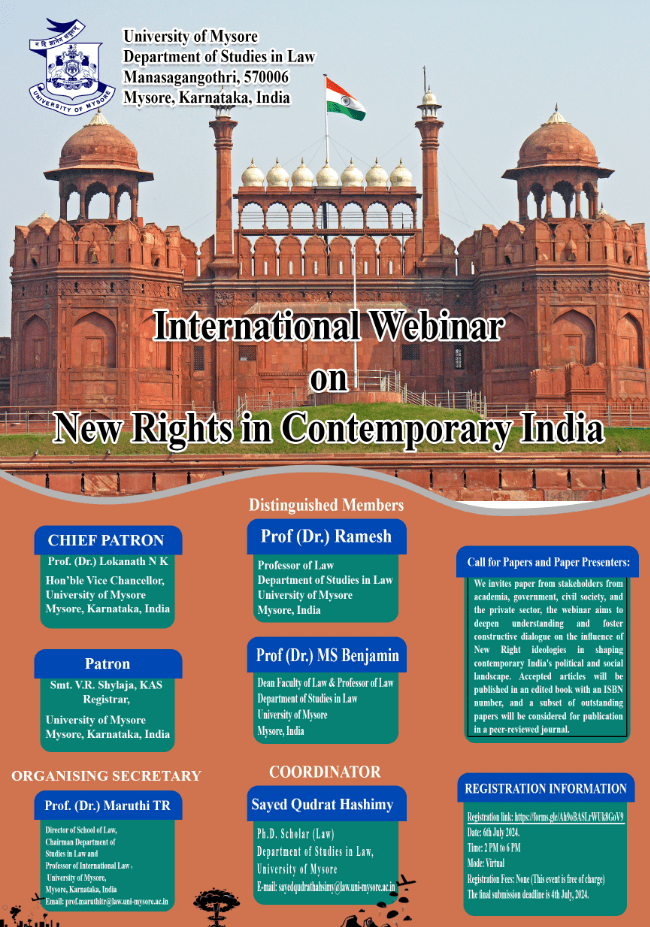
Welcome to the International Webinar on New Rights in Contemporary India. In this era of globalization and interconnectedness, understanding the emergence and impact of various political ideologies is paramount. The term “New Right” encompasses a diverse range of right-wing movements and policies that have emerged in different countries across the globe. This webinar aims to delve into the nuances of New Right ideologies and their manifestations in contemporary India.
The New Rights
The “New Right” has emerged as a formidable force in global politics, encompassing diverse right-wing movements and ideologies across different countries and historical contexts. The New Right has left an indelible mark on diverse political terrains worldwide. From the emergence of Eastern European parties post-Soviet Union to the rise of New Right movements in Australia, Brazil, Chile, France, Germany, Greece, Iran, Israel, the Netherlands, New Zealand, Poland, South Korea, the United Kingdom, and the United States, its influence spans continents. The New Right espouses principles such as democracy, personal freedom, free-market capitalism, reduction of bureaucracy, privatization of state-run companies, tax cuts, and political reform. This webinar endeavors to unravel the multifaceted dimensions of New Right ideologies as they intersect with the socio-political fabric of contemporary India.
In the annals of human rights, the European Convention stands as a testament to the perpetual quest for justice and dignity. Over the span of six decades, its essence has not only endured but flourished, propelled by the winds of change and the relentless pursuit of progress. Central to its dynamism are the Protocols, which serve as conduits for the infusion of new rights into the Convention’s hallowed framework. From the inception of Protocol No. 1, which enshrined the sacrosanct principles of the right to peaceful enjoyment of property, the right to education, and the right to free elections by secret ballot, to the seminal abolishment of the death penalty under Protocol No. 6, each addition has been a stride towards a more equitable and enlightened society.
Protocol No. 4, a beacon of liberty, fortifies the bulwarks of freedom by prohibiting the deprivation of liberty for non-fulfillment of contractual obligations, affirming the right to liberty of movement and the freedom to choose one’s residence, while staunchly opposing the collective expulsion of aliens. Likewise, Protocol No. 7, with its edicts on procedural guarantees, underscores the intrinsic value of justice by ensuring the right to review convictions and sentences, and the right to compensation in cases of miscarriages of justice.
Moreover, Protocol No. 12 stands as a resolute shield against discrimination in all its guises, proclaiming unequivocally that no individual shall suffer the indignity of bias at the hands of any public authority. And in the crucible of Protocol No. 13, the death knell tolls for the ultimate affront to human dignity, as the Convention resoundingly renounces the death penalty in all circumstances, even amidst the tempests of war and imminent threat. Yet, in this symphony of progress, resonance finds its limitations. Protocols, akin to solemn oaths, bind only those states that have pledged their allegiance through both signature and ratification. Mere gestures of intent are insufficient; it is the solemn commitment to uphold these principles that imbues them with the force of law. Thus, as custodians of the Convention, we stand not only as witnesses to its evolution but as stewards of its legacy. In each Protocol, we find not only the promise of a brighter tomorrow but the solemn duty to defend and cherish the rights enshrined within. For in the crucible of human rights, it is not merely the parchment upon which they are written that endures, but the indomitable spirit of humanity itself.
The New Right in India
In recent years, India has witnessed the emergence of New Right ideologies, marked by a shift towards economically liberal and socially conservative policies. This trend has been influenced by both domestic factors and global ideological currents. The webinar will explore how these ideologies intersect with India’s socio-political landscape, including their implications for governance, public policy, and societal values.
Theme
- Analyzing the balance between economic deregulation and social traditionalism advocated by the New Right in India.
- Assessing the influence of New Right ideologies on governmental decision-making processes and policy formulation.
- Exploring the cultural and social factors driving the adoption of New Right principles among different segments of Indian society.
- Examining the challenges and critiques faced by the New Right in India, including concerns related to social cohesion, minority rights, and democratic principles.
Speakers and Panelists
The webinar will feature a diverse panel of experts, including scholars, policymakers, activists, and thought leaders with expertise in Indian politics, economics, sociology, and public policy.
Audience Engagement
Participants will have the opportunity to engage in interactive discussions, Q&A sessions, and virtual networking opportunities, fostering dialogue and exchange of ideas on the complexities of New Right ideologies in the Indian context.
General Details
Organiser: Department of Studies in Law, University of Mysore, India
Event Title: International Webinar on New Rights in Contemporary India
Call for Papers: We invites paper from stakeholders from academia, government, civil society, and the private sector, the webinar aims to deepen understanding and foster constructive dialogue on the influence of New Right ideologies in shaping contemporary India’s political and social landscape. Accepted articles will be published in an edited book with an ISBN number, and a subset of outstanding papers will be considered for publication in a peer-reviewed journal.
Certificates: Digital certificates with QR code verification will be awarded based on active participation and letter of appreciation will be awarded to the Outstanding Presentation.
Submission Guidelines
Submitted abstracts must not exceed 150 words, must include a title, and be accompanied by five keywords and final manuscript must be between 5000-8000 words.
Formatting Guidelines
- Submissions must conform to the Oxford University Standard for Citation of Legal Authorities (OSCOLA), 4th Edition.
- The font shall be in Times New Roman, size 12 with a line spacing of 1.5.
- Footnotes shall be in Times New Roman, size 10 with single line spacing.
How to Submit
To submit a proposal, please click on
Registration link: https://forms.gle/Ah9oBASLrWUk8GoV9
Date: 6th July 2024.
Time: 2 PM to 6 PM
Mode: Virtual
Registration Fees: None (This event is free of charge)
- The final submission deadline is 4th July, 2024.
- Submissions are accepted only in electronic form.
- Submissions must be made in Word format (.doc)/(.docx)
- The submission must be accompanied by a cover letter stating the title of the manuscript, the name and details of the author/authors, and the author’s contact details.
- Co-authorship of a maximum of two persons is allowed.
- The proper acknowledgement must be given for such use of literature in the article submitted.
- The submission will be run through anti-plagiarism software, and plagiarism in any form will result in rejection of the submission.
Eligibility
Academicians, practitioners, researchers, and students in the field of law are invited by the Editorial Board to submit their research articles.
Contact Information
For inquiries and participation confirmation, please contact
Prof. (Dr.) Maruthi TR
Director of School of Law, Chairman Department of Studies in Law and Professor of Law, University of Mysore, Mysore, Karnataka, India
Email: prof.maruthitr@law.uni-mysore.ac.in
Office (+91)-821-2419847
Phone No.+91-6366189651




0 Comments