
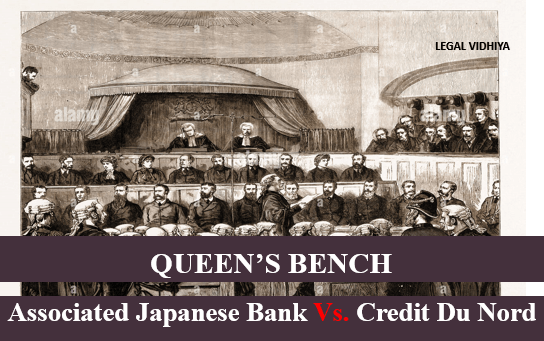
| CITATION | 1988 3 All ER 902 |
| DATE OF JUDGEMENT | 13th April 1988 |
| COURT | Commercial Court; Queen’s Bench Division |
| PLAINTIFF | Associated Japanese Bank |
| DEFENDANT | Credit Du Nord |
| JUDGE | Steyn J., |
INTRODUCTION
In the case of Associated Japanese Bank Vs. Credit Du Nord, is a case under which the plaintiff’s lease over one Bennett over some engineering machines was guaranteed by the defendant. The plaintiff held the defendants liable for the amount due from the lessee, he becoming bankrupt. The centre of issue was whether the defendants were liable over the machines guaranteed against which were found out to be rogue and fraudulent and they never actually existed. This case served as a precedent over issues where the common mistake is the face of the cases. Common mistake is one which is shared by both the partied to the contract. In the case of common mistake, which determines its importance is whether it had a prime importance on the performance of the contract.
FACTS OF THE CASE
- The case was with regards to some engineering machines where were transacted as a result of sale and leaseback transaction.
- The plaintiff bank purchased 4 specified engineering machines from one Bennett and they leased them back to the seller and he received a sum of 1,021,000 euros as a result of that transaction.
- The plaintiff was ready to enter into the transaction only due to the defendant bank guaranteeing over the lessee’s obligations.
- The defendant guaranteed over Bennett’s obligations since they believed that the machines against which the transaction took place actually existed.
- The amount from Bennett became due as he failed to keep up with the payments. It was also discovered that the machines never actually existed and they were fraud perpetrated by Bennett.
- The plaintiff raised claim against Bennett for the outstanding balance due but he went bankrupt. So, the plaintiff bank raised claim against the defendant bank.
ISSUES RAISED
- Whether the defendants were exempted from the payment due to the non-existence of the subject-matter of the contract that is the engineering machines?
- Whether the non-existence of the subject-matter of the contract that is the machines is considered a common mistake and declares the guarantee contract void ab initio?
CONTENTIONS OF THE PLAINTIFF
- The plaintiff was ready to enter into the sale transaction with Bennett due to the act of guarantee by the defendant bank, so they contended that the defendants bank was only liable for the amount due.
- They stated that the principal debtor has defaulted the lease and therefore the guarantor were only liable.
- They held that although there was non-existence of the engineering machines against which the contract was made, the risk of non-payment always pre-existed, so the contract is indeed valid.
CONTENTIONS OF THE RESPONDENT
- The counsel for the respondent contended that the guarantor should be exempted from the payment of the default amount by Bennett because, there exists a right for the guarantor against the property guaranteed. Since in this case, there is non-existence of the engineering machines, which were the subject matter of the contract, their right extinguishes which relieves them from the liability arising from the contract of guarantee.
- It was also contended that the non-existence of the condition precedent, the existence of the engineering machines declares the contract void ab initio.
JUDGEMENT
The contract of guarantee was constructed truly, and the condition precedent that the lease existed only with regards to the four machines’ existence. The court held that the contract between the plaintiff and the defendant was void. The non-existence of the machines was considered to be a fundamental common mistake, since they were the prime consideration into the performance of the contract.
The court held that in order for the common mistake to render a contract void, the parties should have believed something radically and essentially different. The machines were the root of the contract, so the contract was declared void and the defendants were not held liable as the contract was void ab initio.
ANALYSIS
- The common mistake, for to be considered for the declaration of any contract void, it should have made the parties believe something radically and essentially different from what it is truly.
- The common mistake in such sense declares the contract void, and in this case the mistake as to the machines declared the contract void ab initio. By the declaration of the contract as void, exempts the defendants from the payment of the claim.
REFERENCES
- https://www.lawteacher.net/cases/associated-japanese-bank-v-credit-du-nord.php
- https://www.oxbridgenotes.co.uk/law_cases/associated-japanese-bank-v-credit-du-nord
- https://www.studocu.com/row/document/central-university-ghana/company-law/associated-japanese-bank-v-credit-du-nord-sa/8335242
- https://core.ac.uk/download/pdf/37956779.pdf
This Article was written by Magizhini M of The Tamilnadu Dr. Ambedkar Law University (SOEL), An intern as the Legal Vidhiya.
Disclaimer: The materials provided herein are intended solely for informational purposes. Accessing or using the site or the materials does not establish an attorney-client relationship. The information presented on this site is not to be construed as legal or professional advice, and it should not be relied upon for such purposes or used as a substitute for advice from a licensed attorney in your state. Additionally, the viewpoint presented by the author is of a personal nature.





0 Comments