




This article is written by Tanisha Singh of OP Jindal Global University, an intern under Legal Vidhiya
ABSTRACT
The emergence of autonomous weapons systems (AWS) that are driven by artificial intelligence, particularly lethal autonomous weapons (LAWS), pose as one of the most crucial challenges to international Humanitarian Law (IHL), since the advent of nuclear weapons. These systems that can select and engage targets without direct human intervention, are raising profound concerns regarding their compliance with the core principles of IHL which are: Distinction, Proportionality, Precaution and Accountability. This article aims to examine whether existing IHL norms and jurisprudence can regulate autonomous weapons and whether these systems are inherently incompatible with humanitarian law. By integrating landmark judicial decisions, including advisory opinions and international criminal jurisprudence, this article argues that while IHL formally applies to autonomous weapons, their deployment risks undermining the normative foundations of humanitarian law unless strict legal and operational constraints are imposed.
KEYWORDS
Autonomous weapon systems, international humanitarian law, principles of distinction, principle of proportionality, accountability, meaningful human control
INTRODUCTION
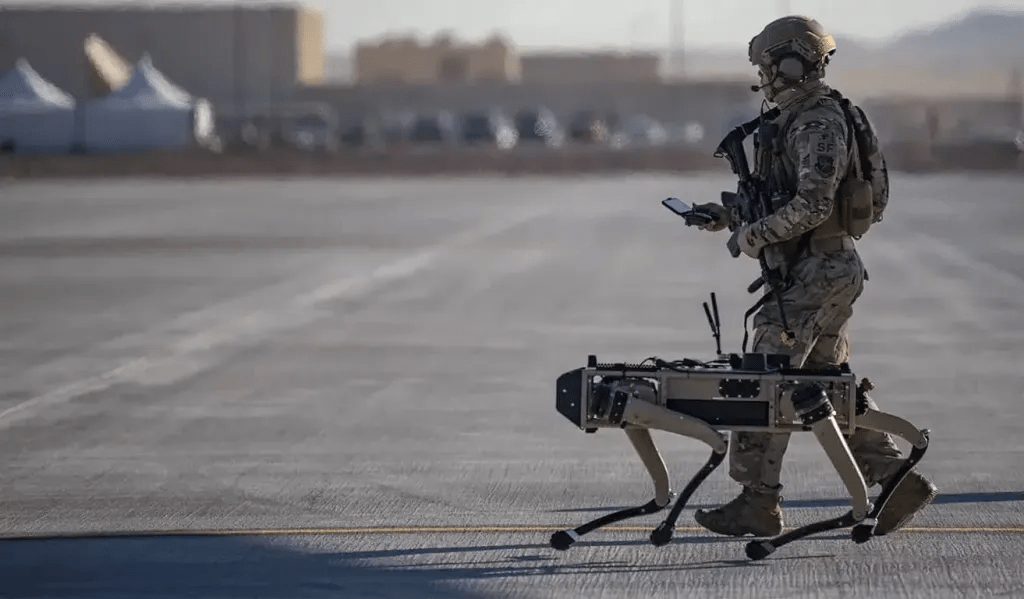
Technological innovation has always shaped the conduct of warfare, but very few developments have provoked as much legal and ethical concern as the artificial intelligence-driven autonomous weapons. Unlike remotely piloted drones or automated defense systems, autonomous weapons are distinguished by their capacity to independently select and attack targets once activated. This delegation of lethal decision-making authority to machines represents a qualitative shift in warfare, one that directly contradicts the foundational assumption of international humanitarian law. IHL was developed on the premise that human agents are capable of moral reasoning, contextual judgement ,legal accountability and that they would make decisions about the use of force. Autonomous weapons destabilize this premise.
The international community has increasingly recognized the urgency to address this issue. The United Nations Convention on Certain Conventional Weapons, CCW, has hosted prolonged debates amongst groups of governmental experts on lethal autonomous weapon systems. Meanwhile, the International Committee of the Red Cross has warned that autonomous weapons pose profound challenges to the application of IHL. Despite this, no binding international instrument currently regulates or prohibits LAWS. This article therefore examines a central question: Can existing IHL, as interpreted through the treaty laws and judicial precedents, meaningfully regulate AI-driven autonomous weapons or do these systems require new legal norms?
APPLICATION OF INTERNATIONAL HUMANITARIAN LAW TO AUTONOMOUS WEAPONS
IHL is supposed to apply to all means and methods of warfare, including those enabled by Artificial Intelligence. Article 36 of Additional Protocol 1 makes states obligated to determine whether any new weapon or method of warfare would be prohibited under the international law. The obligation to conduct legal weapon reviews reflects a broader principle affirmed by international jurisprudence that technological novelty does not exempt a weapon from humanitarian constraints. This position was powerfully articulated by the International Court of Justice in its advisory opinion on the legality of the threat or use of nuclear weapons, where the court affirmed that the fundamental principles of humanitarian law applied to all weapons.Although the court declined to declare nuclear weapons as unlawful, it emphasized that weapons incapable of distinguishing between civilians and combatants or causing unnecessary suffering would violate IHL.This reasoning is directly relevant to autonomous weapons which may be unable by design or operation to comply with the principles in complex environments.
DISTINCTION AND AUTONOMOUS TARGETING
The principle of distinction is an integral part of IHL. Codified in Article 48 of Additional Protocol 1, it requires all parties of armed conflict to always distinguish between civilians and combatants, and to direct operations only towards military objects.The jurisprudence of international criminal tribunals has repeatedly undermined this principle.
in Prosecutor v. Kupreškić,the International Criminal Tribunal for the former Yugoslavia (ICTY) held that attacks that are deliberately directed against civilians violate customary international law and may constitute war crimes. The tribunal emphasised that even in asymmetrical or irregular warfare, the obligation to distinguish between combatants and civilians remains absolute. Autonomous weapons challenge this obligation because they rely on algorithmic pattern recognition rather than contextual human judgement. Civilian behaviour often defies predictable patterns, particularly in non-international armed conflicts where combatants may not wear uniforms or carry arms openly. Autonomous systems trained on historical data may fail to account for culturally specific behaviours leading to misidentification. Unlike human operators, machines cannot interpret surrender gestures, fear or hesitation. If a system cannot reliably distinguish civilians from combatants, its deployment risks being inherently indiscriminate. As the ICJ observed in the Nuclear Weapons Advisory Opinionweapons that are incapable of being directed at specific military objectives violate the principle of distinction. Applied to autonomous weapons, this reasoning suggests that systems lacking robust discriminatory capacity may be unlawful.
PROPORTIONALITY AND ALGORITHMIC DECISION MAKING
The principle of proportionality prohibits attacks expected to cause incidental civilian harm that would be excessive in relation to the anticipated military advantage. Proportionality assessments are not just purely quantitative, they also involve normative judgements about military necessity, civilian risk and contextual factors. International jurisprudence has consistently recognised the evaluative nature of proportionality.
In Prosecutor v. Galic, the ICTY examined the shelling of Sarajevo and held that indiscriminate attacks violating proportionality constituted war crimes. The Tribunal’s reasoning highlighted the requirement of foresight and judgement in assessing civilian harm.
Autonomous weapons however, operate on predefined parameters and statistical thresholds. They lack the capacity to comprehend moral values, long term consequences of symbolic civilian harm.
While proponents argue that AI could eventually perform proportionality calculations more consistently than humans, this argument misunderstands the nature of proportionality rule. Proportionality is not a mathematical formula, it is a legal and ethical judgement. Delegating this judgement to algorithms risks hollowing out the principle itself, reducing it to a computational exercise divorced from humanitarian reasoning.
PRECAUTIONS IN ATTACK AND MEANINGFUL HUMAN CONTROL
The obligation to take precautions in attack, described in article 57 of additional protocol 1, requires attackers to do everything feasible to verify targets and minimise civilian harm. This obligation presupposes situational awareness and the ability to abort or modify attacks based on evolving circumstances. Autonomous weapons, particularly those operating without real time human supervision, undermine the obligation.
The concept of meaningful human control has emerged as a normative response to the problem. Although not explicitly codified in treaty law, meaningful human control reflects an attempt to preserve human responsibility and judgement in the use of force. The ICRC has argued that retaining human control over critical functions of weapons is necessary to ensure compliance with IHL and to uphold human dignity.
The relevance of human judgement is reinforced by the jurisprudence of commander’s responsibility. In Prosecutor v. Delalić (Čelebići Case), the ICTY held that commanders are responsible for crimes committed by subordinates if they knew or had reason to know about them and failed to prevent or punish them. This doctrine assumes that commanders exercise effective control over those who commit violence, if lethal decisions are made autonomously by machines, the chain of control becomes attenuated, weakening the basis of commander’s responsibility.
Accountability is a foundational pillar of IHL. Without the possibility of attributing responsibility for violations, humanitarian law risks becoming aspirational rather than enforceable. Autonomous weapons complicate both state responsibility and individual criminal responsibility.
RESPONSIBILITY GAP
Under the law of state responsibility, internationally wrongful acts are attributed to a state if committed by its organs or agents. While acts committed by autonomous systems may be attributed to the deploying state, individual criminal liability under international criminal law requires proof of Mens Rea. In prosecutor v Tadić, the ICTY affirmed that individual criminal responsibility depends on personal intent or knowledge. Autonomous systems lack intent and their actions may not reflect the mental state of any identifiable human.
This creates a responsibility gap, where harm occurs without a clear perpetrator. Scholars have warned that such gaps undermine deterrence and erode the moral authority of IHL. Accountability becomes diluted across programmers, commanders, manufacturers and political leaders, none of whom individually satisfy the elements of criminal liability.
MARTEN’S CLAUSE
In areas where positive law is silent or in a grey area, the Martens Clause has been invoked to argue that delegating lethal decision-making to machines violates fundamental humanitarian values. Even if autonomous weapons could theoretically comply with technical IHL rules, their use may still contravene the principle that human life should not be reduced to algorithmic calculation. This clause thus provides a normative lens through which autonomous weapons can be assessed beyond strict doctrinal compliance.
CONCLUSION
In summation, AI- driven autonomous weapons present a profound challenge to international humanitarian law. While existing IHL norms formally apply to these systems, their practical compatibility with principles of distinction, proportionality, precaution and accountability remains deeply contested. Landmark judicial decisions like the ICJ’s Nuclear Weapons Advisory Opinion and ICTY’s jurisprudence on civilian protection and commander’s responsibility suggest that weapons incapable of being used in conformity and humanitarian principles may be unlawful.
Unless autonomous weapons are constrained by meaningful human control, robust weapon reviews and clear accountability frameworks, their deployment risks eroding the normative foundations of IHL. The challenge posed by autonomous weapons is hence not merely technical but existential and forces the international community to question whether the laws of war can survive the delegation of human judgement to machines.
REFERENCES
- Int’l Comm. of the Red Cross, Autonomous Weapon Systems: Implications of Increasing Autonomy in the Critical Functions of Weapons (2016).
- Protocol Additional to the Geneva Conventions of 12 Aug. 1949, art. 36, June 8, 1977, 1125 U.N.T.S. 3.
- Legality of the Threat or Use of Nuclear Weapons, Advisory Opinion, 1996 I.C.J. 226, ¶ 86 (July 8).
- Id. ¶¶ 78–79.
- Additional Protocol I, art. 48.
- Prosecutor v. Kupreškić, Case No. IT-95-16-T, Judgment, ¶¶ 521–524 (ICTY Jan. 14, 2000).
- Nuclear Weapons Advisory Opinion, supra note 3, ¶ 95.
- Additional Protocol I, art. 51(5)(b).
- Prosecutor v. Galić, Case No. IT-98-29-T, Judgment (ICTY Dec. 5, 2003).
- Additional Protocol I, art. 57.
- ICRC, Position on Autonomous Weapon Systems (2021).
- Prosecutor v. Delalić (Čelebići Case), Case No. IT-96-21-T, Judgment (ICTY Nov. 16, 1998).
- Draft Articles on Responsibility of States for Internationally Wrongful Acts, art. 4, U.N. Doc. A/56/10 (2001).
- Prosecutor v. Tadić, Case No. IT-94-1-A, Judgment (ICTY July 15, 1999).
- Hague Convention (II) with Respect to the Laws and Customs of War on Land, pmbl., July 29, 1899.
- Nuclear Weapons Advisory Opinion, supra note 3, ¶ 78.
Disclaimer: The materials provided herein are intended solely for informational purposes. Accessing or using the site or materials does not establish an attorney-client relationship. The information presented on this site is not to be construed as legal or professional advice, and it should not be relied upon for such purposes or used as a substitute for advice from a licensed attorney in your state. Additionally, the viewpoint presented by the author is personal.

