




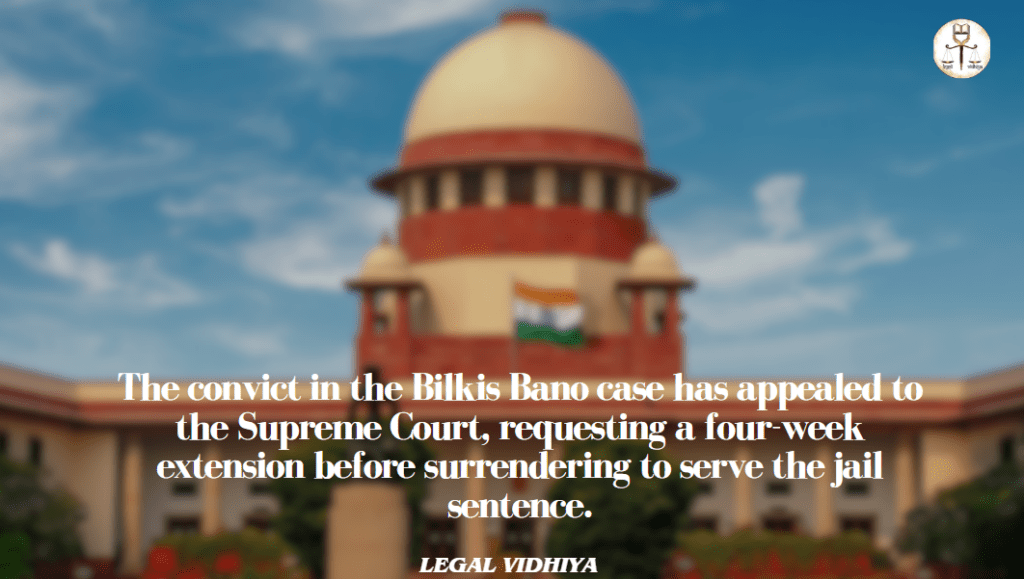
Govindbhai Nai, one of the convicts, has petitioned the Supreme Court for a four week extension, citing health concerns and his role as the primary caregiver for his elderly father and ailing mother.
The Supreme Court, on January 8, overturned the remission orders issued by the Gujarat Government, which had permitted the advance release of the convicts in August 2022 after completing a 14-year sentence. Justices BV Nagarathna and Ujjal Bhuyan, on the bench, determined that the State of Gujarat did not have the authority to grant remission since the trial took place in Maharashtra. The court granted the convicts a two-week window to surrender.
In his plea submitted to the Supreme Court, Nai asserted his status as an elderly individual grappling with asthma and deteriorating health. He disclosed recent medical procedures, including angiography, with another surgery scheduled for the treatment of hemorrhoids.
Nai highlighted the fragile health of his 75-year-old mother and emphasized his responsibility as a father supporting two dependent children. Throughout his release period, Nai attested to maintaining exemplary conduct, adhering meticulously to the conditions outlined in the remission order. Requesting compassionate consideration, he appealed for a four-week extension to surrender to the relevant Jail Authorities.
Background-
During the communal riots in Gujarat on March 3rd, 2002, in Dahod district, Bilkis Bano, a 21-year-old pregnant woman, and other female relatives were subjected to gang rape. Tragically, along with her ordeal, seven of her family members fell victim to murder at the hands of the perpetrators.
Bilkis Bano alleged that the police omitted crucial details necessary for the FIR (First Information Report). Faced with this obstacle, she approached the National Human Rights Commission (NHRC) and later petitioned the Supreme Court. The Supreme Court, upon her plea, ordered a CBI (Central Bureau of Investigation) inquiry, resulting in the swift arrest of the accused within a month. However, during this period, the perpetrators threatened her life. Bano raised these death threats in the Supreme Court, prompting the decision to transfer the case from the Gujarat Court to Maharashtra Court for a more impartial investigation.
On August 15, 2022, the Gujarat government released all 11 convicts involved in the gangrape case based on its remission policy. However, this action triggered substantial public outcry and led to petitions from opposition MPs. In 2022, Bilkis Bano filed an appeal in the Supreme Court urging a review of the Gujarat government’s decision to release the 11 gangrape convicts, questioning the validity of their release.
The case was scheduled for hearing in the Supreme Court in March 2023, during which arguments from both the Central and Gujarat governments were heard. The Supreme Court also directed the state government to provide the original documents used as the basis for their decision. Finally, on January 8, 2024, the Supreme Court ruled to reject the remission granted to the convicts involved in the Bilkis Bano gang rape case. The Court mandated that these convicts surrender to the authorities within two weeks.
The Supreme Court will now review the petition filed by the convict and will give its decision.
Case Reference- Bilkis Yakub Rasool vs. Union of India (2023)
Anshra Zafar, a B.A.LLB (Hons) student at IILM University, Greater Noida, 4t, Semester. An intern under Legal Vidhiya.
Disclaimer: The materials provided herein are intended solely for informational purposes. Accessing or using the site or the materials does not establish an attorney-client relationship. The information presented on this site is not to be construed as legal or professional advice, and it should not be relied upon for such purposes or used as a substitute for advice from a licensed attorney in your state. Additionally, the viewpoint presented by the author is of a personal nature.

