




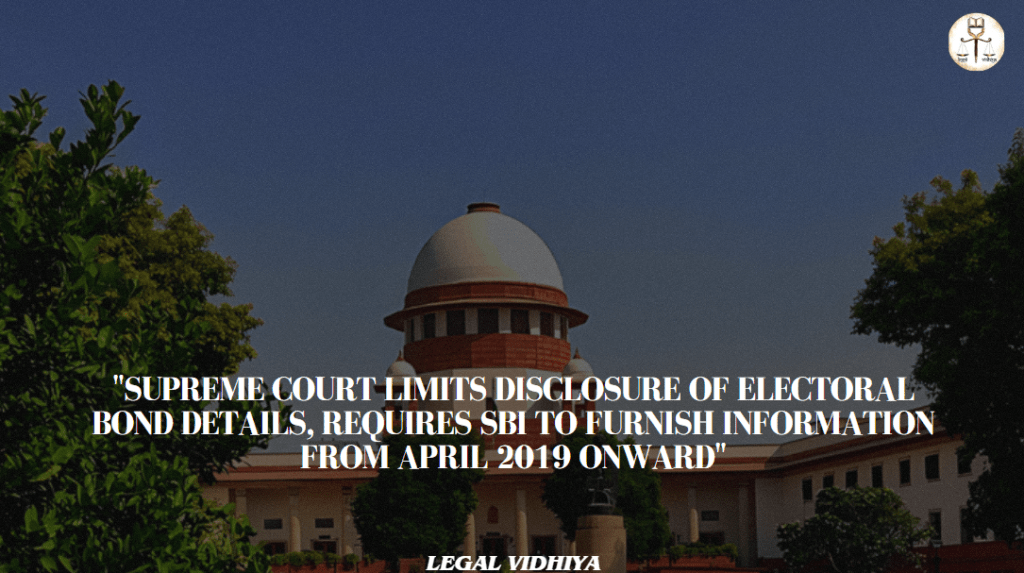
On Monday (March 18), the Supreme Court declined to order the disclosure of electoral bond details dating back to their inception on March 1, 2018. Currently, the court has instructed the State Bank of India (SBI) to reveal information pertaining only to bonds sold from April 12, 2019, when the court issued an interim order, until February 15, 2023, when it deemed the scheme unconstitutional. This interim order mandated political parties to furnish the Election Commission of India (ECI) with donation details received through electoral bonds.
During the recent hearing, a five-judge bench led by Chief Justice DY Chandrachud emphasized that the decision to commence disclosure from April 12, 2019, was a deliberate one. Chief Justice Chandrachud clarified that after the interim order of April 12, 2019, donors were made aware of the potential disclosure requirement.The court further stated that altering the disclosure date would amount to a significant modification of the judgment, which cannot be done through a miscellaneous application. Consequently, this application was dismissed.Chief Justice Chandrachud informed Senior Advocate Mukul Rohatgi, representing the Federation of Indian Chambers of Commerce & Industry (FICCI) and the Associated Chambers of Commerce & Industry of India (ASSOCHAM), that all parties were put on notice in April 2019 following the court’s interim order to collect details.
Towards the end of the proceedings, the court clarified that the SBI must provide all available details, including alphanumeric and serial numbers of bonds purchased after April 11, 2019. The bank’s chairperson was instructed to submit an affidavit by 5 PM on Thursday, March 21, affirming that all custody details have been disclosed without withholding any information. Additionally, the Election Commission of India was directed to promptly upload these details on its website upon receipt from the SBI.Association for Democratic Reforms & Anr. v. Union of India & Ors.
Written by- Pradyumn sharma
Disclaimer: The materials provided herein are intended solely for informational purposes. Accessing or using the site or the materials does not establish an attorney-client relationship. The information presented on this site is not to be construed as legal or professional advice, and it should not be relied upon for such purposes or used as a substitute for advice from a licensed attorney in your state. Additionally, the viewpoint presented by the author is of a personal nature.

