




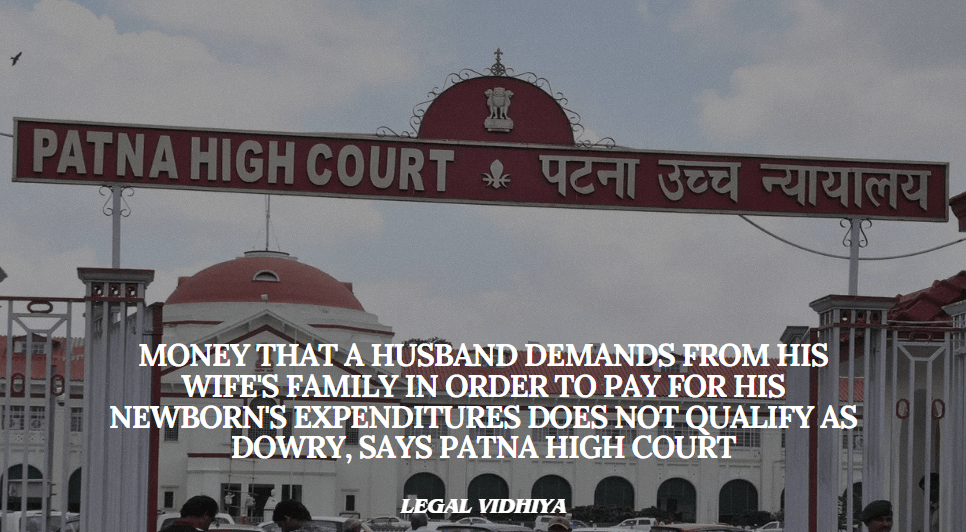
In a recent judgement, a single judge bench of Justice Bibek Chauduri ruled that if husband demands money from his wife’s paternal home to meet the expenses for his new born child it does not come under the definition of dowry.
The decision was made in response to an instant revision petition that was filed against the order of conviction finding the petitioners guilty of demanding dowry. In 1994, Naresh Pandit and Srijan Devi tied the knot and their marriage was solemnized in accordance with the hindu rites. Three children, two boys and a girl, are born into the couple’s union. The female child was born in 2001. Naresh Pandit and his family demanded Rs. 10,000 from his wife’s paternal home three years after the girl child was born in order to support and maintain the child. The wife was tortured for non-fulfilment of the demand. As a result, the wife filed a case in 2004 under Section 4 of the Dowry Prohibition Act and Section 498A of the Indian Penal Code.
The Court noted that the only question raised in the instant revision is whether or not the husband and his family’s demands for maintenance of the parties’ child constitutes dowry. In order to respond to the question, the court examined Section 2 of the Dowry Prohibition Act, 1961. This section covers any valuables or property that is given or promised to be given to the other party directly or indirectly, either by the engaged parties themselves or by the parents of the engaged parties, or by other parties in connection to the marriage. It may occur before to, during, or following the wedding. But, when Muslim Personal Law (Shariat) is observed, this does not apply to the customary Muslim practice of providing “dower” or “mahr.” It should be given or agreed to be given as a consideration to the marriage.
The Court referred the judgement given in Girdhar Shankar Tawade vs State of Maharashtra 2002 5 SCC 177 which states that all acts of cruelty upon a married woman by her husband or other matrimonial relations do not come within the definition of cruelty under Section 498A of IPC. The court also pointed out that the word “dowry” is not mentioned specifically in Explanation (b) of Section 498A of the IPC. But, the court rulings have determined that harassment associated with fulfilling any illegal demand for property or valuable security falls under the purview of the definition of dowry specified in Section 2 of the Dowry Prohibition Act.
The court also referred the case Manju Ram Kalita Vs. State of Assam (2009) 13 SCC 330, where the Supreme Court ruled that in order to file a charge under Section 498A of the IPC, the prosecution must prove that the woman has been the victim of cruelty continuously and persistently, or at least in close proximity of time of lodging of complaint. Petty quarrel cannot be said to come under the purview of cruelty mentioned in the section.
The Court observed that the husband and wife come from socially marginalized backgrounds, where it is customary for daughters to remain at their parent’s house during pregnancy until the child is born. After the child is three or six months old, the mother and child are then typically sent to the matrimonial home, with the wife’s family covering all of the costs during this time. The court added that it is not in the position to decide whether the prevalent culture is morally right or wrong as it is not the duty of the court.
After taking into account the aforementioned facts, the Court determined that the demand of Rs. 10,000 was made for the girl-child’s maintenance rather than as a consideration for the complainant and petitioner’s marriage and it did not fall under the definition of a “dowry” under Section 498A of the IPC and the 1961 Act. Hence, the review petition was allowed and the judgement and order of conviction passed in the case were set aside and quashed.
CASE NAME: Naresh Pandit vs The State of Bihar and Anr (CRIMINAL REVISION NO 1021 OF 2016)
Written by V.Angelin Subiksha, Second year LLB, Government Law College, Vellore, intern under legal vidhiya.
REFERENCES:
Naresh Pandit vs The State of Bihar and Anr (CRIMINAL REVISION NO 1021 OF 2016)
Disclaimer: The materials provided herein are intended solely for informational purposes. Accessing or using the site or the materials does not establish an attorney-client relationship. The information presented on this site is not to be construed as legal or professional advice, and it should not be relied upon for such purposes or used as a substitute for advice from a licensed attorney in your state. Additionally, the viewpoint presented by the author is of a personal nature

